Need help?
Do you have a question about the Axis P1455-LE and is the answer not in the manual?
Locating the camera on the network and accessing its web interface.
Setting a secure password for the administrator account.
Best practices for password security and understanding the webpage layout.
Settings for image leveling, focus, exposure, and IR illumination.
Optimizing IR, reducing noise/blur, handling backlight, and improving image quality.
Compensating for barrel distortion and monitoring long/narrow areas.
Improving license plate recognition and setting up privacy masks.
Adding image overlays, reducing bandwidth, and setting up network storage.
Setting up rules, motion detection, and recording based on events.
Creating event rules and displaying text overlays triggered by motion detection.
Configuring recording based on detected loud noises or physical impacts.
Using an I/O Indication LED to signal ongoing events like recording status.
Setting up intrusion alarms and tamper detection for lens obstruction with email alerts.
Adding audio to recordings and connecting to network speakers.
Defining view areas and understanding capture modes for resolution and frame rate.
Adjusting focus/zoom remotely and setting up privacy masks.
Adding overlays and selecting video compression formats like H.264.
Managing bandwidth using Variable, Maximum, and Average bitrate controls.
Understanding Axis Edge Vault for secure device identity and cryptographic storage.
Resetting to defaults, checking, and upgrading device firmware.
Solving common issues with firmware, IP addresses, and browser access.
Addressing streaming problems, local/external access, and performance considerations.
Information on how to contact Axis support for further assistance.
Identifying camera components and understanding LED status indicators.
Details on SD card slots, control buttons, and network/audio connectors.
Technical details for audio input and I/O connectors, including pinouts and voltage.
This document is the user manual for the AXIS P1455-LE Network Camera, providing comprehensive information on its setup, operation, and maintenance.
The manual begins with instructions on how to get started with the device, including finding it on the network, accessing its web interface, and setting up a secure password for the root account. It emphasizes the importance of secure passwords, recommending at least 8 characters, preferably generated by a password generator, and advising against exposing the password and to change it at recurring intervals, at least once a year. The initial password is sent in clear text, so setting up a secure HTTPS connection and changing the password after the first login is crucial. A webpage overview is provided, detailing the live view control bar, live view, product name, user information, color themes, help, video control bar, and settings toggle.
Additional settings cover image adjustments, such as leveling the camera using a guide, adjusting focus with an autofocus area and slider, and selecting exposure modes. For most use cases, "Automatic exposure" is recommended. For environments with artificial lighting like fluorescent lights, "Flicker-free" is suggested, matching the power line frequency. For mixed lighting conditions (outdoors with fluorescent lighting at night and sun during daytime), "Flicker-reduced" is recommended, also matching the power line frequency. The "Hold current" option locks the current exposure settings. The manual also explains how to optimize IR illumination by manually adjusting LED intensity, benefiting from IR light in low-light conditions using night mode, and reducing noise and motion blur in low-light scenarios. To handle scenes with strong backlight, Wide Dynamic Range (WDR) is discussed, which makes both dark and bright areas of an image visible. Barrel distortion correction is also covered to compensate for bent straight lines near the edges of the frame, common with wide fields of view. For monitoring long and narrow areas, the corridor format is recommended, which involves rotating the camera or lens 90° or 270°. Improving license plate recognition is addressed by using the pixel counter to set optimal pixel resolution and adjusting shutter speed, gain, and zoom. Privacy masks can be created to hide parts of the image with solid color blocks or mosaic patterns. Image overlays can be added to the video stream for extra information like timestamps or during installation.
For viewing and recording video, the manual details how to reduce bandwidth and storage by using Zipstream, dynamic GOP, increased compression, and dynamic FPS. Setting up network storage is explained for storing recordings on the network. The device supports various video compression formats, including Motion JPEG, H.264 (MPEG-4 Part 10/AVC), and H.265 (MPEG-H Part 2/HEVC). It clarifies how Image, Stream, and Stream profile settings relate, with Image settings affecting all video streams, Stream settings affecting new streams, and Stream profiles overriding Stream settings. Bitrate control options include Variable Bitrate (VBR) for constant image quality with varying bandwidth, Maximum Bitrate (MBR) for handling bitrate limitations, and Average Bitrate (ABR) for automatically adjusting bitrate over time to meet storage and retention requirements.
Security features include Axis Edge Vault, a hardware component providing cryptographic storage and features to protect the device ID from unauthorized use or access, which is always activated and cannot be changed.
Troubleshooting covers common issues such as resetting to factory default settings, firmware options (active track for latest features, long-term support for stability), checking and upgrading firmware, and problems with IP address settings (different subnet, IP in use, IP conflict). It also addresses issues with browser access (cannot log in, IP changed by DHCP, certificate error) and streaming problems (multicast H.264 accessibility, poor rendering, color saturation differences, lower frame rate than expected, inability to select H.265 encoding in live view). Performance considerations are outlined, noting factors like high image resolution, lower compression, image rotation, multiple client access, simultaneous viewing of different streams, and heavy event settings usage can affect bandwidth and frame rate. Heavy network utilization, poorly performing client computers, and running multiple ACAP applications can also impact performance.
The manual also describes how to set up rules and alerts to trigger actions based on events. Examples include recording video when motion is detected (using AXIS Video Motion Detection), showing a text overlay in the video stream when motion is detected, recording video when loud noises are detected (requiring a microphone and audio detection), and recording video when impact is detected (shock detection). It also explains how to provide visual indication of an ongoing event by connecting an AXIS I/O Indication LED to an output port, and how to set up an intrusion alarm using a digital input and send email notifications if someone spray paints the lens (using "Trigger on dark images").
Audio features include adding audio to recordings by enabling audio and selecting an audio source, then editing the stream profile to include audio. Connecting to a network speaker is also covered, allowing a compatible Axis network speaker to act as an audio out device for playing audio clips and transmitting sound through the camera.
Cleaning recommendations advise against using harsh detergents and suggest using compressed air for dust and a soft cloth with lukewarm water for lens cleaning, avoiding direct sunlight or elevated temperatures during cleaning.
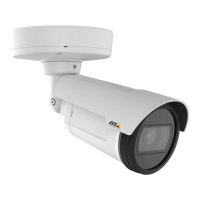
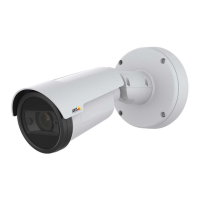
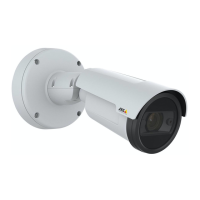
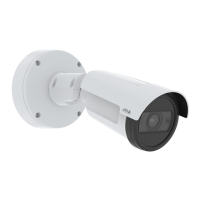
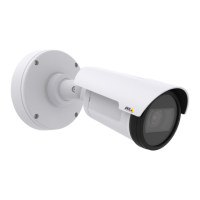
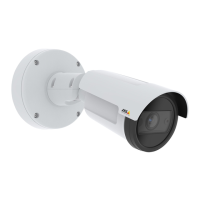
The product overview section provides a diagram of the camera, identifying components such as the status LED indicator, audio connector, I/O connector, microSD card slot, network connector, control button, and part number/serial number. LED indicators are detailed, showing different states for unlit, green, amber, amber/red, and red lights, indicating connection status, normal operation, startup, firmware upgrade, network connection issues, and firmware upgrade failure. The SD card slot section warns against using sharp tools or excessive force and removing the card while the product is running. The control button is used for resetting to factory default settings or connecting to an AXIS Video Hosting System service. Connectors include the RJ45 Ethernet connector with PoE, the audio connector for mono microphones or line-in signals, and the I/O connector for external devices, providing digital input and output capabilities with connection diagrams and specifications.
 General
| Sensor type | CMOS |
|---|---|
| Progressive scan | Yes |
| Number of sensors | 1 |
| Optical sensor size | 1/2.8 \ |
| Optical zoom | 3 x |
| Focal length range | 3 - 9 mm |
| Maximum aperture number | 1.6 |
| Camera shutter speed | 1/66500 - 2 s |
| Minimum illumination | 0.01 lx |
| Type | IP security camera |
| PTZ modes | Digital PTZ |
| Certification | 55032 Class A, EN 50121-4, IEC 62236-4, EN 55035, EN 61000-3-3, EN 61000-6-1, EN 61000-6-2, FCC Part 15 Subpart B Class A, ICES-3(A)/NMB-3(A), VCCI Class A, RCM AS/NZS CISPR 32 Class A, IEC/EN/UL 62368-1, IEC/EN/UL 60950-22, IS 13252, IEC 62471, IEC 60068-2-1, IEC 60068-2-2, IEC 60068-2-6, IEC 60068-2-14, IEC 60068-2-27, IEC 60068-2-78, IEC/EN 60529 IP66/IP67, IEC/EN 62262 IK10, NEMA 250 Type 4X, NEMA TS 2 (2.2.7-2.2.9), NIST SP500-267 |
| Placement supported | - |
| Connectivity technology | Wired |
| Bit rate control | Variable Bit Rate (VBR) |
| Total megapixels | 2 MP |
| Maximum resolution | 1920 x 1080 pixels |
| Image quality adjustment | Brightness, Contrast, Saturation, Sharpness |
| Video compression formats | H.264, H.265, M-JPEG, MPEG4 |
| Supported graphics resolutions | 160 x 90, 1920 x 1080 (HD 1080) |
| Number of users | 8 user(s) |
| Streaming method | Multicast |
| Networking standards | IEEE 802.3af, IEEE 802.3at |
| Ethernet interface type | Gigabit Ethernet |
| Supported network protocols | IPv4, IPv6 USGv6, HTTP, HTTPS , SSL/TLS, QoS Layer 3 DiffServ, FTP, SFTP, CIFS/SMB, SMTP, Bonjour, UPnP, SNMP v1/v2c/v3 (MIB-II), DNS, DynDNS, NTP, RTSP, RTP, SRTP, TCP, UDP, IGMP, RTCP, ICMP, DHCP, ARP, SOCKS, SSH, LLDP, MQTT |
| IK code | IK10 |
| Form factor | Bullet |
| Mounting type | Wall |
| Product color | Black, White |
| Housing material | Aluminum |
| International Protection (IP) code | IP66, IP67 |
| Sample rate | 48 kHz |
| Audio system | 2-way |
| Audio formats supported | AAC-LC, ADPCM, LPCM, PCM |
| Security algorithms | 802.1x RADIUS |
| Alert notification type | |
| Flash memory | 512 MB |
| Compatible memory cards | MicroSD (TransFlash), MicroSDHC, MicroSDXC |
| Power source type | PoE |
| Power consumption (max) | 12.95 W |
| Power consumption (typical) | 7.7 W |
| LED type | IR |
| Infra-red wavelength | 850 nm |
| Night vision distance | 40 m |
| Storage temperature (T-T) | -40 - 65 °C |
| Operating temperature (T-T) | -40 - 60 °C |
| Storage relative humidity (H-H) | 5 - 95 % |
| Operating relative humidity (H-H) | 10 - 100 % |
| Harmonized System (HS) code | 85258900 |
 Weight and Dimensions
| Depth | 260 mm |
|---|---|
| Width | 132 mm |
| Weight | 1000 g |

 To Next Page