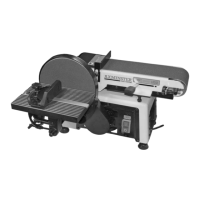
This document provides comprehensive instructions and specifications for the Axminster Workshop AW150BDS Belt & Disc Sander, a versatile woodworking machine designed for efficient sanding operations. The manual covers everything from initial assembly and setup to detailed operating procedures, abrasive belt/disc changes, maintenance, and troubleshooting.
Function Description:
The Axminster Workshop AW150BDS is a neatly designed belt and disc sander that combines two essential sanding functions into one robust unit. It features a sanding belt (linisher) and a sanding disc, both utilizing a shared worktable. The machine is engineered to provide high levels of efficient dust extraction when connected to a simple vacuum extractor, ensuring a cleaner and safer working environment. Its heavy-duty chassis, constructed from a single iron casting, provides excellent support for the tables and belt arm, and includes locating holes for securing the sander to a workbench.
The worktable is a key feature, designed for use with both the belt and disc functions. It is easily transferable between the two, enhancing the machine's versatility. The table pivots from 0° to 45°, allowing for bevel and compound angle sanding, and incorporates a mitre fence that runs in a slot for precise angle adjustments. The sanding linisher itself can be moved from a vertical to a horizontal position by loosening two hexagon socket bolts, adapting to various sanding tasks. Close-fitting guarding around the belt further aids in efficient dust extraction.
Important Technical Specifications:
- Code: 107679
- Model: AW150BDS
- Rating: Workshop
- Power: 230V 50Hz 370W 1Ph
- Duty Cycle: S1 370W
- Belt Size: 100 x 914 mm
- Disc Size: 150 mm
- Table Size: 216 x 146 mm
- Disc Table Tilt: 0° - 45°
- Dust Extraction Outlet: 63 mm
- Overall L x W x H: 470 x 370 x 295 mm (Machine) / 500 x 250 x 650 mm (Packaging)
- Weight: 21kg
Usage Features:
The AW150BDS offers several features that enhance its usability and precision:
- Versatile Worktable: The worktable is a decent size and can be easily transferred between the belt and disc functions. It pivots from 0° to 45°, enabling precise bevel and compound angle sanding.
- Mitre Fence: A mitre fence runs in a slot on the worktable, allowing for accurate angle adjustments for various sanding applications. The mitre fence pointer, scale, and clamping knob facilitate precise setting.
- Adjustable Linisher Position: The sanding belt (linisher) can be quickly adjusted from a horizontal to a vertical position by loosening two Hex screws, making it suitable for different workpiece sizes and sanding orientations.
- Linisher Guard/Workstop: The linisher guard can also be used as a work support when the linisher is in the vertical position, providing additional stability for workpieces.
- Belt Tracking Control: The machine includes a tracking wheel for adjusting the linisher belt's position, ensuring it runs centrally on the table. The manual emphasizes making small, gradual adjustments due to the belt's delayed reaction.
- Dust Extraction: A 63mm dust extraction outlet is provided, allowing connection to a vacuum extractor for efficient removal of dust and grit, which is crucial for a clean workspace and prolonging abrasive life.
- NVR ON/OFF Control Switch: The machine is equipped with a No-Volt Release (NVR) ON/OFF control switch for safety, preventing automatic restart after a power interruption.
- Work Bench Mounting Holes: The chassis includes mounting holes, allowing the sander to be securely fastened to a workbench for increased stability during operation.
- Hex Key Storage: The mitre fence assembly incorporates storage holders for the Hex keys, ensuring they are readily available when needed.
- Three Function Positions: The machine can be configured for linisher function with the worktable, linisher function utilizing the guard as a work support, and disc function set at either 90° or 45° degrees.
Maintenance Features:
The manual outlines several maintenance procedures to ensure the longevity and efficient operation of the sander:
- Regular Cleaning: It is recommended to inspect and remove all dust/resin build-up using a class 'M' vacuum cleaner at reasonable intervals. This includes cleaning the worktable, side extraction panel, and disc extraction plate.
- Abrasive Disc Replacement: The abrasive disc is attached via Velcro and can be easily peeled off and replaced. The manual advises cleaning the disc surface before applying a new disc and firmly pressing it into place.
- Abrasive Belt Replacement: The process for changing the linisher belt involves loosening screws, removing guards, releasing belt tension, and carefully fitting the new belt, ensuring the directional arrows point towards the drive drum. Cleaning dust and resin build-up from drums and extraction ports during belt changes is emphasized.
- Drive Belt Tension Check: The manual provides instructions for checking and adjusting the drive belt tension, which is crucial if the belt stops under load while the disc is still in motion. This involves removing the drive belt cover and using a Hex key and spanner to adjust the tensioning grub screw and locking nut. A 1-2mm depression in the belt indicates correct tension.
- Pre-Operation Checks: Before each use, users are advised to perform a 'quick' burst check (ON-OFF) to ensure everything is functioning correctly and to verify that all tools are cleared from the work area.
- Safety Precautions: Throughout the maintenance sections, the manual reiterates critical safety warnings, including disconnecting from the mains supply, wearing a dust mask and eye protection, and avoiding over-tensioning the belt to prevent motor overload.
The Axminster Workshop AW150BDS is designed to be a reliable and adaptable tool for various sanding tasks, with clear instructions provided to ensure safe and effective use and maintenance.



 To Next Page
 General