16
17
The terminals and cable terminals must be lubricated to prevent depos-
its and corrosion.
Electrolyte level in cells
Do not use matches, a cigarette lighter or other form of naked ame
when checking the electrolyte level, because the battery gives off
explosive gas.
The electrolyte level in the batteries must be checked at regular inter
-
vals. The electrolyte level must be approx. 10 mm above the plates. If
the level is too low, top up with distilled water.
BILGE PUMP SYSTEM
CAUTION!
Avoid pollution! The purpose of the boat’s electrical bilge pumps is to
minimize the risk of accidental discharge of oil polluted water. The boat
owner should check the bilge water regularly for contaminants such as
oil, diesel, glycol etc.
The bilge pump system comprises several different pumps that cover all
areas of the boat.
Your boat has electrical as well as manual bilge pumps. There is also a
sign in the boat indicating the draining area of each pump respectively.
The manual bilge pump is operated with the handle next to the pump,
located in a storage compartment on the aft deck.
The electrical pumps are submersible. One is located in the area before
the toilet (models Open and TT) and the other in front of the engine
compartment in the bilge. The bilge water level should always be kept
at a minimum.
The pumping capacity of the automatic bilge pump is 41 litres per
minute. The pumping capacity of the manual bilge pump is 33 litres per
minute. The automatic bilge pump has an alarm sound which is activ
-
ated when the pump starts.
DANGER!
Check the functionality of the bilge pumps regularly. Remove any waste
from the intakes.
The combined capacity of the bilge pump system is not designed to
pump out the boat in the event of hull damage. The pumps are con
-
stantly activated and pump out the boat as required. The pumps can also
be started manually from the boat’s main control panel.
CAUTION!
The pumps must not be run dry for any length of time.
DECK AND SECURITY EQUIPMENT
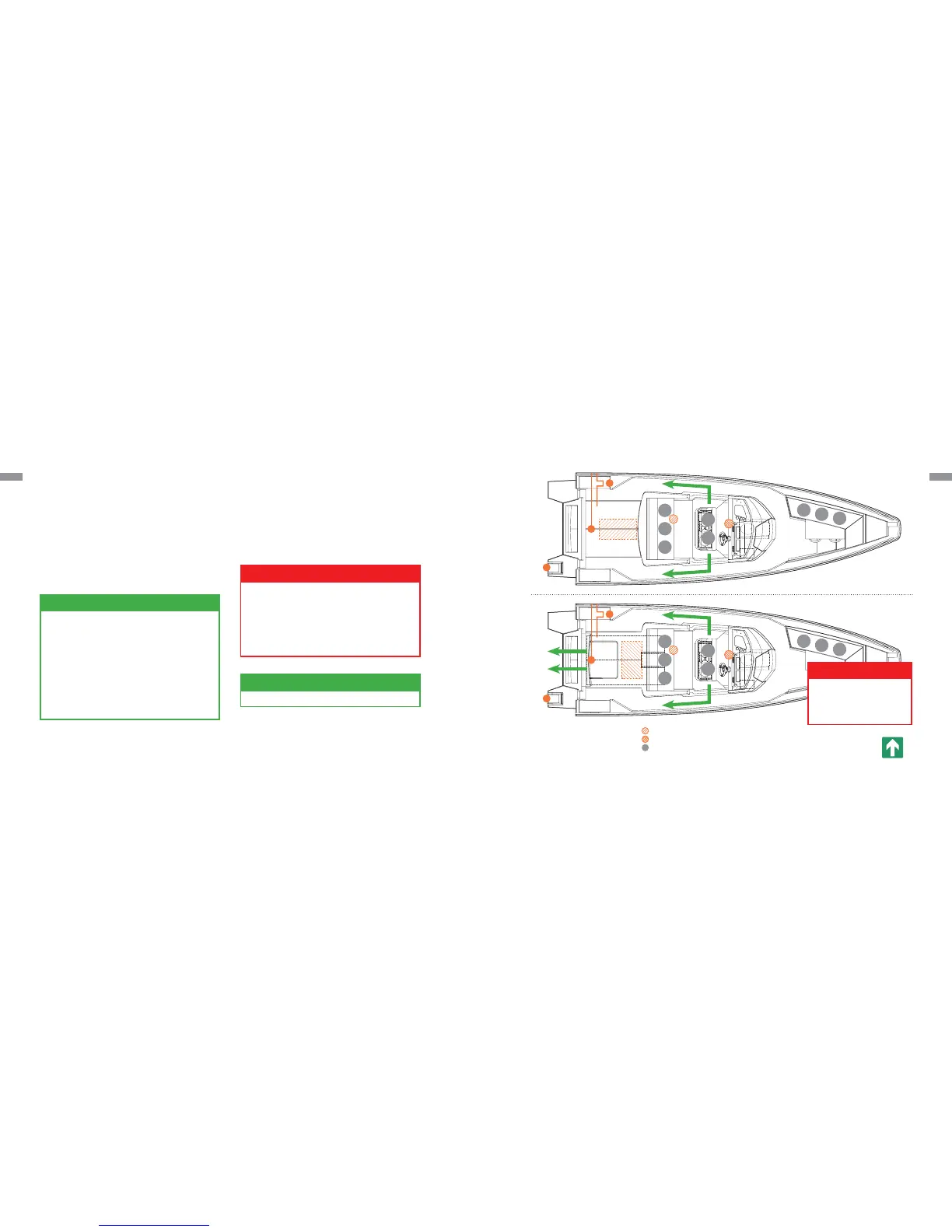
01 Swim ladders
02 Electrical bilge pump 41l /min
03 Manual bilge pump 33l /min
Location of re extinguisher C
Location of re extinguisher AC
Seating
EMERGENCY EXITS
Get to know where the emergency exits
are by studying the illustrations above. All
emergency exits are marked with a white
arrow on a green background.
1
3
LIFE
RAFT
2
1
3
LIFE
RAFT
2
CABIN
AC
DANGER!
The loading hatch on the aft deck must
always be kept closed during driving.
Do not keep the hatch open when the
engines are running, due to the risk of
carbon monoxide poisoning.


 To Next Page