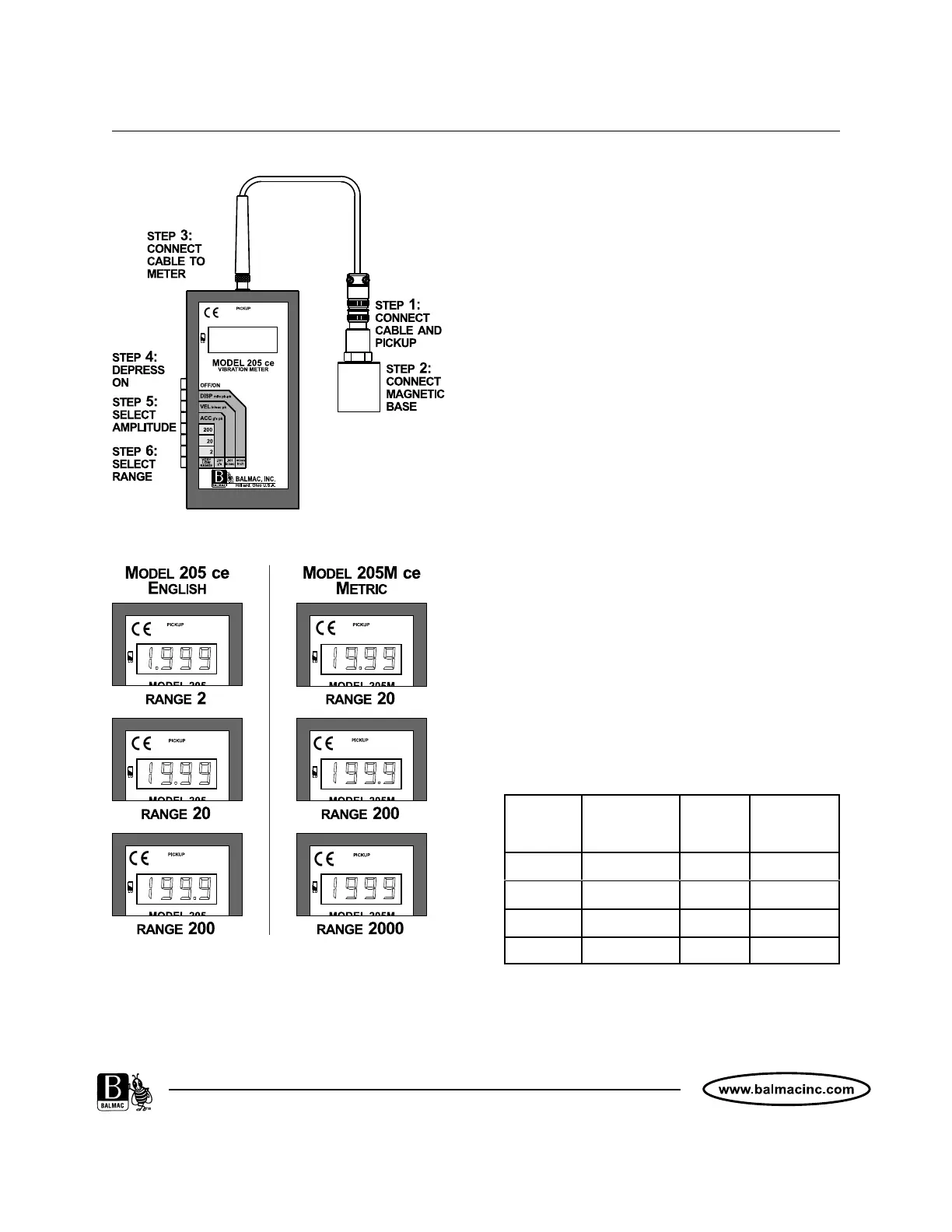
Page 5 MODEL 205 ce
SECTION 4 - MEASUREMENTS
VELOCITY is the recommended setting for
machinery severity vibration readings with the
Model 205 ce Vibration Meter. The destructive
forces generated in today’s higher speed
machines are more proportional to vibration
velocity than either displacement or acceleration.
For example, it is very unusual for someone to
arrive on the scene of an automobile accident
and ask “How far did they come?”
(Displacement), or “How fast did they stop?”
(Acceleration). The common question is “How
fast were they going when they hit?” (Velocity)
DISPLACEMENT is the peak to peak distance a
part is moving measured in “mils.” One mil
equals one thousandth of an inch (.001"). When
measuring in mils, the operating speed must be
known to establish a vibration condition limit.
(Example: a cooling tower fan operating at 175
RPM vibrating at 10 mils may be considered in
good condition. An electric motor operating at
1750 and vibrating at 10 mils typically requires
immediate attention.)
ACCELERATION - is useful for detecting the
deterioration and defects or rolling element
bearings and gears. An acceptable level for
most machines is less than 0.5 g’s. If the level is
higher, the bearing may be defective and should
be analyzed. An acceptable level of g’s can be
established by comparing similar machines and
by studying vibration trends.
Table 1: Comparison of Velocity, Displacement and Acceleration
SPEED
RPM
(cpm X 60)
DISPLACEMENT
MILS
(Peak to Peak)
VELOCITY
IN/SEC
(Peak)
ACCELERATIO
N
G’s
(Peak)
175 21.9 0.2 0.00945
1750 2.19 0.2 0.0945
17,500 0.219 0.2 0.945
175,000 0.0219 0.2 9.45


 To Next Page