BANDIT 240 DB v.206
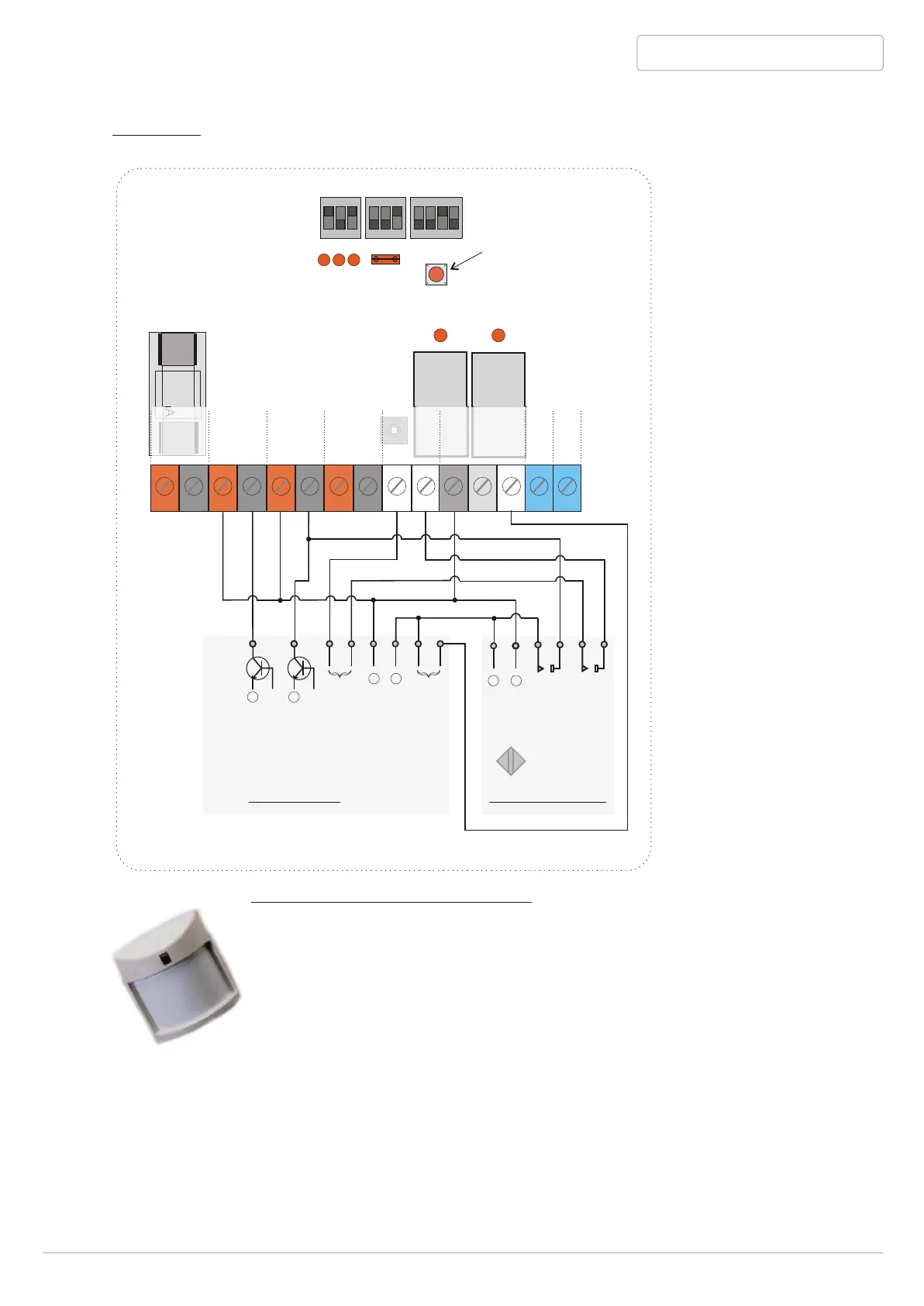
p. 31 - Examples of application - diagram 2
Diagram 2: Alarm system with npn-outputs, technical input and additional
confirmation sensor.
Alarm central
Alarm-
output npn
Guard
output npn
Sabotage
loop
Input technical
failure to dialer
12 V supply
+
_
_
_
OKout
Tmp
Read switch
dips
Red jump
PaninV
GrdinV
F2
ONON
11 22 33
ONON
11 22 33
ONON
11 22 33
44
500mA
AlinV
Read
OKout
Grdout
Alout
Tmpout
Grdin
Panin
Alin
Supply
Ta
P+
A+
G+
+
Tb
P-
A-
G-
-
COM
NC
NO
A B
C
This connection is
identical to the previous
diagram 1 with the
exception that there is
connected an additional
sensor. Only if the
transistor of the alarm
system is off (not
conducting) and the
confirmation sensor is
being activated (its alarm
contact opens) there will
be 0 volts over [Alin]. Dip
A2 position OFF, so if
BANDIT is in guard,
alarm mode is activated.
This means fog ejection
during adjusted period
(dip block C).
Alarmcontact
Tampercontact
12 V in
+
_
PIR/radar sensor
Why to use a confirmation sensor:
- To postpone the transition to alarm mode until a local zone detector
confirms the burglary signal of the alarm system.
For example: the alarm system is in alarm because of burglary detection
through back door. BANDIT will go into its alarm mode the moment the
burglar enters the protected zone e.g. “private office”, because the local
Connected PIR/radar detector will then open its contacts and the bridging
of the alarm system signal is removed.
- A fire detector in the secured area can have the same bridging function, if it’s a type with NC
contacts (no fire = contacts closed), serial connection of contacts. So as long as fire is
detected, BANDIT can’t switch to its alarm mode.
If possible: install temperature sensitive fire detectors, because these are difficult to mislead
from a distance and don’t react to ejected fog. Install them against the ceiling, where a
burglar has no possibility to reach them before being detected through a burglar detection.


 To Next Page