10
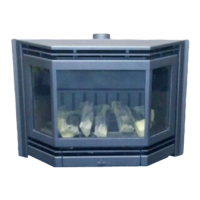
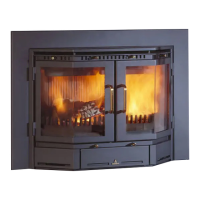
PANOLUX 65PANOLUX 52
3.3. FITTING
A • tted • replace can be • tted in the newly-built or existing chimney breast
of an open • re. When • tting, both • re safety and operational safety must be
safeguarded. The • tter is responsible for this.
General guidelines:
Ÿ If there is a wooden beam above the • tting location, heat must not radiate
directly onto it. An insulation plate must be hung below the beam, leaving an air
gap between it and the beam of at least 1 cm.
Ÿ Always use (white) unbound glass or ceramic wool. Bound material (yellow)
spreads an irritating smell on heating, causes excess smoke and is unsuitable
for high temperatures (insulation requirements: temperature ≥ 700°C, density
80 kg/m
3
).
Ÿ If electrical connections are to be • tted for an extractor fan, have this done by
an expert.
Ÿ Before • tting, remove the door to protect the glass.
3.3.1. Aeration / ventilation
A • tted • re generates : - heating air and
- combustion air
Heating air is devoted to the convection of heat from the appliance to the room. No
other provisions are necessary. The source of heat is in the room and stays there.
Combustion air is needed to keep the combustion going by drawing in air from the
room due to the natural pull of the chimney. The air inlet openings are in the ash
drawer and above the door. When using the appliance, please ensure there is a
suf• cient supply of fresh air. In today’s super-insulated homes, it is important that
adequate ventilation is provided. In homes with mechanical ventilation or where
a kitchen extractor fan is in operation, they must be set at the lowest level or
switched off respectively.
If the mechanical ventilation remains operative, extra ventilation must be provided
to compensate for the extraction. This not only prevents poor combustion, it also
prevents smoke from being sucked out of the appliance into the room. (See also
Chapter 6)


 To Next Page