www.barbecook.com
30
3. Re-ignite the burner(s) as outlined in “9.2.1. Using the
igniter”.
9.5. Checking the flames
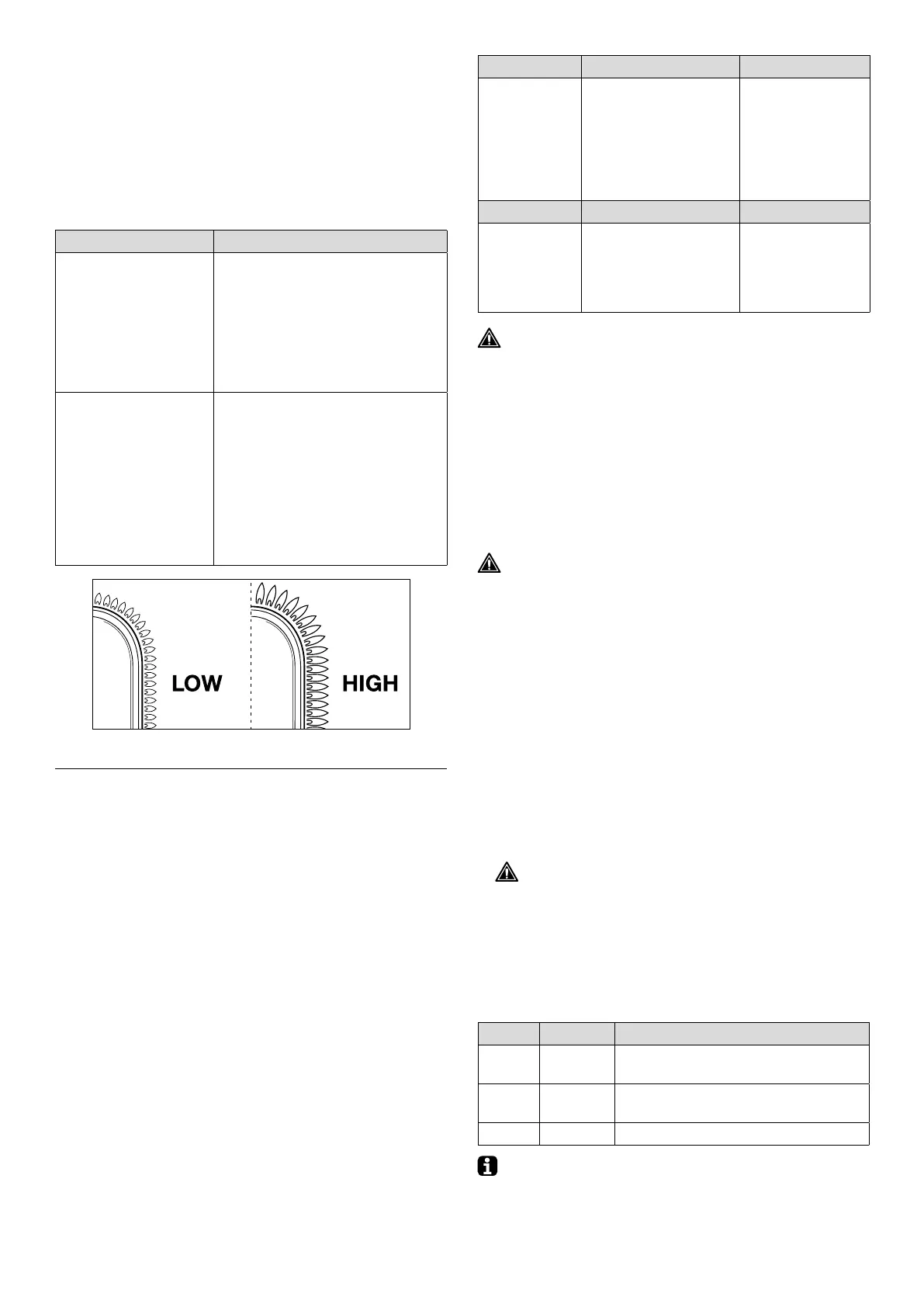
Whenever you ignite a burner, you must check its
ames. A perfect ame will be almost blue,
with a small amount of yellow at the top. Sporadic yellow
ames are normal and safe.
If there is a problem with the ames, take one of the following
measures to rectify it:
The flames are... Proceed as follows...
Low and entirely yellow 1. Close the gas supply
immediately and set all control
knobs to OFF.
2. Consult "14. Rectifying
problems" in order to identify the
cause of the problem.
The venturi tubes are most likely
blocked.
Higher than the bowl 1. Close the gas supply
immediately and set all control
knobs to OFF.
2. Wait for 5minutes to allow the
accumulated gas to escape.
3. Re-ignite the burner(s).
4. If this does not rectify the
problem, consult "14. Rectifying
problems" in order to identify the
cause.
10. USEFUL TIPS AND TRICKS
10.1. Pre-heating the appliance
Pre-heating the appliance ensures that the
grill is hot enough when you come to place food on it.
Proceed as follows:
1. Ignite the burner(s) and set the control knob(s) to HIGH.
2. Close the lid and allow the appliance to burn for ten minutes
(i.e., until the barbecue reaches 210°C).
3. After ten minutes, open the lid and place the food on the
grill.
4. If you want less heat, set the control knob(s) to
a lower heat.
10.2. Preventing food from sticking
To prevent your food from sticking to the grill:
• Oil the food lightly with a brush before placing it on the grill.
You can also oil the grill itself.
• Pre-heat the appliance. The hotter the grill when you place
the food on it, the less the chance of the food sticking.
• Do not turn the food too quickly. Allow it to sear rst.
10.3. Grilling directly and indirectly
You can grill directly or indirectly depending on the type of
food that you want to cook and the way in which you want to
do it:
Method Description Use
Directly Place the food
immediately above an
ignited burner, choose
a high heat with the
control knob for the
burner, and leave the
lid open.
Searing
meat and
vegetables
Method Description Use
Indirectly
Place the food next
to an ignited burner,
choose a medium/low
heat with the control
knob, and close the lid.
Pre-cook meat
or further cook
seared meat.
If grilling with the lid closed, you must keep
an eye on the lid thermometer to ensure that the
appliance does not become too hot. See “10.5
Checking the temperature”.
10.4. Grilling with the lid closed
There are a number of benets of grilling with the lid closed.
• The temperature of the grill will be higher and remain more
consistent.
• The food will need to cook for less time and will remain
more succulent.
• There will be fewer are-ups and gas consumption will be
lower.
If grilling with the lid closed, you must keep
an eye on the lid thermometer to ensure that the
appliance does not become too hot.
See “10.5 Checking the temperature”.
10.5. Checking the temperature
The appliance is equipped with powerful burners, which
means that you will be able to heat them up quickly, and can
maintain a constant temperature. However, if you grill with the
lid closed, you will need to ensure that the appliance does
not become too hot. You should check the lid thermometer
regularly and take the following guidelines into account:
• A normal operating temperature is around 210°C. If the
temperature is higher, there is a risk of dripping and caked
fat igniting.
• The temperature must not exceed 300°C for more than ve
minutes. If it does, there is a risk of the appliance being
damaged and becoming deformed.
If the appliance becomes too hot, allow it to cool
by opening the lid, and choose a lower heat for
the burners.
10.6. Using the heat zones
Once all burners have been ignited, the burner covers distribute
the heat as evenly as possible over the grill. Even though
heating is as even as possible, some zones will be warmer than
others. You can use these heat zones for perfect grilling:
Zone Warm Use for...
For Warm Grilling delicate foods
(shrimps, sh, etc.)
Middle Warmer Preparing foods that need to cook for
longer (sausages, chicken, etc.)
Rear Warmest Searing meat and vegetables
You can also create heat zones by playing with the
power of the burners. For example, you could set a
burner at a lower level and use the zone above the
burner for delicate foods or foods that need to cook for
longer.



 To Next Page