Page 33
Connecting the gas cylinder
(If you are using Natural gas or connecting to a reticulated supply, refer to details at the start of
this manual under “Checking the gas type and supply”).
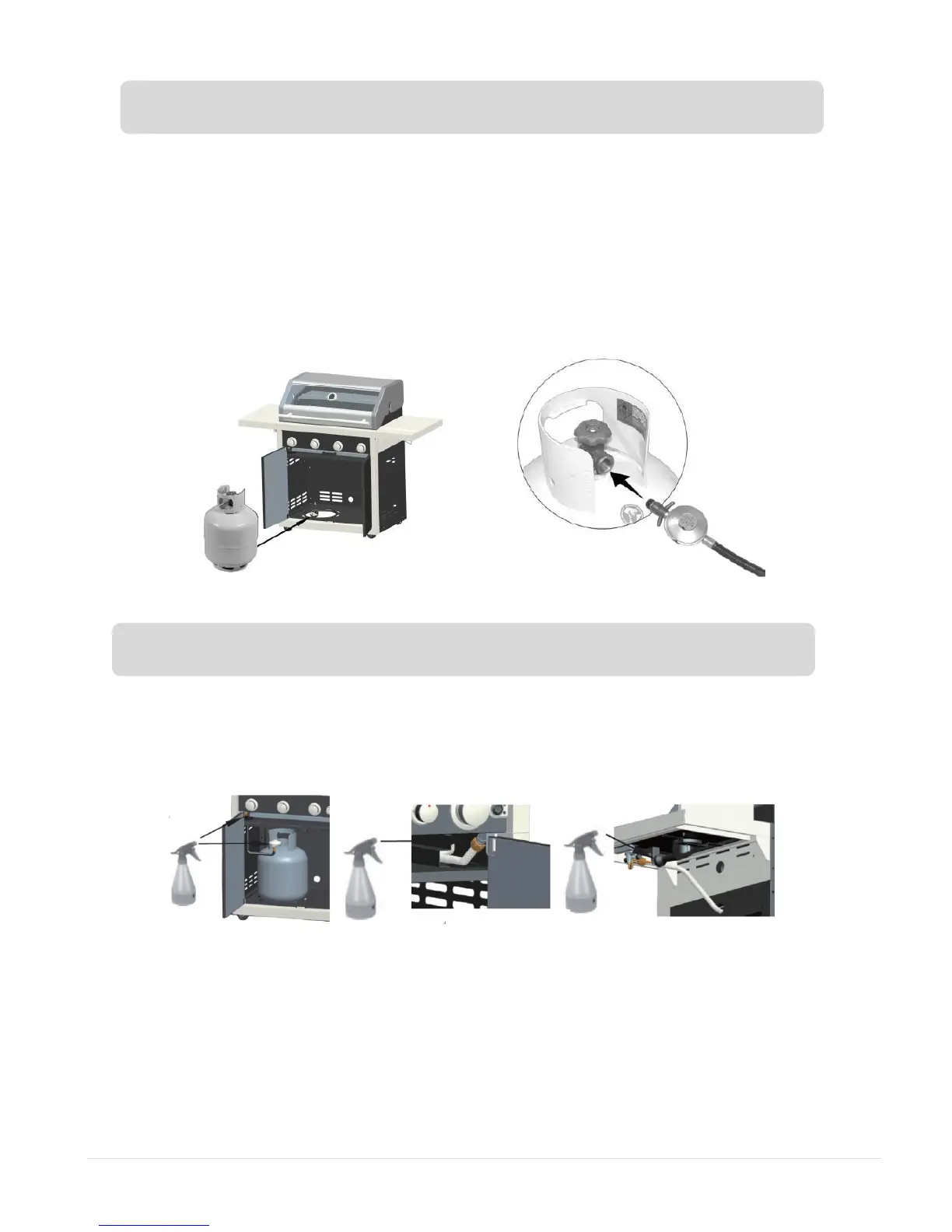
If you are using a portable LPG gas cylinder, place the LPG cylinder into the right side of the
cabinet, so that it sits inside the round cut out in the base shelf (or if your model has a slide out
cylinder drawer, sit the cylinder into the round cut out in the cylinder drawer). Take the hose that
came with the barbeque, check that it has a rubber seal on the regulator end of it, and connect this
end of the hose to the gas cylinder. You won’t need a spanner here. Just turn the fitting in an
anticlockwise direction and hand tighten as much as you can. This should seal it sufficiently.
Ensure the gas cylinder is secure.
Safety leak testing
Before proceeding, it is important that you leak test the barbeque. Make sure all the barbeque
control knobs are OFF. If you have a portable gas cylinder, turn the cylinder ON by rotating the
control knob anti-clockwise. If you have a wall connection, ensure the bayonet fitting is connected.
Spray or pour soapy water (about the same concentration as washing up water) along the gas line
including:
The gas connection at the inlet of the barbeque.
The gas hose or copper piping, including any joints or bends in the piping.
The gas connection at the gas cylinder or the wall connection.
If bubbles appear, there is a gas leak. If the leak is at a connection, tighten and retest. If
the leak is anywhere else, or if you cannot resolve the leak, do not proceed.
If you have a portable gas cylinder, turn the gas cylinder OFF and consult your retailer.
If you have a bayonet connection, remove the hose from the wall fitting and consult your
retailer.
NEVER use a flame to test for leaks.
You can also check for leaks using a gas safety gauge, available at your Barbeques Galore store.
This provides an easier and more convenient way to check for leaks.



 To Next Page