9
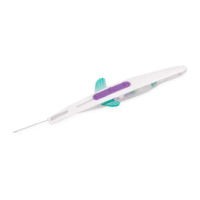
Alternate Technique: The safety IV catheter may be used
as an alternate to the safety introducer needle. Remove the
needle from the catheter after the vein is accessed.
WARNING: If the artery is entered, withdraw the needle and
apply manual pressure for several minutes.
Caution: Do not reinsert needle into IV catheter to minimize
the risk of the needle damaging or shearing the IV catheter.
C. Release tourniquet.
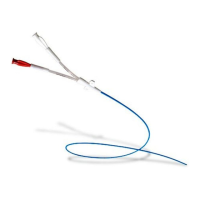
D. Remove the guidewire tip protector from the guidewire hoop and insert the exible
end of the guidewire into the introducer needle or IV catheter and into the vein.
Advance the guidewire to the desired depth.
Caution: Do not cut guidewire to alter length.
Caution: Do not insert stiff end of guidewire into vessel as this may result in
vessel damage.
Caution: Keep sufcient guidewire length exposed at hub to allow for proper han-
dling. A non-controlled guidewire can lead to wire embolism.
Caution: Do not use excessive force when introducing guidewire or microintroducer
as this can lead to vessel perforation and bleeding.
Caution: Do not advance the guidewire past the axilla.
E. Gently withdraw and remove the safety introducer needle or safety IV catheter, while
holding the guidewire in position.
Caution: If the guidewire must be withdrawn while the needle is inserted, re-
move both the needle and wire as a unit to prevent the needle from
damaging or shearing the guidewire.
F. Advance the small sheath and dilator together as a unit over the guidewire, using a
slight rotational motion. If necessary, a small incision may be made adjacent to the
guidewire to facilitate insertion of the sheath and dilator. Verify institutional guide-
lines concerning the use of a safety scalpel prior to making incision.
Caution: Avoid blood vessel damage by maintaining a catheter or dilator as internal
support when using a peel-apart introducer.
Caution: Avoid sheath damage by simultaneously advancing the sheath and dilator
as a single unit using a rotational motion.
Caution: Do not withdraw dilator from microintroducer sheath until sheath is within
vessel to minimize the risk of damage to sheath tip.
G. Withdraw the dilator and guidewire, leaving the sheath in place.
WARNING: Place a nger over the orice of the sheath to minimize blood loss and
risk of air aspiration. The risk of air embolism is reduced by performing this part of
the procedure with the patient performing the Valsalva maneuver until the catheter is
inserted into the sheath.
8. Insert and Advance the Catheter
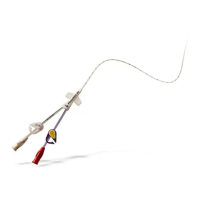
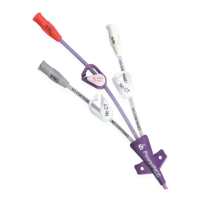
A. Insert the catheter into the introducer sheath.
B. Advance the catheter slowly.
NOTE: Resistance may be felt approximately 7 cm distal of catheter hub when intro-
ducing the catheter into the sheath due to an increase in outer diameter (O.D.) The
introducer may be partially split, but not removed to facilitate insertion of the catheter
past this point if necessary.




 To Next Page