Need help?
Do you have a question about the Bauer 19112C-B and is the answer not in the manual?
Guidelines for maintaining a clean, well-lit work area to prevent accidents and ensure safety.
Precautions for preventing electric shock when using power tools in wet conditions.
Advises users to stay alert, use common sense, and wear appropriate protective equipment.
Instructions on proper usage, maintenance, and care to ensure tool longevity and safety.
Specific safety rules for chain saw operation, including body positioning and hazard avoidance.
Explains the causes of kickback and operator techniques to prevent it.
Guidance on safe handling, charging, and maintenance of battery-powered tools.
Crucial warnings about handling lithium batteries to prevent fire or explosion.
Information on reducing vibration-related injuries and symptoms.
Instructions on how to charge the battery before the first use of the tool.
Diagram and labels identifying the various parts and functions of the chainsaw.
Essential instructions and warnings for operating the chainsaw safely.
Detailed steps for installing, adjusting, and replacing the guide bar and saw chain.
Proper methods for making notching and felling back cuts on a tree.
Safe techniques for removing branches from a tree after it has been felled.
Techniques for cutting logs supported along their entire length or on one end.
Safety precautions and techniques for cutting logs on sloped terrain.
Steps for cleaning the tool after use and basic maintenance procedures.
Daily, periodic, and wear-based maintenance tasks for the chainsaw.
Instructions for sharpening and replacing the saw chain for optimal performance.
Procedures for maintaining and replacing the guide bar for safe operation.
A detailed list of all components of the chainsaw with part numbers and quantities.
Visual representation of how the chainsaw parts are assembled together.
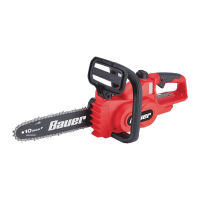
The Bauer 20V Lithium-Ion 19112C-B Cordless Compact Chainsaw is a battery-operated power tool designed for cutting small logs and for lighter weight trimming jobs. For maximum performance, it is recommended to use a 3.0 Amp Hour battery or greater, which is sold separately.
The chainsaw is an integrated unit consisting of handles, motor, guide bar, and saw chain, designed to be supported with two hands for operation. The cutting length refers to the approximate effective length of cut of the chain saw. The drive sprocket is the chain drive wheel with teeth. The front hand guard is a guard positioned between the front handle and the saw chain, protecting the hand from injuries if it slips off the handle. The front handle is the support handle located at or towards the front of the machine, while the rear handle is the support handle located towards the rear. The guide bar is an attachment that supports and guides the saw chain. The saw chain itself serves as the cutting tool, comprising drive links and cutters. A spiked bumper, fitted in front of the guide bar mounting point, acts as a pivot when in contact with a tree or log. The chainsaw also features an oil reservoir cap and an oil level window to monitor oil usage.
Before operation, users must read all safety warnings and instructions. The tool is designed for two-handed operation, with the right hand on the rear handle and the left hand on the front handle, gripping firmly with thumbs and fingers encircling the handles. The chainsaw is started by pushing in the trigger lockout, squeezing and holding the trigger, then releasing the trigger lockout. Releasing the trigger turns off the chainsaw.
For optimal performance, the saw chain should be soaked in bar and chain oil overnight before first use. The oil reservoir must be filled with bar and chain oil to just below the neck; running the chainsaw without oil can cause property damage. The saw chain tension must be checked before and periodically during operation. New saw chains often require tensioning multiple times during initial use. Proper tension allows the saw chain to snap back against the guide bar when pulled away, with drive links fitting snugly in the groove but still allowing the chain to slide easily by hand. There should be no sagging on the underside of the guide bar, and drive links should not be visible.
When cutting, the chainsaw should reach full speed before applying light, downward pressure against the bottom mid-section of the saw chain. The tool should be allowed to cut at its own rate, as excessive pressure can cause damage. The guide bar nose should not touch the wood to prevent kickback.
Specific techniques are provided for felling a tree, limbing, and cross-cutting. When felling, an escape path should be planned, and the natural lean of the tree, large branches, and wind direction should be considered. Dirt, stones, loose bark, nails, staples, and wire should be removed from the tree before cutting. Notching undercut should be 1/3 the diameter of the tree, perpendicular to the direction of fall, with the lower horizontal cut made first. The felling back cut should be at least 2 inches higher than the notching cut and parallel to it, leaving enough wood to act as a hinge. Limbing involves removing branches from a fallen tree, leaving larger lower limbs for support. Bucking a log (cutting into lengths) requires firm footing and evenly distributed weight. Logs supported along their entire length are cut from the top (overbuck). Logs supported on one end require a 1/3 diameter underbuck cut followed by an overbuck cut to meet. Logs supported on both ends require a 1/3 diameter overbuck cut followed by a 2/3 diameter underbuck cut. When bucking on a slope, the operator should stand on the uphill side of the log.
A maintenance schedule is provided, emphasizing daily and periodic checks.
All repairs and parts replacements should be undertaken by certified and licensed technicians. The user assumes all risk and liability for repairs or installation of replacement parts.

 To Next Page
 General