30
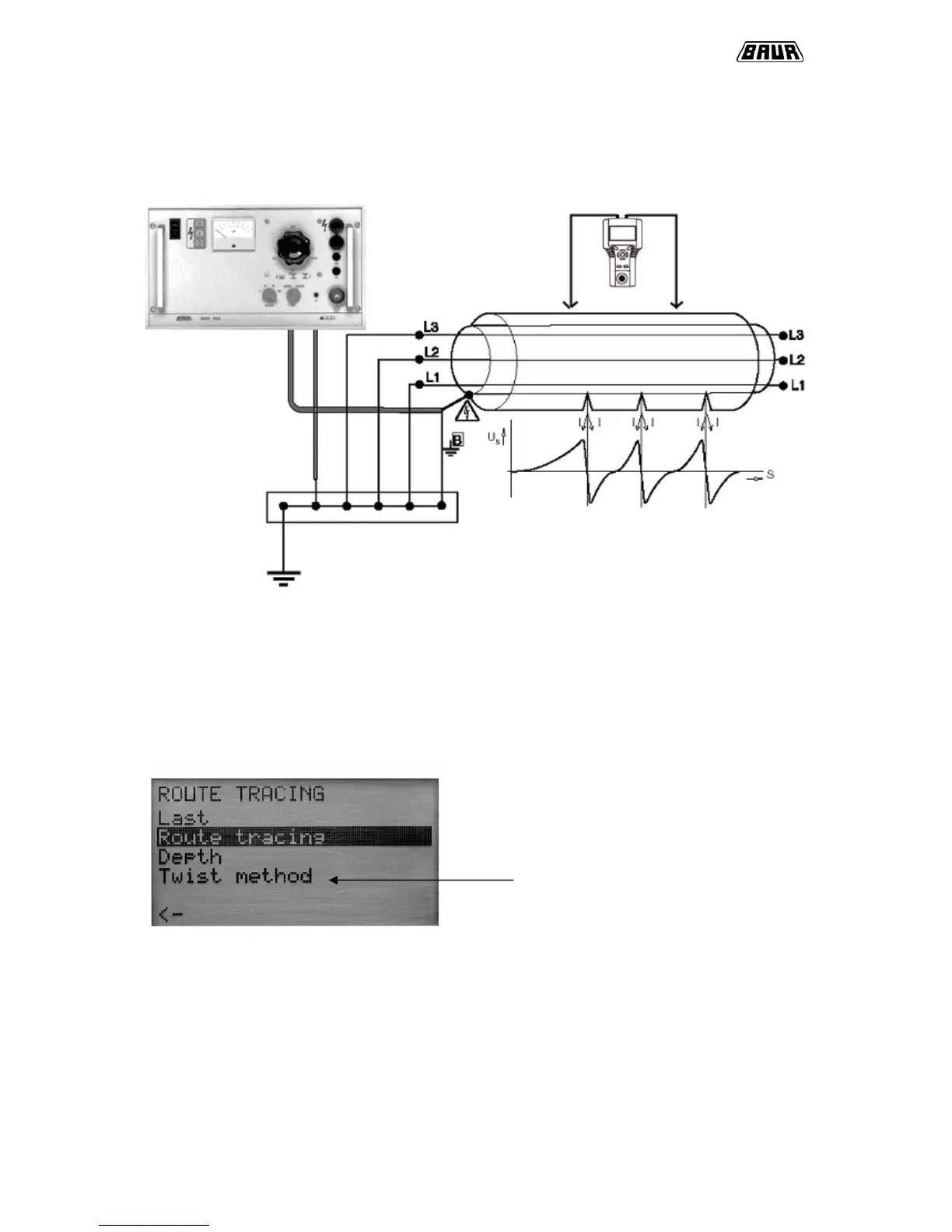
If a cable sheath has several faults, e.g. 2 between 1 k. and 5 k., all 3 faults can be located
with the STG or SSG and KMF1 during one passage over the route. This requires
appropriate practice and one should know that the step voltage shows several passings
through zero (5 passings through zero). The following sketch should serve for better
understanding.
In opposite to the pin pointing methods above, the twist method needs a frequency generator
(TG 20/50 or TG 600) and a search coil SP 30 instead of SSG and BM 30. When using the
twist method, the highest possible power adjustment of the Audio Frequency Generator
should be observed. The higher the obtainable output current of the generator, the better the
twist effect on the surface can be heard.
Applications:
- Cable selection, determination of joints, fault location on multicore lines and cables
The twist method offers particular advantages for low voltage and signal cables, where the
maximum permissible voltage is less than 1kV. The cable is loaded only slightly and the
route tracing and the location itself can be carried out in one operation. As an example, fast
results can be obtained in lighting cables and in house connections. Conditions for a
successful twist method measurement:
- Faulty cores must be stranded or pitched and must not be screened one by one.
- Distance of cores < 3 cm
- Fault resistance < 3
- In case of contact between fault and ground, any existing sheaths must be released
from ground (stationary earth).



 To Next Page