14
The NiMH batteries in the battery pack are paired with charge management circuits to give several
hundred recharge cycles. While the battery is in a good condition and is fully charged, the scanner will
run for the duration below. This time will vary depending on the display option used.
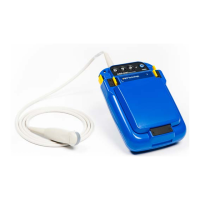
• Easi-Scan Micro-Convex with power pack latched 4 hours
Scanner run time may approach double this duration using the Auto Standby feature.
Electrical connection to the power pack is through the gold pads on battery and scanner. Power pack
output is protected with a resetting fuse but care should be taken to prevent short circuiting the gold
connector pins and pads. Battery metering relies on internal calculation. Repeated cycling without
complete discharge or charge completion will result in increasingly inaccurate battery level indication.
For peak performance, and for most accurate battery meter indication, batteries should occasionally
be run flat followed by a complete charge cycle.
Occasionally (every ten cycles, or once a fortnight) discharge until the scanner automatically switches
off, followed by a complete charge in one go (preferably from the mains supply).
Notes: The biggest difference you can make towards battery longevity is the occasional full
discharge-recharge cycle. When charging in short bursts e.g. top-up charging between
jobs, or in-car with Cigar power cycling on engine start etc the charger uses a less
accurate method to terminate charging. Occasional full charge-discharge cycle not only
helps maintain maximum capacity, but ensures updated calibration of the integrated
charge control circuit for optimum charge control which in turn ensures maximum battery
lifetime. Corrections are also made to battery level metering for continued accuracy of
on-screen battery level display.
‘Memory effect’ - if NiMH batteries are not used regularly (weekly) or fully (repeatedly
using only a fraction of full capacity) there will be a temporary reduction in available
capacity, with resulting reduced run times. After the battery has been “exercised” the
full capacity returns. A return to almost full capacity is achieved with a complete charge
/ discharge cycle. Further marginal improvement in capacity may be seen progressively
over two to three complete charge/discharge cycles.
Do not store the scanner for extended periods without occasional exercise. Store the scanner
fully charged – particularly in hot climates.
Notes: This is only relevant if your scanner will remain unused for 6 months or more. Some
permanent reduction in capacity can be incurred through prolonged storage without
occasional recharging. Battery charge will not be maintained very long in storage –
particularly at higher ambient temperatures. Batteries can lose as much as 30% of
their charge in 1 month’s storage.
Warning:
To reduce the risk of burns, fire, electric shock, or injury to persons an
appliance should never be left unattended when plugged into mains or
12V cigarette lighter.


 To Next Page
 Loading...