Servicing and operation of lead-acid batteries
Lead-acid batteries are to be charged immediately after use. Disch-
arged lead-acid batteries are to be charged for approximately 16
hours at 1/10 of the rated capacity.
A few basic rules need to be observed in the handling of lead-acid batte-
ries, to maintain their service life over several years.
Lead-acid batteries should never be exhaustively discharged, i.e. col-
lapse of the cell voltage must be absolutely avoided. A sudden progres-
sive process of decay starts in the inside of the lead-acid battery immedi-
ately the charge is completely exhausted. With so-called starter
batteries this can lead to complete destruction after just a few hours. A
lead-acid battery which has been largely discharged must therefore be
recharged without delay. It is best if lead-acid batteries retain a certain
residual charge and are then immediately recharged to their rated capa-
city.
The manufacturers of lead-acid batteries also recommend that lead-acid
batteries which are not in use should pass through a complete dischar-
ge/charge cycle once a month in order retain the capacity.
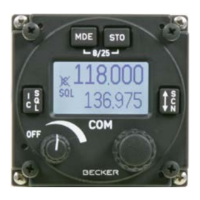
The VHF RT unit in the cabinet contains a voltage monitoring facility. If
the operating voltage drops below 10.5 V, the frequency display begins
to flash. When operating with a lead-acid battery, this is a signal to imme-
diately recharge the battery.
Operating Instructions
Page 34 Issue 05/2000
CAUTION



 To Next Page