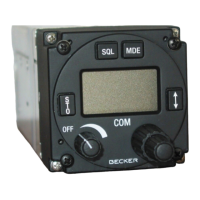
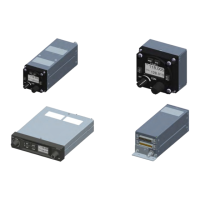
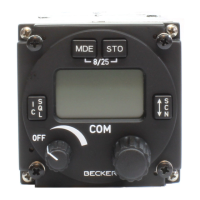
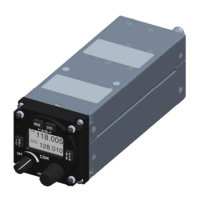
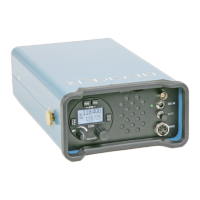
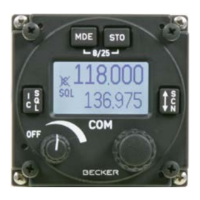
The Becker AR 3209 is a VHF transceiver designed for voice communication across 760 channels within the 118.000 MHz to 136.975 MHz frequency range, with a channel spacing of 25 kHz. It complies with the requirements of ICAO Annex 10, valid from January 1, 1995. The device is built with robust mechanical strength, allowing for installation in various aircraft types, including helicopters, without environmental class restrictions. It can be fitted into an instrument panel, center console, operating console, or fixed in the fuselage.
Function Description
The VHF transceiver offers several operating modes, selected by briefly pressing the MDE key (4).
-
Mode 1 (Standard Mode): In this mode, the left LC display (7) shows the active frequency, while the right LC display (8) is switched off. The active frequency can be directly changed using the MHz (9) and kHz (10) frequency selector switches. Frequencies can also be stored in individual storage channels. To store a frequency, press the STO key (3). The active frequency remains displayed in the left LC display (7) and the transceiver is ready to transmit and receive on this frequency. The active frequency will appear flashing in the right LC display (8) during the storage operation.
-
Mode 2: This mode displays both active and preset frequencies. The last indicated active and preset frequencies are shown in the left (7) and right (8) LC displays, respectively. The preset frequency (right LC display (8)) can be adjusted using the MHz (9) and kHz (10) frequency selector switches. Pressing the Exchange key (5) swaps the active and preset frequencies. Further activation of this key reverses the frequency change. A storage operation in Mode 2 is similar to Mode 1, with the preset frequency flashing in the right-hand LCD.
-
Mode 3 (Channel Selection Mode): In this mode, the last indicated storage channel appears in the right LC display (8), and its stored frequency is shown in the left LC display (7). The transceiver is ready to transmit and receive on this frequency. The required channel can be selected using the kHz (10) (steps of 1) or MHz (9) (steps of 10) frequency selector switches. The currently memorized frequency in the left display (7) becomes the active frequency. It is not possible to erase memory channel 1; it can only be overwritten. To leave Mode 3, press the MDE key (4).
-
Service Mode (Equipment Configurations): This mode is intended for ground technicians to set equipment configurations and should not be used in flight. To access it, switch off the VHF transceiver, then hold the MDE key (4) pressed while switching the unit back on. The transceiver will enter service mode without a unit test, displaying "SL" in the left LC display (7) and the squelch switch-on threshold in the right LC display (8). Settings are selected by briefly pressing the MDE key (4). Pressing the MDE key (4) for at least one second allows for a direct return to the SQL setting. The transceiver operates independently of control panel settings in service mode, on the last set active frequency. A password can be set to interlock configuration settings.
Usage Features
- Switching On: Rotate the ON/OFF rotary switch (1) clockwise. Both LC displays (7, 8) should flash "188.88" for approximately 2 seconds during a unit test. If the test is positive, the transceiver reverts to the mode selected before switch-off. A negative test results in the left LC display (7) flashing for about 5 seconds, and a fault report can be called up by pressing the STO key (3).
- Volume Control: Adjust the reception volume using the VOL control (1).
- Squelch: The squelch key (2) switches the squelch on or off, suppressing weak reception signals and noise. The switch-on threshold can be set in service mode.
- Transmit/Receive Mode: Set the local ground station frequency in the preset display and press the exchange key (5). The green LED (6) indicates transmit mode. During transmission, a protective circuit prevents frequency or channel changes, even if selector switches are rotated. Keying functions on the control panel are also inhibited.
- Intercom Mode: Switch on the external IC switch to operate the intercommunication. The IC volume can be adjusted in service mode to match aircraft noise levels.
- Audio Auxiliary Input: A second and third radio unit (navigational receiver) can be monitored simultaneously. During transmission, the auxiliary input is switched off from the audio end amplifier. Input sensitivity can be adjusted in service mode.
- Transmit Button Jamming Protection: The transceiver has a protective circuit that automatically switches from transmission to reception after two minutes of continuous transmission to prevent blocking the channel. The transmitter can be reactivated by re-pressing the transmit button. If the button is jammed or short-circuited, the transceiver must be switched off and on again to resume transmission for another two minutes.
- Frequency Setting and Storage Release: Functions SF 5 and SF 6 in service mode allow enabling or disabling frequency setting (channel selection only) and frequency storage, respectively.
- Password Protection: The equipment configuration settings can be interlocked with a 4-digit numerical password, set using the kHz (10) or MHz (9) switches and stored with the STO key (3). If a password is set, a "0" appears when service mode is called up, requiring the password to be entered.
Important Technical Specifications
- Frequency Range: 118.000 MHz to 136.975 MHz
- Number of Channels: 760
- Channel Spacing: 25 kHz
- Operating Temperature Range: -20° C to +55° C
- Dimensions (Front Panel): 146 mm x 47.5 mm
- Depth of Unit (without cable connector): 194 mm
- Weight:
- AR 3209 - (09): 1 kg
- AR 3209 - (11): 1.2 kg
- Internal Fuse: 5 A
- Power Supply Voltage AR 3209 - (09):
- Nominal Supply Voltage: 13.75 V DC
- Supply Voltage Range: 12.4 V to 15.1 V
- Emergency Operation (10.0 V): Good intercom
- Power Consumption (without panel lighting):
- "Standby" reception mode: 70 mA
- Reception mode: 500 mA
- Transmission mode: 2.5 A
- Panel Lighting: 1 A at 5 V DC, 400 mA at 13.75 V DC
- Power Supply Voltage AR 3209 - (11):
- Nominal Supply Voltage: 13.75 V DC or 27.5 V DC
- Supply Voltage Range: 12.4 V to 15.1 V or 24.8 V to 30.3 V
- Emergency Operation (10.0 V or 20.0 V): Good intercom
- Power Consumption (without panel lighting):
- "Standby" reception mode: 70 mA
- Reception mode: 500 mA
- Transmission mode: 2.5 A
- Panel Lighting: 1 A at 5 V DC, 400 mA at 13.75 V DC, 200 mA at 27.5 V DC
Maintenance Features
- Fault Reporting: If a unit test is negative, the LC display (7) flashes for approximately 5 seconds, and a fault report can be called up by pressing the STO key (3). Possible fault signals include E1 (Processor defective), E2 (Synthesizer failed), E3 (Fault in EE-PROM), and E4 (Controller (PIC) audio assembly defective).
- Service Mode Adjustments: The service mode allows for various adjustments:
- SqL (Squelch Threshold): Adjustable from 00 to 200 (standard 100) using MHz (steps of 10) or kHz (steps of 5) switches.
- SIdE (Sidetone Level): Adjustable from 00 to 63 (standard 32) using MHz (steps of 10) or kHz (steps of 1) switches.
- AU (Audio Auxiliary Level): Adjustable from 00 to 63 (standard 63) using MHz (steps of 10) or kHz (steps of 1) switches.
- IC (IC Level): Adjustable from 00 to 63 (standard 32) using MHz (steps of 10) or kHz (steps of 1) switches.
- SF9 (Dynamic Mike Input Sensitivity): Adjustable from 00 to 63 (standard 32) using kHz (steps of 1) or MHz (steps of 10) switches.
- SF10 (Inhibiting Transmit Mode for Memory Channel): Allows selecting channels where transmit mode is inhibited.
- SF12 (Speaker Muting Switch ON/OFF): Configures whether the speaker muting is on or off.
- SF13 (Software Version and Change Status Indication): Displays software versions for the microprocessor and CO-Microprocessor (PIC).
- Restoring Standard Values: To revert to standard equipment configuration values (SQL, SIdE, AU, IC, SF9), switch off the transceiver and then switch it on again while simultaneously pressing the STO (3) and MDE (4) keys.
- Repair Instructions: In case of a fault, the unit should be sent to a Becker Dealer or customer service with a detailed fault description to shorten repair times and reduce costs. The operating instructions do not replace the equipment manuals (Installation and Operation DV 37501.03, Article No.: 892.531-071; Maintenance and Repair DV 37501.04, Article No.: 892.548-071).
- A speech test should be performed before startup.
- Use a loud voice and hold the microphone close to the lips during communication to minimize cabin noise interference.
- Only use microphones or headsets suitable for aircraft. Be aware of potential feedback issues in aircraft made of wood, synthetic materials, or gliders/helicopters, which can cause whistling or distortion.
- Ensure the green LED (6) disappears when the transmission button is released to confirm the transmit mode has ended, as transmit buttons can stick.
- Never connect the transceiver to AC voltage or voltage sources exceeding 32 V DC.
- Never connect the transceiver with reversed polarity.
- Avoid installation or use in ambient temperatures below -20° C or above +55° C.
- Switch off the unit when starting or shutting down engines.
- Do not switch on the VHF transceiver when engines are being started or shut down.

 Need help?
 General

 To Next Page