Need help?
Do you have a question about the Beko CFP1675DW and is the answer not in the manual?
This document describes the Beko Frost Free Fridge-Freezer, model CFP1675DW, a quality appliance designed for domestic household use. It emphasizes safe operation, proper installation, and effective maintenance to ensure long-lasting service.
The Beko Frost Free Fridge-Freezer is a combined refrigeration appliance designed for storing both fresh and frozen foodstuffs. It features a fridge compartment that performs full-automatic defrosting, eliminating the need for manual scraping of frost. Water resulting from defrosting flows into a collection groove and then evaporates, ensuring a clean and frost-free environment for fresh food. The freezer compartment also defrosts automatically, preventing the decay of frozen food and maintaining optimal performance. The appliance utilizes non-CFC/HFC natural substances (R600a refrigerant and cyclopentane insulation), making it environmentally friendly.
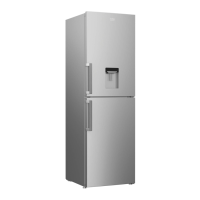
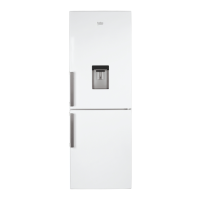
The appliance includes a water dispenser, allowing users to access fresh drinking water conveniently without opening the fridge door. The interior temperature of the refrigerator can be adjusted using a thermostat knob, enabling users to customize cooling settings based on seasonal temperatures, frequency of door opening, and the amount of food stored. A freezer fan circulates cold air within the freezer compartment to maintain consistent temperatures and prevent frost buildup.
Installation and Setup: Before initial use, the appliance requires careful installation. It should be left to stand for at least 4 hours after transportation to allow compressor oil to settle. The appliance must be connected to a suitable switched and fused socket, and the supply cord should not be trapped or damaged. Proper earthing is crucial for safety, and if the fitted plug is unsuitable, an appropriate 13A fuse-rated plug must be installed by a qualified electrician. The appliance should be placed on a smooth, level surface, with the front feet adjusted to ensure stability and minimize vibration and noise. Adequate air circulation around the appliance is necessary, with specific clearances from heat sources like cookers and radiators. Wall spacers are provided to ensure proper ventilation at the back.
Temperature Control: The interior temperature is controlled by a thermostat knob, with settings ranging from MIN to MAX, where MAX indicates the coldest position. Users are advised to set the thermostat midway initially and monitor the temperature with an accurate thermometer to ensure desired storage conditions are met. Factors like ambient temperature, door opening frequency, and the temperature of food placed inside can influence the internal temperature, necessitating occasional adjustments.
Food Storage: The fridge compartment is suitable for short-term storage of fresh food and drinks. The freezer compartment is rated for 4-STAR freezing, suitable for long-term storage of commercially frozen foods and for freezing fresh food. To achieve optimal freezing capacity, the thermostat knob should be set to the MAX position 24 hours before placing fresh food in the freezer. Small quantities of food (up to 1/2 kg or 1 lb) can be frozen without adjusting the temperature control. It is important to avoid mixing already frozen food with fresh food. Food items should be wrapped or covered to prevent drying out and odor transfer. Hot food should be allowed to cool before placing it in the fridge or freezer.
Water Dispenser: The water dispenser provides convenient access to drinking water. To use, simply push the lever with a glass. The flow rate depends on how far the lever is depressed. The water tank, located inside the door rack, has a capacity of 3 liters and should only be filled with clean drinking water. Using other liquids like fruit juices, carbonated beverages, or alcoholic drinks can damage the dispenser and void the warranty.
Door Reversal: The appliance's doors can be reversed to suit different kitchen layouts. This process involves a series of steps, including removing hinges, covers, and the door itself, then reattaching them on the opposite side. Detailed diagrams and numerical instructions are provided to guide users through this procedure.
Cleaning and Care: Regular cleaning is essential for maintaining the appliance's hygiene and performance. Before cleaning, the appliance should be switched off and unplugged from the mains. Mild cleaning agents, such as a solution of one teaspoon of bicarbonate of soda in one pint of lukewarm water, should be used. Abrasive substances, sharp instruments, or petroleum-based products must be avoided. The interior and exterior of the cabinet should be wiped dry after cleaning. Special attention should be given to the temperature control box, ensuring no water enters it.
The condenser at the back of the appliance should be vacuumed once a year to remove dust buildup, which can affect efficiency. Door seals should be checked regularly for cleanliness and proper sealing. The special plastic container (drain tray) at the back, which collects defrost water, must be kept clean. Instructions are provided for removing and cleaning this tray.
Drawer and Flap Removal: For thorough cleaning or to rearrange storage, freezer drawers can be pulled out, tilted upwards, and removed. The freezer flap door can also be gently pulled off after opening it slightly. It is important to ensure the flap is correctly in place before closing the freezer door. Care should be taken to prevent small food items like rice, peas, or beans from falling through the fan guard, as this can obstruct the cooling system.
Defrosting: Both the fridge and freezer compartments feature automatic defrosting, eliminating the need for manual intervention. In the fridge, defrost water flows into a drain pipe and evaporates. Users should regularly check and clear the drain pipe if it becomes clogged. The freezer's automatic defrosting system prevents ice buildup, ensuring efficient operation without user effort.
Light Bulb Replacement: If the interior light bulb (or LED) requires replacement, users are advised to contact an Authorized Service agent.
Troubleshooting: The manual includes a problem-solving section to address common issues such as the appliance not operating. Users are advised to check basic points like power supply, plug connection, fuse, and thermostat settings before contacting service. This helps avoid unnecessary service calls, as a charge may be levied if no fault is found.
Energy Saving Tips: To optimize energy efficiency, the appliance should be installed in a well-ventilated area. Minimizing the time between purchasing chilled/frozen food and placing it in the appliance, especially in summer, is recommended, possibly using a cool bag. Doors should not be left open longer than necessary. Defrosting frozen food in the fridge compartment can help cool the fridge, acting as an ice pack.
 General
| Appliance type | Refrigerator |
|---|---|
| Placement | Freestanding |
| Product colour | White |
| Door hinge | Right |
| Reversible doors | Yes |
| Control type | Mechanical |
| Built-in display | No |
| No Frost system | Yes |
| Ice cube tray | Yes |
| Noise emission class | C |
| Noise level | 39 dB |
| Number of Doors | 2 |
| Defrost System | Automatic |
| Width | 54 cm |
| Star rating | 4 stars |

 To Next Page