Need help?
Do you have a question about the Beko CXFG1685 and is the answer not in the manual?
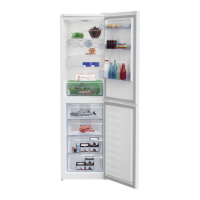
Identifies and illustrates the main parts of the refrigerator.
Outlines essential safety rules for using the appliance.
Details on proper electrical connection and earthing for safe operation.
Provides advice on minimizing energy consumption for efficiency.
Information on WEEE and RoHS directives and product disposal.
Guidelines for safely moving and preparing the refrigerator for installation.
Instructions for connecting the appliance to the power supply.
Instructions on where and how to position the refrigerator for optimal function.
Detailed steps for fitting the appliance correctly.
A checklist to ensure the appliance is ready for use after installation.
How to set and adjust the refrigerator's temperature for optimal cooling.
Best practices for storing frozen and fresh food, and making ice cubes.
Step-by-step guide for defrosting the fridge and freezer compartments.
Instructions for using the special compartment for extended food freshness.
Recommendations for cleaning the appliance's interior and exterior.
Guidance for cleaning parts like the drain tray and fan guard.
Advice on proper food storage, preparation, and freezing techniques.
Lists food items and practices to avoid for appliance safety and food preservation.
Guides users through diagnosing and resolving operational problems.
Explains what the product warranty covers and its limitations.
How to get assistance and contact Beko for repairs or inquiries.
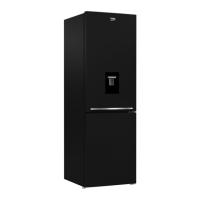
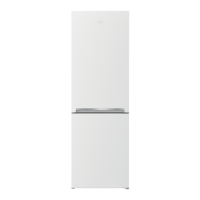
This document describes a Beko refrigerator, model CXFG1685B, providing comprehensive instructions for its safe and efficient use, maintenance, and installation.
The Beko CXFG1685B is a refrigerator designed for storing and freezing edible foodstuffs. It features a fridge compartment and a freezer compartment, allowing for both chilled and frozen storage. The appliance utilizes non-CFC/HFC natural substances (R600a in the cooling system and cyclopentane in the insulation), making it environmentally friendly. The refrigerator is equipped with a compressor-based refrigeration system. A "Superfresh zone" is included, designed to maintain a temperature of around 0°C and a drier environment than other zones, suitable for keeping meat, fish, and wrapped food fresh for longer periods.
The refrigerator's operating temperature is controlled by a thermostat knob, with settings ranging from 1 (warmest) to 5 (coldest), and 0 for system cooling off. The average temperature inside the fridge compartment is recommended to be around +5°C. The interior temperature can be adjusted based on seasonal temperatures, frequency of door opening, and the temperature of food placed inside. The coldest region in the fridge is located immediately above the vegetable compartment.
For storing frozen food, it is recommended to place packets in the freezer as quickly as possible after purchase, ensuring they are labeled and dated. The appliance has a freezing capacity of 5 kg in 24 hours. Fresh food should be frozen in small portions and wrapped in aluminum foil or freezer-quality polythene bags with all air excluded. When freezing fresh food, the temperature control should be turned towards MAX. Small quantities of food (up to 1/2 kg) can be frozen without adjusting the temperature control. Users should avoid mixing already frozen food with fresh food.
Ice cubes can be made by filling the ice-cube tray 3/4 full with water and placing it in the Ice Bank. Frozen trays can be loosened with a spoon, but sharp objects like knives or forks should not be used.
Energy-saving tips are provided to optimize efficiency. These include ensuring the appliance is installed in a well-ventilated area, minimizing the time between purchasing and storing chilled/frozen food, and not leaving the door open longer than necessary. Defrosting frozen food in the fridge compartment can assist cooling. For maximum loading capacity in the freezer, it is advised to load it without using the top shelf lid and all drawers except the bottom one.
Regular cleaning and maintenance are crucial for optimal performance. Before cleaning, the appliance should be switched off at the socket outlet and the mains plug pulled out. Abrasive instruments, soap, household cleaners, detergents, and wax polish should not be used for cleaning. The cabinet interior should be cleaned with lukewarm water and wiped dry. A damp cloth wrung out in a solution of one teaspoon of bicarbonate of soda to one pint of water can be used for the interior. Care must be taken to prevent water from entering the lamp housing.
The fridge compartment defrosts automatically, with defrosting water running to a drain tube and collection container at the back. If water does not drain, the drain tube can be cleared by pushing the provided plastic plunger. If a frost layer of about 1/4" (7 mm) forms, the setting should be reduced (e.g., from 4 to 1) to restart automatic defrosting.
The freezer compartment requires manual defrosting, recommended twice a year or when a frost layer of around 7 mm (1/4") has formed. To defrost, the appliance should be switched off and unplugged. All food should be wrapped in newspaper and stored in a cool place. Containers of warm water can be placed in the freezer to speed up defrosting. Sharp objects should not be used to remove frost. Hairdryers, electrical heaters, or similar appliances are also prohibited for defrosting. After defrosting, any water collected at the bottom of the freezer should be sponged out, and the interior thoroughly dried before plugging the appliance back in.
The condenser at the back of the appliance should be cleaned annually with a vacuum cleaner to remove dust. Door seals should be regularly checked for cleanliness and to ensure they are free from food particles. The special plastic container (drain tray) at the back, which collects defrost water, should be kept clean.
Door trays can be removed by emptying them and pushing them upwards from the base. Freezer drawers can be removed by pulling them out as far as possible, tilting them upwards, and then pulling them out completely.
For the illumination lamp, if it needs changing, an Authorized Service should be contacted. The lamp(s) are not suitable for household room illumination but are intended to assist the user in placing foodstuffs.
The manual also provides instructions for installation, including adjusting the front feet for leveling, ensuring proper air circulation around the appliance (at least 5 cm distance from the ceiling and walls), and placing it on an even floor surface. The appliance should be kept away from heat sources, humid places, and direct sunlight. The room where the appliance is installed should not be smaller than 10 cubic meters and should have a temperature between +5°C and +32°C.
 General
| Appliance placement | Freestanding |
|---|---|
| Fridge interior light | Yes |
| Lamp type | LED |
| Egg balcony | Yes |
| Bottle rack | Yes |
| Number of shelves/baskets in freezer | 3 |
| Ice cube tray | Yes |
| Number of Doors | 2 |
| Width | 70 cm |
| Depth | 705 mm |
| Height | 185 cm |

 To Next Page