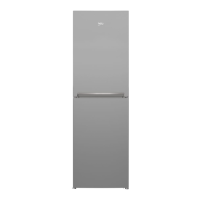
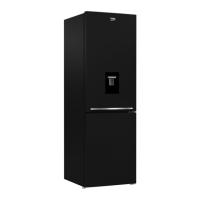
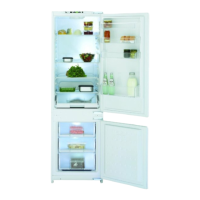
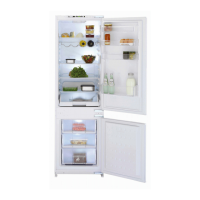
This document is an instruction manual for a Beko Frost Free Fridge-Freezer, model CXFG3601VW. It provides comprehensive guidance on the appliance's operation, maintenance, and safety, ensuring users can maximize its performance and longevity.
The primary function of this appliance is to provide both refrigeration and freezing capabilities for edible foodstuffs. It is designed as a combi fridge-freezer, meaning it has separate compartments for fresh food storage (fridge) and frozen food storage (freezer). The "Frost Free" feature indicates that the freezer compartment automatically defrosts, eliminating the need for manual defrosting and preventing ice buildup. The fridge compartment also defrosts automatically.
Usage Features:
- Temperature Control: The appliance's operating temperatures are controlled by a thermostat knob, which can be set at any position between 0 and 5, with 5 being the coldest. The average temperature inside the fridge should be around +5°C (+41°F). Users are advised to adjust the thermostat to achieve the desired temperature and to monitor it periodically with a thermometer. Frequent door openings can cause internal temperatures to rise, so it's recommended to close the door as soon as possible after use.
- Food Storage:
- Fridge Compartment: Designed for short-term storage of fresh food and drinks. Cooked dishes should be stored in airtight, covered containers. Fresh wrapped produce, fruits, and vegetables can be placed on shelves or in crisper bins after cleaning. Bottles can be stored in the door section. Raw meat should be wrapped in polythene bags and stored separately from cooked food for two to three days to avoid contamination. Hot food and beverages should be allowed to cool before being placed in the fridge. Explosive substances and high-proof alcohol should not be stored in the fridge. Fizzy drinks should not be frozen. Certain fruits and vegetables (like pineapples, melons, cucumbers, and tomatoes) should be wrapped in polythene bags if kept near 0°C to prevent damage. Chilled cooked food should be placed near the rear of the fridge liner where the cold wall is located.
- Freezer Compartment: This compartment is **** rated, suitable for freezing and long-term storage of pre-frozen food. Users should observe the storage recommendations on food packaging. To achieve the best freezing capacity for fresh food, the setting knob should be turned to the maximum position 24 hours before placing food in the freezer. Small quantities of food (up to 1/2 kg) can be frozen without adjusting the temperature control knob. It's crucial not to mix already frozen food with fresh food.
- Ice Cube Making: Ice cube trays should be filled 3/4 full with water and placed in the Ice Bank. Frozen trays can be loosened with a spoon handle, avoiding sharp objects. Ice cubes stored in the Ice Bank for several weeks may slowly reduce in size and disappear.
- Freezer Guard: The appliance is equipped with "Freezer Guard" technology, which ensures that frozen food in the freezer will not defrost even if the ambient temperature drops as low as -15°C, provided the control is set to '4'. This feature makes the appliance suitable for installation in garages or unheated rooms. However, at such low ambient temperatures, fridge contents are likely to freeze, so users should check and consume food in the fridge accordingly.
- Harvest Fresh Technology: Crispers illuminated with HarvestFresh technology help preserve the vitamin content (A and C) of fruits and vegetables for a longer time. This is achieved through blue, green, red lights, and dark cycles that simulate a day cycle. If the refrigerator door is opened during the dark period, the system will automatically detect this and illuminate the crisper for convenience. The dark period resumes once the door is closed.
- Door Reversing: The manual provides detailed instructions and diagrams for reversing the doors, allowing users to adjust the appliance's opening direction to suit their kitchen layout.
Maintenance Features:
- Cleaning: Regular cleaning is essential for hygiene and optimal performance.
- General Cleaning: The appliance should be switched off and unplugged before cleaning. Harsh instruments, abrasive substances, soap, household cleaner, detergent, or wax polish should not be used. A damp cloth wrung out in a solution of one teaspoon of bicarbonate of soda to one pint of water should be used to clean the interior and wiped dry. The cabinet should be cleaned with lukewarm water and wiped dry. Care should be taken to prevent water from entering the temperature control box.
- Condenser Cleaning: Any dust that accumulates on the condenser at the back of the appliance should be removed annually with a vacuum cleaner.
- Door Seals: Door seals should be checked regularly to ensure they are clean and free from food particles.
- Drain Tray: The special plastic container (drain tray) at the back of the appliance, which collects defrost water, must be kept clean. Instructions are provided for removing and cleaning the drain tray.
- Removable Parts: Shelves, racks, crisper bins, drawers, flaps, and bottle grippers are all removable for easier cleaning.
- Defrosting:
- Fridge Compartment: Defrosts automatically. Defrost water runs to a drain tube and collection container at the back. Water droplets may form on the back wall and refreeze, which is normal. Pointed or sharp-edged objects should not be used to remove these droplets. If the drain tube is blocked by food particles, it can be cleared with a pipe cleaner or the provided plastic plunger. The drain tube's end must be permanently placed in the collecting tray on the compressor to prevent water spillage. If the frost layer reaches about 1/4" (7 mm), the thermostat setting should be reduced (e.g., from 4 to 1) to restart automatic defrosting.
- Freezer Compartment: Defrosts automatically. The internal fan circulates cold air. Users are warned not to insert objects through the fan guard, store inflammable propellant gas or explosive substances, cover shelves with materials that obstruct air circulation, or obstruct the freezer fan guard, as these actions can impair performance and increase freezer temperature.
- Light Bulb Replacement: For illumination, the product is equipped with a lighting source of "G" energy class. The manual states that the light source should only be replaced by professional repairers. The lamp is specifically designed for the appliance's extreme physical conditions (temperatures below -20°C) and is not suitable for household room illumination.
- Long-Term Storage: If the appliance will not be used for an extended period, it should be switched off, emptied of food, cleaned, and the door left ajar.
Safety and Installation:
- Electrical Requirements: The appliance must be earthed and connected to a mains supply with the correct voltage and frequency as indicated on the rating plate. The supply cord should not be trapped or damaged. If the mains lead is damaged, it must be replaced by a special purpose-made lead from a BEKO Authorised Service Agent. The fitted moulded plug incorporates a 13 A fuse, which must be replaced with an ASTA approved BS 1362 fuse of the same rating if needed. Instructions for fitting a different plug are also provided, emphasizing correct wire connections (green-yellow/green to Earth, blue to Neutral, brown to Live). Extension sockets or charging transformers/power supplies or Lithium-Iron battery operated products should not be placed near the compressor due to overheating risk.
- Transportation: The appliance should be transported in an upright position with intact packing. If transported horizontally, it must be laid on its left-hand side (when facing the front) and left to stand upright for at least 4 hours before switching on to allow compressor oil to settle. The appliance must be protected from rain, moisture, and other atmospheric influences. Care should be taken not to damage flooring, pipes, or wall coverings during positioning. The appliance should not be moved by pulling the door or handle. Any water in the drain tray should be emptied before moving. The defrost water pipe at the back must be fixed to the plastic evaporating pan to prevent spillage.
- Installation: The room space must be at least 10 cubic meters. The appliance should not be placed near cookers, radiators, or in direct sunlight. Minimum side clearances from heat sources are specified: 2" (50 mm) from cookers, 12" (300 mm) from radiators, and 1" (25 mm) from other refrigerators or larder fridges. The appliance should be placed on a smooth surface, and the two front feet can be adjusted clockwise or anti-clockwise to ensure it stands upright and firmly contacts the floor, preventing excessive vibration and noise. All packing and transit protectors, including polystyrene blocks between the compressor motor and the cabinet, must be removed before connecting to electricity. The plastic drain tray above the compressor motor on auto-defrost fridge models should not be removed.
- General Safety: Do not sit or stand on the appliance. Ensure the mains cable is not caught under the appliance. Children should not play with the appliance or tamper with controls. Electrical appliances should not be used inside food storage compartments unless recommended by the manufacturer. Mechanical devices or other means to accelerate defrosting should not be used, other than those recommended by the manufacturer. The refrigerant circuit should not be damaged.
- Disposal: When discarding an old refrigerator with a lock or latch, disable it to prevent children from becoming entrapped. The appliance should not be disposed of in a fire. It contains non-CFC/HFC natural substances (R600a) in the cooling system and cyclopentane in the insulation, which are potentially flammable if exposed to fire. Care must be taken not to damage the cooling circuit/pipes during transportation and use. In case of damage, the appliance should not be exposed to fire or potential ignition sources, and the room should be immediately ventilated. Local authorities should be contacted for disposal information. The product bears the selective sorting symbol for waste electrical and electronic equipment (WEEE) and must be handled according to European Directive 2012/19/UE for recycling and dismantling to minimize environmental impact.
Energy Saving Tips:
- Install the appliance in a well-ventilated area.
- Minimize the time between purchasing chilled/frozen food and placing it in the appliance, especially in summer, using a cool bag or special carrier bag.
- Do not leave the appliance doors open longer than necessary and ensure they are properly closed after each opening.
- Defrost frozen food in the fridge compartment, allowing it to act as an ice pack to assist cooling in the fridge.
The manual also includes a troubleshooting guide for common issues and details about the manufacturer's guarantee and how to obtain service.

 Need help?
 General

 To Next Page