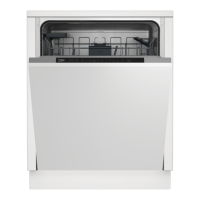
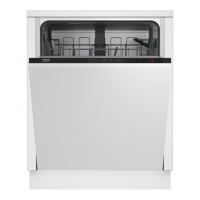
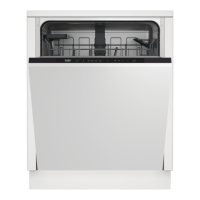
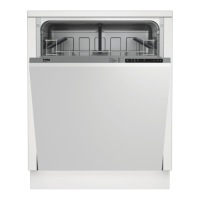
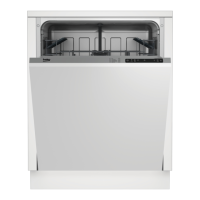
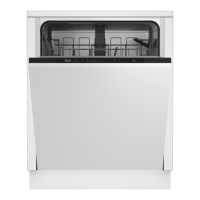
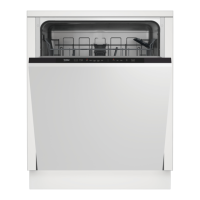
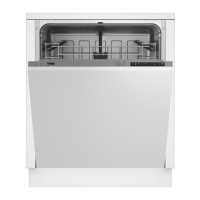
This document is a user manual for a Beko dishwasher, specifically models DIN16X10 and DIN16R10. It provides comprehensive instructions for safe operation, installation, preparation, usage, maintenance, troubleshooting, and warranty information.
Function Description
The Beko dishwasher is designed for domestic use to clean household dishes efficiently. It incorporates a water softening system to adjust for varying water hardness, ensuring optimal washing, rinsing, and drying performance. The appliance features multiple washing programs tailored for different soiling levels and dish types, along with auxiliary functions to optimize time, water, and power consumption. A fan drying system is included for efficient drying.
Important Technical Specifications
The dishwasher operates on a power input of 220-240 V at 50 Hz. Total power consumption ranges from 1800-2100 W, with the heater power consumption being 1800 W. The total current draw depends on the model, typically 10 A. The drain pump power consumption is 30 W. Water pressure requirements are between 0.3-10 bar (3-100 N/cm² or 0.01-1.0 Mpa). The product complies with EU WEEE Directive (2012/19/EU) and RoHS Directive (2011/65/EU), indicating its adherence to environmental and safety standards. The appliance is designed to be earthed for electrical safety.
Usage Features
Control Panel: The control panel includes an On/Off Key, Rinse Aid Indicator, Programme Indicators (which also serve as Water Overflow Warning flashes), Tablet detergent function, Half Load function, Delayed Start Key, Time Delay Countdown Indicator, Start/Pause/Cancel Key, Salt Indicator, and Water Cut-off Indicator.
Program Selection: Users can select programs by pressing the desired program key. The manual provides a "Programme Table" with details on various programs like Eco (50°C), Auto (40-65°C), Intensive (70°C), Quick&Shine (60°C), Mini (35°C), and Prewash, outlining their cleaning temperatures, degree of soiling suitability, prewash/wash/dry stages, duration, water consumption, and energy consumption.
Auxiliary Functions:
- Half Load: Allows operation with a partial load, saving water and power.
- Tablet Detergent: Optimizes drying performance when using all-in-one detergents (2in1, 3in1, etc.), adapting to tap water hardness. This function remains active for subsequent programs if used previously, and can be deactivated.
- Time Delay: Enables delaying the program start up to 9 hours in 3-hour increments, useful for off-peak electricity tariffs.
- Warning Sound Volume: Adjustable for end-of-program alerts.
- Inner Illumination (model dependent): Provides interior lighting when the door is opened, with adjustable settings.
Loading Dishes:
- Coarse food remnants should be wiped off before loading.
- Thin, narrow pieces should be placed in the middle sections of baskets.
- Heavily soiled and larger items go in the lower basket; smaller, delicate items in the upper basket.
- Hollowed dishes (bowls, glasses, pans) should be placed upside down to prevent water accumulation.
- Sharp and pointed items (forks, knives) must be placed upside down or horizontally to prevent injury.
- Dishes should be unloaded from the lower basket first, then the upper basket.
Basket Configuration:
- Cutlery Basket: Movable to create more space in the lower basket for different dish sizes.
- Upper Basket Height Adjustment: Allows adjusting the upper basket to three positions (lower, middle, upper) to accommodate different heights of glasses, cups, etc., whether empty or loaded.
- Upper Basket Multipurpose Service Rack: An accessory for washing extra-long items like ladles and bread knives, which can be removed if not needed.
- Collapsible Upper Basket Wires: Wires in the upper basket can be folded down to create larger spaces for dishes.
- Collapsible Lower Basket Tines: Foldable tines in the lower basket provide flexibility for placing large items like pans and bowls.
Detergent and Additives:
- Only dishwasher-safe detergents, rinse aids, and softening salts should be used.
- Detergent (powder, liquid/gel, or tablet) should be added just before operating the machine.
- The detergent dispenser has level markings (15 cm³, 25 cm³) for powder detergent. One tablet is sufficient for tablet detergents.
- Special softening salts (granule or powder form) are required for the water softening system. The salt reservoir should be filled with 1 litre of water during initial use, then refilled with salt when the Salt Indicator appears. Salt should be added before starting the machine to prevent corrosion.
- Rinse aid increases drying efficiency and prevents water/lime stains. The rinse aid reservoir should be filled to the "MAX" level when the Rinse Aid Indicator appears. Rinse aid dispensing level is adjustable.
Warnings and Indicators:
- Salt Indicator (S): Illuminates when softening salt needs refilling.
- Rinse Aid Indicator (*): Illuminates when rinse aid needs refilling.
- Water Cut-off Warning: Flashes if mains water is cut off or the inlet tap is closed, pausing the program until water supply is restored.
- Overflowing Warning: Flashes if the machine intakes too much water or has a leak, activating a safety algorithm to discharge water. A persistent flash indicates a permanent fault.
- Floor Illumination (model dependent): A light projected onto the floor indicates the machine is in a washing phase, turning off when complete.
Maintenance Features
Regular maintenance is crucial for extending product life and reducing problems.
- Unplug and Turn Off Tap: Always unplug the product and turn off the tap before any cleaning procedures.
- No Abrasive Substances: Do not use abrasive cleaners.
- Outer Surface Cleaning: Wipe with a mild cleaning material and damp cloth. The control panel should only be wiped with a slightly damp cloth.
- Interior Cleaning: Run a program with or without detergent, or drain any remaining water. If water cannot be drained, remove and clean the filters.
- Filter Cleaning: Filters (micro filter, coarse filter, metal/plastic filter) should be cleaned at least once a week. They can be removed by turning counter-clockwise and separating components for cleaning under running water with a brush. Incorrect filter placement reduces washing efficiency.
- Hose Filter Cleaning: The filter attached to the water inlet hose should be checked and cleaned regularly to prevent damage from impurities in the water supply. This involves turning off the tap, removing the hose, cleaning the filter under running water, replacing it, and re-installing the hose.
- Impeller Cleaning: The lower and upper impellers should be checked and cleaned at least once a week to ensure efficient operation. Clogged holes can be cleared by removing and cleaning the impellers. The upper impeller's nut must be tightened well after re-installation.
Troubleshooting
The manual provides a detailed troubleshooting guide for common issues:
- Machine does not start: Check power cable, fuse, water inlet tap, door closure, and On/Off button.
- Dishes not washed clean: Check dish loading, program suitability, impellers (stuck or clogged), filters (clogged or incorrectly installed), basket overloading, detergent storage, detergent quantity, rinse aid quantity, and detergent dispenser lid closure.
- Dishes not dry at end of cycle: Check dish loading (to prevent water accumulation), rinse aid quantity, immediate unloading (wait 15 minutes for cooling), program suitability (longer duration for better drying), and surface quality of kitchen utensils (Teflon may retain water droplets).
- Tea, cafe or lipstick stains remain on dishes: Check program suitability and surface quality of kitchen utensils.
- Lime traces/misty appearance on dishes/glassware: Check rinse aid quantity, water hardness setting, and salt leakage.
- Different odour in the machine: New machines may have a peculiar odour that fades. Check for clogged filters, dirty dishes left for days (run prewash, leave door ajar), or use odour removers.
- Rust, discoloration or surface deterioration on dishes: Check for salt leakage, salty food remnants left for long periods, ungrounded electrical installation, use of intensive cleansers (bleach), metal items used for unintended purposes, and low-quality stainless steel cutlery or already corroded items.
- Detergent remains in detergent dispenser: Check if dispenser was damp, detergent added too early, dispenser lid opening obstructed, detergent storage, and clogged impeller holes.
- Decorations/ornaments on kitchen utensils erased: Decorated items, lustre porcelains, and some glassware/porcelain are not suitable for dishwashers.
- Dishes scratched: Aluminium items should not be washed. Check for salt leakage, low water hardness setting, and improper dish placement (dishes striking each other).
- Foam forms in the machine: Caused by hand-wash detergent or spilled rinse aid.
- Kitchen utensils broken: Check dish loading and basket overloading.
- Water remains in the dishwasher at the end of the programme: Check for clogged filters and discharge hose.
If problems persist after following the troubleshooting steps, users are advised to contact their dealer or an Authorised Service Agent and not attempt repairs themselves.

 Need help?
 General

 To Next Page