What kind of ovenware can be used.
Microwave function:
• Microwave energy can pass through glass, china, plastic, clay pots and paper containers to be absorbed into the
food.
• Microwave energy cannot pass through metal containers as the metal reflects the microwaves.
• Therefore, it is best to use heat-resistant glass containers in the microwave.
• If the glass or china cookware has a metallic trim (like a gold leaf decoration) or contains metal (like lead crystal),
then it cannot be used in the microwave.
• Microwave energy heats the moisture in the food directly rather than heating the cookware. However, the
cookware will become hot eventually from the heat radiated from the food. Therefore, you must use oven gloves
when removing the cookware from the oven.
• To test if an item of cookware is suitable to use in microwave mode, place it on the oven turntable with a cup of
water next to it. Start the microwave on maximum power for 20 seconds. At the end of the test, the water in the
cup should be warm (because it has absorbed the microwave energy) and the cookware item should be cool. The
cookware item is then suitable to use in the microwave. If the cookware item was warm and the water was cold,
then that would indicate that the cookware item had absorbed the microwave energy and would not be suitable
to use for microwave cooking. If you notice any arcing during the test, switch the oven off immediately.
Grilling:
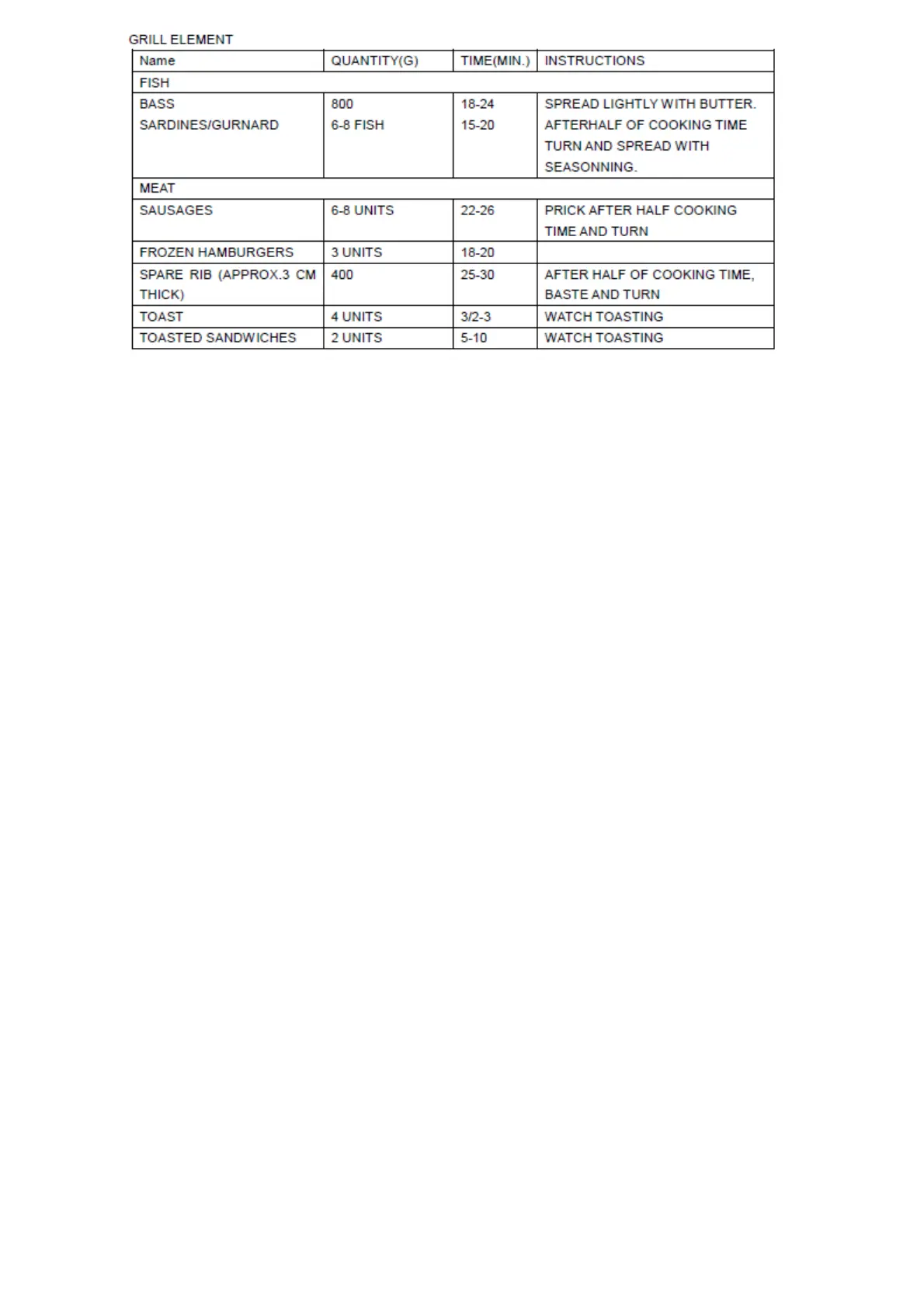
• For grilling and convection fan oven, cookware needs to be heat-resistant to at least 300°C.
• Plastic containers are not suitable for grill, convection or grill-combination, convection-combination or grill-
convection-combination functions.
Combination functions:
• For combination cooking functions, it is best to use heat-resistant glass cookware.
• Heat-resistant glass will be able to cope with the high temperatures from the grill and/or convection oven and will
also allow microwave energy to pass through the glass into the food.
Aluminium containers and foil:
• Exercise caution if using aluminium containers or aluminium foil in microwave mode.
• Always follow the cooking instructions on the food packaging.
• The aluminium containers must not be more than 3cm high, and must be kept at least 3cm away from the oven
cavity walls.
• Remove any aluminium lid or top from the container.
• Food cooked in an aluminium container will take longer to cook as the microwaves can only penetrate the food
from the top. It is better to take the food out of the aluminium container and place it into a dish suitable for
microwave cooking.
• Aluminium foil must not come into contact with the oven cavity walls as this may cause arcing.
• Never use aluminium foil in grill or grill-combination modes as it can reflect the heat from the grill element leading
to excessively high temperatures and the risk of fire.
• For covering food during microwaving, it is best to use glass or plastic lids or covers, or microwave-safe cling film.
This will help to preserve moisture and flavours in the food.
• These should have vents to allow steam and pressure to escape.
• Plastic cooking bags should be left open or lightly closed with plastic clips in microwave mode.
• If heating baby bottles or baby food in jars, the tops/lids must be removed to prevent the bottle/jar from bursting.


 To Next Page