21
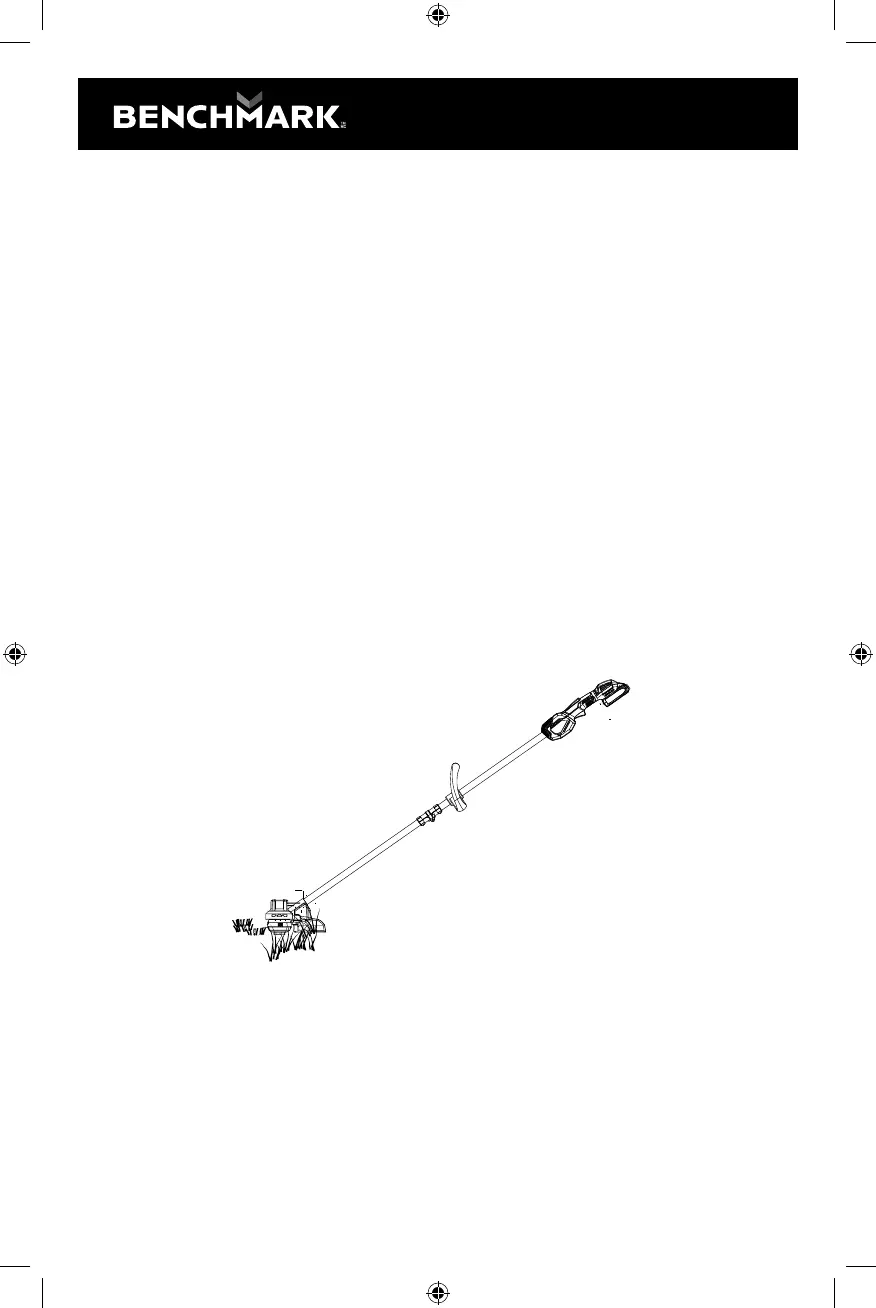
FIG. 21
NOTE: The trimming line will easily remove grass and weeds from around walls,
fences, trees and ower beds, but it can also cut the tender bark of trees or shrubs,
scar fences, etc. Be extremely careful when trimming near objects that can be easily
damaged by the trimmer line.
Trim grass only when it is dry. Trim during the middle of the day when the grass is
completely dry. Trimming wet grass will prevent the trimmer from cutting cleanly.
Trimming wet grass will also shorten the battery life.
Always use two hands while operating the trimmer. Use one hand on the main
handle to operate the switches and the other on the assist handle.
Use a semi-circular sweeping motion, with the trimmer head tilted slightly
downward where the trimmer line is cutting the grass.
Move the trimmer from right to left, feeding it into the uncut grass on the left side.
This motion will cause the trimmer to throw the cut grass away from the operator,
reducing the amount that is thrown toward the operator.
Maintain a consistent motion and speed when moving the trimmer through the
grass. This will provide a more even cut.
Hold the trimmer about 3" (7.6 cm) above the ground to avoid “scalping” and to
prevent premature wear on the line and the spool cover (Fig. 21).
If the grass it taller than 6" (15.2 cm), cut the grass in stages to maintain motor
speed and to prolong the battery run time.
If the cutting circle is getting too small, the trimmer line may be either jammed on
the spool or has run out. Manually advance the line as described on page 18. If that
fails, see “CORRECTING A JAMMED OR SHORT TRIMMER LINE” below.
When nished trimming, clean the underside of the guard and the spool.
Advance the line as outlined on page 18 to ensure the line is the correct length
for the next trimming.
5073-039f EnProdManual P.indd 215073-039f EnProdManual P.indd 21 2020-12-17 1:59 PM2020-12-17 1:59 PM


 To Next Page