8
Some brake failures result from the use of rivets which are too short, too long, or the wrong diameter. Incorrect setting of the
riveting machine may induce other types of failures. The correct length rivet must be selected for each application. A
variation in shoe table thickness may require a different length rivet.
The solid portion of the rivet should end just at the inner surface of the shoe. The hollow portion of the rivet should protrude
past the inner surface of the shoe.
The proper size rivet must be used to completely fill the rivet hole.
Brass plated steel rivets are recommended but cartridge brass rivets can be used if so desired.
The riveting machine must be adjusted so that the roll of the rivet is complete, but the rivet should not split. Always use a roll
set, never a star set, when riveting brake linings. A star set does not compress the rivet and expand it to fill the hole.
Consequently, the lining may work loose in service.
FOUNDATION BRAKE TROUBLESHOOTING CHART
SYMPTOM CAUSE REMEDY
1. Degraded brake A. Too much push rod free travel. A. Adjust brakes.
performance. B. Severely glazed or worn out linings. B. Deglaze linings or replace.
C. Grease or oil on linings. C. Replace linings.
D. Worn, heat checked, cracked drums. D. Replace part.
E. Push rod length too long. E. Adjust device, shorten push rod
length.
F. Air chamber in wrong position in F. Reposition.
G. Broken or bent parts. G. Replace part.
H. Cam flipover, drum I.D. too large. H. Replace drum.
I. Flat spots on cam or rollers. I. Replace flat-spotted parts.
2. Slow brake A. Cam shaft bushings binding. A. Clean and lubricate. Check for
application. seal leakage.
3. Slow brake release. A. Binding cam shaft and bushings. A. Clean and lubricate.
B. Weak or broken shoe return spring. B. Replace part.
C. Flat spotted cam or rollers. C. Replace flat-spotted parts.
4. Grabbing or pulling A. Grease, oil or dirt on lining. A. Replace lining.
B. Glazed linings. B. Deglaze lining or replace.
C. Brake linings not a balanced set, C. Replace linings.
different friction codes, or lining brand.
D. Loose or broken linings. D. Replace linings.
E. Brake drum out-of-round. E. Turn, per manufacturer’s
specifications.
F. Defective brake drum. F. Replace part.
G. Clevis pin or cam shaft binding at one G. Clean and lubricate.
or more wheels.
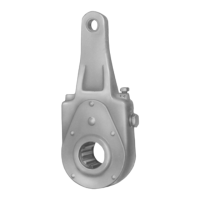
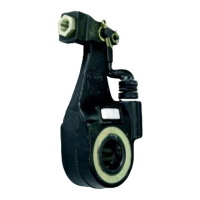
H. Defective slack adjuster. H. Replace part.
I. Uneven brake adjustment (side to side) I. Adjust brakes.
J. Broken or bent parts. J. Replace part.
K. Loose spider or drum mounting bolts. K. Retorque, per manufacturer’s
specifications.
L. Different air chamber size or slack L. Use same size and materials on
all adjuster length (side to side).
brakes.




 To Next Page