27
EN
5) SYSTEM TYPES
Different types of installation are possible to choose from based on the characteristics of the door (Fig. 3):
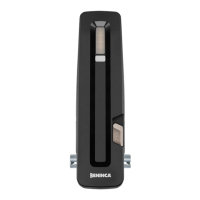
- 1 MARK motor with incorporated control panel with central assembly for doors up to 8mq (A).
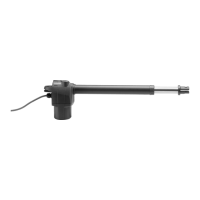
- 1 MARK motor with incorporated control panel + 1 MARK.SC motor without control panel with side assembly, for doors up to 12mq
or doors with pedestrian entrance (B).
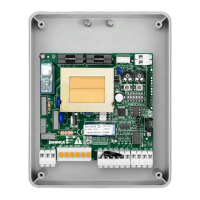
- 1 Wall control panel Mod. CP.MARK motor + 2 MARK SC motors without control panel with side assembly, for doors up to 12mqor
doors with pedestrian entrance (C). The wall control panel can be useful to simplify wiring in the event many accessories are used.
6) EMERGENCY MANUAL MANOEUVRE
If there is no power supply or a fault, you can release the door to move it manually (Fig. 11).
• Turn the unlocking lever clockwise to unlock the automation, to make it manually moveable.
• To restore automatic operation, turn the lever clockwise until it locks, restoring the initial position.
7) MOUNTING ACCESSORIES (FIG.1)
Central assembly:
- plate for attachment to overhead door: short MARK.P49 (490 mm) or long MARK.P160 (1600 mm);
- pair of galvanised 20x20 square tubes with MARK.T180 bushing (1800 mm) with the adjustable return bushes;
- pair of straight arms with MARK.D sleeve (600 mm) or in case of reduced space curved arms 6 mm thick (MK.D6) or 10 mm thick (MK.
D10).
Side mounting:
- plate for attachment to overhead door: short MARK.P49 (490 mm) or long MARK.P160 (1600 mm);
- pair of galvanised square tubes 20x20 with bushing MARK.T22 (220 mm)
- pair of straight arms with welded 20 x 20 square tube MARK.DT (600 mm).
- pair of straight arms with MARK.D sleeve (600 mm) or in case of reduced space curved arms 6 mm thick (MK.D6) or 10 mm thick (MK.
D10).
Important
If the space between the door frame and the up-and-over arm is less than 15 mm, it is necessary to use the curved arms MK.D6 and
MK.D10 available in two different thicknesses (MK.D6: 6 mm and MK.D10:10 mm) (fig.12).
8) ADDITIONAL ACCESSORIES
- Outdoor release with customised key MARK.E.
- Inside/outside handle release with customised key MARK.SE.
- MK.MS flush release (fig.15).
Note: If the overhead door is the only access point to the garage, a flush release system must be installed from the outside. In the case
of 2 motors, a flush release must be installed for each motor. Batteries cannot be used as an opening system from the outside because
they do not guarantee door movement in the event of a fault.
The CP.MARK control unit has a built-in battery charging circuit; the batteries must be housed in an external container.
9) INSTALLATION
1) Having identified the axis of rotation of the overhead door A, determine the R-axis of the gearmotor output shaft in order to fix the
gearmotor fixing plate in the correct position Fig. 4.
The choice of the long plate mod. MARK.P49 or short plate mod. MARK.P160 depends on the most suitable anchorage points, near
steel uprights or door reinforcements (fig 4 ref. F and G)
The fixing position of the geared motor varies depending on the type of door (Fig. 5):
- P1 Counterweighted overhead door
- P2 Counterweighted, non-overflowing overhead door
- P3 Swinging counterweighted door
In the case of a P1-type door, the R-axis must be lower by between 70 and 100 mm (Fig. 5-P1) than the fulcrum A of the door's existing arm.
In the case of a P2-type door, the R-axis must be 100 to 110 mm lower (Fig. 5-P2) than half of the total door height.
In the case of a P3 type door, as can be seen from the drawing, the R-axis must be lower by a distance of between 130 - 150 mm (Fig.
5-P3) from the point where the door hinge is located. In this type of door, the motor must be installed turned by 180°.
P2 and P3 installations, depending on the height of the R-axis, may require the long version of the arm (Art. MARK.DL), to be cut on site
according to the position of the installation axis
2) Fix plate P (Fig.6) to the frame of the overhead door or to the wall using screws or rivets.
ATTENTION: If the MARK.D arm is to be fitted between the upright and the arm of the up-and-over door, the available space must be
assessed; if this is insufficient, use the curved arm MK.D6 and MK.D10, which allow work to be carried out on axis with the arm of the
up-and-over door (Fig. 7).
If the X gap is 15 mm or more, the MARK.D straight telescopic arm can be used.
If the space X is less than or equal to 15 mm, the straight telescopic arm MARK.C6 6 mm thick or mod. MARK.C10 10 mm thick can be
used, depending on the space available and the size of the door.
3) Provisionally fix the bracket S with the square tube T threaded into the bushing both in the latter and in the hole of the gearmotor's
through-spline shaft (fig. 8), checking that the bushing on the gearmotor is orientated as shown in figure 8.
Measure dimension X on site (Fig. 10). Cut off the excess part of the tube MARK.T180 so that it is aligned with the arm MARK.C and
parallel to the upright of the overhead door.
Keep in mind that the tube must fit inside the MARK for about 65mm.
Now fix bracket S, taking care to level the tube MARK.T180. The latter must also be parallel to the rocker; use the adjusting screws V
for this (Fig. 10).


 To Next Page
 Loading...