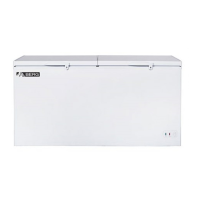
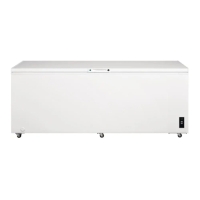
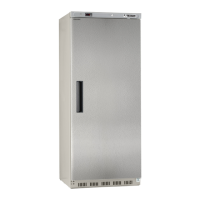
This document is a user manual for Berg Chest Freezers, covering models BD155, BD215, BD305, BD450, BD550, BD750, and BD950. The manual provides essential information for the safe operation, installation, usage, and maintenance of these chest freezers.
Function Description:
The Berg Chest Freezer is designed for the long-term storage of frozen food. It operates by maintaining a low internal temperature to preserve food quality. The unit features a temperature control knob to adjust the cooling intensity, a green "Power" light to indicate electrical connection, and a red "Alarm" light that illuminates when the internal temperature rises above -11°C (12.2°F). The freezer is intended for freestanding use and should not be recessed or built-in. It requires manual defrosting when frost buildup reaches a thickness of ¼ to ½ inch.
Important Technical Specifications:
The manual provides a table of specifications for each model, including:
- External Dimensions (W x D x H):
- BD155: 28.94 x 23.23 x 33.46 inches (735 x 590 x 850 mm)
- BD215: 35.24 x 23.23 x 33.46 inches (895 x 590 x 850 mm)
- BD305: 44.29 x 23.23 x 33.46 inches (1125 x 590 x 850 mm)
- BD450: 50.20 x 29.53 x 33.46 inches (1275 x 750 x 850 mm)
- BD550: 60.43 x 29.53 x 33.46 inches (1535 x 750 x 850 mm)
- BD750: 81.69 x 29.53 x 33.46 inches (2075 x 750 x 850 mm)
- BD950: 79.92 x 35.83 x 37.40 inches (2030 x 910 x 950 mm)
- Capacity:
- BD155: 5.4 Cu Ft / 152 L
- BD215: 7 Cu Ft / 197 L
- BD305: 8.9 Cu Ft / 252 L
- BD450: 13.0 Cu Ft / 368 L
- BD550: 16.2 Cu Ft / 459 L
- BD750: 23.7 Cu Ft / 670 L
- BD950: 30.6 Cu Ft / 867 L
- Manual Defrost: All models feature manual defrost.
- Voltage / Frequency: 115V/60Hz for all models.
- Horsepower (HP): Ranges from 0.09 HP (BD155) to 0.26 HP (BD950).
- Temperature Range F°/C°: -10° to 10° F (-23° to -12° C) for all models.
- Factory Temperature Setting: 0°F (-17.8°C) for all models.
- Unit Weight: Ranges from 61.7 lbs (28 kg) for BD155 to 194 lbs (88 kg) for BD950.
- Shipping Weight: Ranges from 68.3 lbs (31 kg) for BD155 to 254 lbs (115 kg) for BD950.
The electrical connection requires a standard 115Volt / 60Hz electrical outlet with a three-prong ground. The fuse or dedicated circuit breaker size should be 15 amperes.
Usage Features:
- Installation: Before connecting to power, the freezer should stand upright for approximately 2 hours. The interior should be cleaned with lukewarm water and a soft cloth. It must be placed on a strong, level floor, allowing 5 inches of space at the back and sides for proper air circulation. The freezer should be located away from direct sunlight and heat sources, and in a well-ventilated area with ambient temperatures between 55°F (13°C) and 90°F (32°C). After plugging in, allow 4 hours for the unit to cool down before placing food inside.
- Temperature Control: The temperature control knob has settings from "1 (warmest)" to "7 (coldest)". Setting "7" is a quick-frozen mode and should not be used frequently. Turning the knob to "0" shuts off the cooling cycle but not the electrical power; the unit must be unplugged to completely shut off power. If the unit is unplugged, loses power, or is turned off, a 3 to 5 minute delay is required before restarting. Large amounts of room-temperature food can temporarily lower cooling efficiency. Adjustments to the thermostat should be made one numerical increment at a time, allowing several hours for stabilization.
- Food Storage: When loading, freeze only three pounds of fresh food per cubic foot of freezer space at one time, distributing packages evenly. Storage time for frozen food is generally up to three months, and recommended storage times should not be exceeded. Pre-packed commercially frozen food should be stored according to manufacturer's instructions. Storage baskets are provided for organization.
- Energy-Saving Tips: Locate the freezer in the coolest area of the room, away from heat sources and direct sunlight. Allow hot foods to cool to room temperature before placing them in the freezer. Wrap foods properly and wipe containers dry to reduce frost buildup. Avoid lining storage bins or baskets with aluminum foil, wax paper, or paper toweling, as this interferes with cold air circulation. Organize and label food to minimize door openings and search times.
Maintenance Features:
- Defrosting: Defrost the freezer when frost on the walls is ¼ to ½ inch thick.
- Remove frozen food and place it in another cooling device.
- Turn the thermostat knob to "0" and unplug the freezer.
- Remove the drain plug on the freezer floor.
- Place a shallow pan outside the drain outlet to collect defrost water.
- Clean and thoroughly dry the interior.
- Replace the inside drain plug.
- Close the door and plug in the freezer.
- Reset the thermostat to the desired setting.
- Allow several hours for the cabinet to cool down before returning food.
- Caution: Do not use boiling water or sharp/metallic instruments for defrosting, as this can damage plastic parts or cooling coils and void the warranty. A plastic scraper is recommended. Pouring warm (not boiling) water can speed up melting.
- Cleaning:
- Unplug the freezer and remove food and baskets.
- Wash the inside with a damp warm cloth moistened with a solution of water and baking soda (2 tablespoons per quart of water).
- Wash storage baskets with a mild detergent solution.
- Keep the door gasket (seal) clean for efficient operation.
- Clean the exterior with mild detergent and warm water, then dry with a soft cloth.
- Vacuum condenser coils at the back when dusty or dirty.
- Clean the unit each time it is defrosted to keep it odor-free and efficient.
- Vacations:
- Short vacations (less than three weeks): Leave the freezer operating.
- Long vacations (several months): Remove all food, unplug the power cord, clean and dry the interior thoroughly. To prevent odor and mold, leave the door open slightly (blocked if necessary) or remove it. Exercise extreme caution with children.
- Power Failure: If a power failure occurs, frozen foods will stay frozen for at least 24 hours if the freezer remains closed. For longer outages, pack 7-8 pounds of dry ice into the freezer every 24 hours. Always wear gloves and use caution when handling dry ice.
Safety Precautions:
The manual emphasizes important safeguards, using "DANGER," "WARNING," and "CAUTION" labels.
- Electrical Safety: Plug into a grounded 3-prong outlet; do not remove the grounding prong, use adapters, or extension cords. Do not connect/disconnect the plug with wet hands. Unplug before cleaning or servicing. Ensure the power cord is secured and not dangling. Never unplug by pulling the cord; grip the plug firmly.
- Child Safety: Never allow children to operate, play with, or crawl inside the freezer. When disposing of an old freezer, remove the doors and leave shelves in place to prevent child entrapment.
- Fire/Explosion Hazard: Do not clean parts with flammable fluids. Do not store or use gasoline or other flammable vapors/liquids near the appliance.
- General Safety: Use two or more people to move and install the freezer. Do not attempt to repair or replace parts unless specifically recommended in the manual; refer servicing to a qualified technician. Keep fingers out of "pinch point" areas around the door. Do not use the apparatus for other than its intended purpose.
The manual also includes troubleshooting guidance for common issues such as the freezer not operating, compressor turning on/off frequently, and temperature problems. It concludes with a 1-year limited replacement warranty for Berg Chest Freezers in the continental United States, outlining coverage and exclusions.


 To Next Page
 General