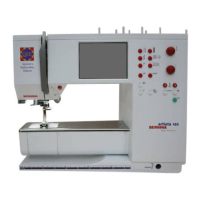
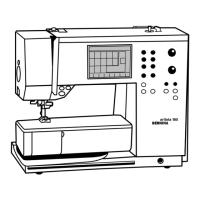
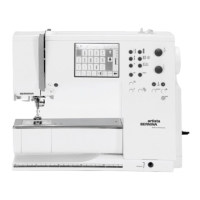
This document is a service manual for the BERNINA artista series sewing and embroidery computers, specifically models 165, 170, 180, and 185. It provides instructions for minor repairs, adjustments, and diagnostic procedures.
Function Description:
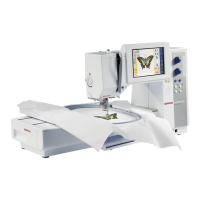
The BERNINA artista series are advanced sewing and embroidery computers designed for a wide range of textile work. They integrate both mechanical and electronic components to offer precise control over stitching and embroidery. The machines feature a main motor for general sewing operations and stepping motors for fine control of stitch width, length, and embroidery patterns. The electronic system, comprising an L-print (power unit) and an S-print (control unit), manages motor control, power supply, and communication with the user interface. The S-print, equipped with a micro-computer, processes signals from the foot control and controls stepping motors to achieve desired stitch patterns and embroidery movements. When switched on, stepping motors are positioned by the micro-computer to a defined zero position, allowing for accurate stitch selection. For embroidery, the machine moves the hooped material using X and Y-carriages, while needle movement is reduced to up and down. The artista supplies embroidery data to the embroidery module, and the S-print translates this for the stepping motors. The embroidery module also returns sensor and carriage position data for stitch calculation.
Important Technical Specifications:
The BERNINA artista series offers a variety of technical specifications depending on the model:
- Screen: LCD (new for artista 185) with graphical display. Sizes range from 100 x 75.5 mm to 94 x 71 mm.
- Resolution: 1/4VGA/320x240 dots.
- Backlighting: CFL (Compact Fluorescent Lamp) for most models, white for artista 185.
- Control: Touch screen for contrast setting and direct stitch selection.
- Stitch Length: Forwards 5 mm (0.05 mm increment), reverse 5 mm.
- Stitch Width: 5.5 mm for 165/170, 9 mm for 180/185 (0.11-0.18 mm increment).
- Needle Positions: 11.
- Sewing Directions: 2 (F./B.) for 165/170, 16 for 180, 16/4 for 185.
- Total Stitches: 180 for 165/170, 376 for 180, 338 for 185.
- Decorative Stitches: 61 for 165/170, 208 for 180, 279 for 185.
- Alphabets/Monogrammes: 3 for 165/170, 5 for 180, 4+3 for 185.
- Motor: DC/65 W/30V.
- Sewing Speed: 120-900 S.p.m. (100-900/min for artista 185).
- Embroidery Speed: 120-750.
- Hook System: BERNINA CB for 165/170, BERNINA rotary for 180/185.
- Needle System: 130/705H (130/707H TCN for 165/170).
- Weight (excl. accessories): Approximately 9.7 kg.
- Through Space: 100 x 210 mm (110 x 210 mm for artista 185).
- Power Supply: Universal L-print 100-240V, max 90W. Supplies 5V (logic), 12V (sewing light), and 30/33V (drive motor, bobbin winder, stepping motors).
Usage Features:
The BERNINA artista machines offer a range of user-friendly features:
- Automatic Basic Settings: For optimal stitch performance.
- Optimum Settings Displayed: Guides users to the best settings.
- Selected Stitch/Function Display: On-screen information.
- Clear (clr) Button: For easy reset.
- Balance: Electronic control for stitch balance.
- Pattern End: Automatically finishes patterns.
- Mirror Image (lateral): Flips patterns horizontally.
- Permanent Reverse Sewing: For reinforcing stitches.
- Memory (mem) and Permanent Save: Stores custom settings and patterns.
- Securing Pattern Begin/End: Ensures neat start and finish.
- Built-in Needle Threader: Simplifies threading.
- Hopper Mechanism: For easy bobbin access.
- Adjustable Presser Foot Pressure: Adapts to different fabric types.
- Lower Thread Control: Available on artista 180/185.
- Needle Stop Up/Down: Controlled via foot control.
- Roll-up Foot Control Cable: For convenience.
- Integrated Service Programs: For diagnostics and adjustments.
Maintenance Features:
The service manual details various maintenance and adjustment procedures:
- Removing Covers: Step-by-step guide for accessing internal components, including top, head, L-print, and free-arm covers.
- Tensioning Drive Belts: Instructions for adjusting tension of both base shaft and motor drive belts.
- Checking Bobbin Winder Unit: Ensures proper thread winding and filling.
- Checking Presser Foot Fixation and Height: Adjustments for 7.5 mm gauge.
- Checking Darning Foot Height: Adjustments for 0.5 mm gauge.
- Checking Needle Position (Needle/Hook Distance): Ensures 0.01-0.05 mm distance.
- Checking Needle Plate Position: Centers the needle in the stitch hole.
- Checking Needle Position (Zig-Zag Stitch): Adjusts lateral spacing.
- Checking Synchronization Disc: Ensures correct pinning position.
- Checking Feed-Dog Position and Height: Ensures equidistant positioning and correct height (0.05 mm higher at front).
- Checking Thread Passage Play: Ensures 0.3 mm play between hook and hook driver (artista 165/170).
- Checking Driver Position in Hook Race: Ensures 0.1-0.15 mm behind front edge of hook race (artista 165/170).
- Checking Radial Play of Driver: Eliminates play between rack and pinion (artista 165/170).
- Checking Hook Adjustment Loop Lift/Synchronization: Ensures hook point is flush with right edge of needle.
- Checking Needle Height: Sets hook tip 0.2 mm above/below needle eye.
- Checking Bobbin Case Stopper Position: Ensures flushness with bobbin case carrier and 0.3 mm clearance (artista 180/185).
- Checking Feed-Dog Synchronization (Feed-Dog Lift and Advance): Ensures correct pinning and lowest position.
- Checking Basic Position of Balance: Adjusts the stitch length crank.
- Basting and Automatic Long Stitch Unit: Checks needle bar guide, release pin position, and decoupling.
- Basic Adjustment to Knee Lifter Lever: Ensures vertical alignment and proper tension release.
- Automatic Threader: Checks threader head position.
- Lower Thread Tension (artista 165/170): Adjusts bobbin case tension using a weight gauge.
- Upper Thread Tension (artista 165/170, 180/185): Basic and fine tuning using a weight.
- Thread Regulator Spring: Checks tension (12-15g) and position (1.6mm distance).
- Thread Cutter (artista 185): Checks for deformities, clean cut, and clamp magnet function.
- Diagnostic Instructions: Emphasizes safety, especially regarding dangerous voltages and electrostatic discharges.
- Test Programs: A comprehensive suite of tests for various functions, including stepping motors, LCD/touch screen, speed equalization, thread detectors, embroidery unit, buttonhole calibration, basting solenoid, clamp magnet, and thread cutter.
- Tests in Basic Position: Checks for P-print, buttonhole sensor, RET-print, bobbin winder switch, presser foot lowering, feed-dog drop, thread cutter key, threader sensor, and foot control functions.
- Further Information Displayed: Shows motor power, hours sewn, and stitch counter.
- Test for Cable Connection S-print to L-print: Checks continuity of wires.
- Embroidery Module Function and Troubleshooting: Guides through diagnosing issues related to hardware, motif, and user error.
- Test Sample Evaluation: Provides a table to evaluate embroidery results against normal conditions and identify possible faults.
- Embroidery Unit Cover Removal: Instructions for Y-carriage cover, top right/left side covers.
- Tensioning Belt Drive of X and Y-carriages: Adjusts belt tension for smooth movement.
- Exchanging S-print of Embroidery Unit: Instructions for replacing the control board.
- Exchanging Y-carriage Stepper Motor: Steps for replacing the motor, ensuring no undue play.
- Exchanging X-carriage Stepper Motor: Steps for replacing the motor, ensuring no undue play.
- Removing Covers a185: Detailed instructions for accessory box, right/left covers, and Y-carriage cover.
- Main Cable a185: Disassembly and assembly of the main cable.
- Free Arm Sensor and Cable a185: Disassembly and assembly of the free arm sensor and cable.
- S-Print a185: Detailed disassembly and assembly of the S-print.
- X-Carriage Stepping Motor: Disassembly and assembly of the X-carriage stepping motor, emphasizing setting without play.
- X-Carriage Belt and Gear Wheels: Disassembly and assembly of the X-carriage belt and gear wheels, including tensioning.
- Y-Carriage Sensor a185: Disassembly and assembly of the Y-carriage sensor.
- Y-Carriage Stepping Motor a185: Disassembly and assembly of the Y-carriage stepping motor, emphasizing setting without play.
- Y-Carriage Belts and Gear Wheels: Disassembly and assembly of the Y-carriage belts and gear wheels, including tensioning.
- Set Hoop Support on Y-Profile: Checks and adjusts play on carriage guide rollers.

 Need help?
 General



 To Next Page