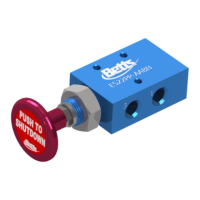
INSTALLATION AND MAINTENANCE MANUAL
Emergency/Remote Shutdown Air Valves
Betts Industries Inc. ▪ 814·723·1250 ▪ 1800 Pennsylvania Ave. West ▪ Warren, PA 16365 ▪ www.BettsInd.com
Print Date: 11/21/2023 This form is considered uncontrolled 24 hrs. after print date.
5.2 Field Testing (monthly testing)
5.2.1 Visual inspection:
5.2.1.1 Inspect exterior of valve for corrosion or damage. Pay special
attention to the area where the stem moves in and out of the bushing.
5.2.1.2 Inspect for any air leaking at any of the fittings, at the stem or end cap.
5.2.1.3 Look for leakage of fluid out of exhaust port. This could be an
indication of a seal failure in one of the Emergency Valves or Air
Manifold. Investigate and repair the problematic component.
5.2.1.4 Ensure the end cap is snapped into the back of the valve and ensure
that the vent hole in the end cap is not plugged or blocked.
5.2.1.5 Inspect exhaust port and make sure it is unobstructed and oriented in
an area that is protected from weather, debris or moisture.
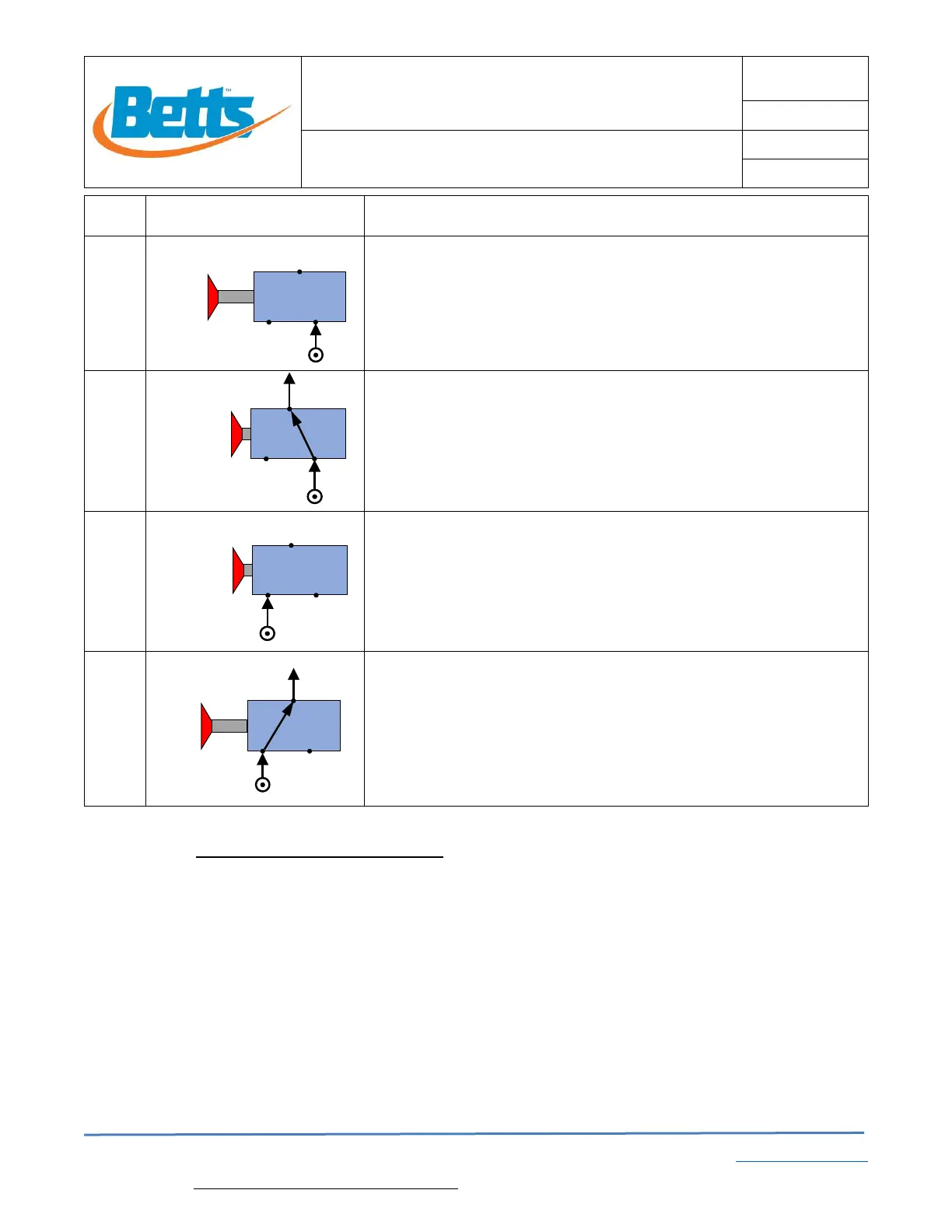
1. Port 1 blocks pressure.
2. No leakage at port 2 or 3.
3. No leakage between the End Cap and the Body or out the
hole in the End Cap.
4. No leakage between the stem and the front of the body.
1. Port 2 expels pressure.
2. No leakage at port 3.
3. No leakage between the End Cap and the Body or out the
hole in the End Cap.
4. No leakage between the stem and the front of the body.
1. Port 3 blocks pressure.
2. No leakage at port 1 or 2.
3. No leakage between the End Cap and the Body or out the
hole in the End Cap.
4. No leakage between the stem and the front of the body.
1. Port 2 expels pressure.
2. No leakage at port 1.
3. No leakage between the End Cap and the Body or out the
hole in the End Cap.
4. No leakage between the stem and the front of the body.


 To Next Page
 Loading...