INSTALLATION AND MAINTENANCE MANUAL
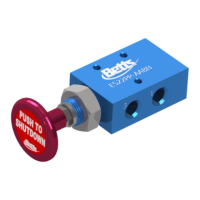
Emergency/Remote Shutdown Air Valves
Betts Industries Inc. ▪ 814·723·1250 ▪ 1800 Pennsylvania Ave. West ▪ Warren, PA 16365 ▪ www.BettsInd.com
Print Date: 11/21/2023 This form is considered uncontrolled 24 hrs. after print date.
nut. Using two 1/2” open ended wrenches, tighten the flange nut (7) into the control
knob (8).
6.2.9 Insert the end cap (10) into the Control Block (1).
6.2.10 Test the rebuilt Emergency/Remote Shutdown Valve for proper function per 5.1
Bench Test Procedure prior to installation. Verify proper shutdown function once
installed.
7.0 Troubleshooting Guide
Use to help diagnose potential issues that could be encountered. The list is not all inclusive and other solutions might be needed.
When actuated, the
Emergency/Remote
Shutdown Valve does
not shutdown the
loading/unloading
outlets (emergency
valves).
Emergency/Remote Shutdown Valve is not
plumbed correctly.
Verify the plumbing is correct depending on how
the air system on the cargo tank is designed.
See schematic in section 3.0.
Exhaust port of Emergency/Remote Shutdown
Valve is plugged.
Airline to Emergency/Remote Shutdown Valve
is not getting air pressure.
Airline from Emergency/Remote Shutdown
Valve is damaged, plugged or pinched.
Master Control Valve on Air Panel is not
operating properly.
Resolve Master Control Valve or Air Panel issue.
Emergency/Remote Shutdown Valve is not
operating properly.
Review entirety of troubleshooting guide and
replace or rebuild Emergency/Remote Shutdown
Valve as necessary.
Valve stuck open or
closed. Hard to
actuate.
Corroded bushing (5) or control block (1).
Investigate reason for corrosion. Harsh cleaning
solutions or incompatible airline additives should
not be used. Remove and replace bushing (5).
If the bore of the control block (1) is corroded it
is recommended to replace the entire valve.
Damaged or bent piston (2).
Replace piston (2) but also inspect bore of
bushing (5) and control block (1) to see if they
are also damaged.
Investigate reason for O-Ring swelling.
Incompatible airline additives should not be
used. Product may be leaking into airline from
one of the Emergency Valves or Air Manifold.
See specific problem below: Product of cargo
tank leaking from exhaust port (liquid/fumes).
Investigate reason for O-rings (3) damage.
Burrs or sharp edges inside bore should be
removed without damaging sealing surface prior
to replacing O-rings (3).
Ice or debris behind end cap (10) or in valve.
Remove ice or debris. Replace end cap (10)
with a new cap. Ensure the exhaust port is
facing down protected from moisture.


 To Next Page
 Loading...