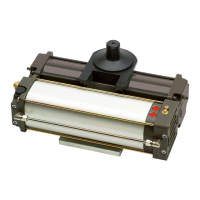
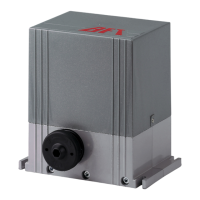
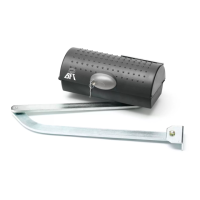
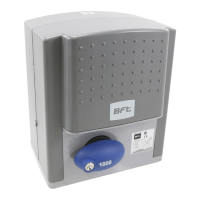
All maintenance on the controller must be performed with the systems power
supply shut o. Check periodically for oil leaks. When topping-up the oil, always
use oil of the same type (see data table) and proceed as follows:
a) Remove the cap “P” (g.3).
b) Top-up with oil until it reaches 1.5 mm on the oil cap hole.
c) Reassemble all of the unit.
ATTENTION: The oil of each actuator must be replaced completely every two
years. Only use oil of the same type (see data table).
- Check the safety devices of the automation.
- When any operational malfunction is not resolved, disconnect the power supply
from the system and request the assistance of qualied personnel.
- If the leaves move jerkily, or if excessive noise is noticed during manoeuvring,
this could be due to air being trapped in the hydraulic circuit, and therefore
a bleed operation may be required.
17.1) Oil bleed
NOTE: The actuator is supplied without air in the hydraulic circuit. If a bleed
operation is required, proceed as described below.
a) Remove the cover from the actuator.
b) Activate the opening command and loosen the bleed screw (S) for opening
(g.19-20) during leaf movement.
c) Let the air out until non-emulsied oil appears (if possible, try to prevent the
oil leaking out of the bleed screw from falling into the foundation case).
d) Tighten the bleed screw before the actuator runs out of operation time.
e) Activate the closing command and loosen the bleed screw for closing (which
can be seen in g.20) during leaf movement.
f) Let the air out until non-emulsied oil appears.
g) Tighten the bleed screw before the actuator operation time runs out.
h) Repeat this operation several times for both bleed screws.
i) Restore the oil level, checking that it just reaches below cap “O” (g.19). Top
up with IDROLUX oil of the same type.
18) NOISE LEVEL
The aerial noise level produced by the gearmotor under normal operating condi-
tions is constant and does not exceed 70 dB (A).
19) SCRAPPING
Materials must be disposed of in conformity with the current regulations.
In case of scrapping, the automation components do not entail any particular
risks or danger. In case of recovered materials, these should be sorted out by type
(electrical components, copper, aluminium, plastic etc.).
20) DISMANTLING
When the automation system is disassembled to be reassembled on another
site, proceed as follows:
- Disconnect the power supply and the entire electrical installation.
- Remove the gearmotor from its xing base.
- Disassemble the control panel, if separate, and all the installation components.
- In the case where some of the components cannot be removed or are dam-
aged, they must be replaced.
21) MALFUNCTION: CAUSES and REMEDIES
When any operational malfunction is found, and not resolved, disconnect the
power supply from the system and request the assistance of qualied personnel
(installer). When automation is out of order, activate the manual release to allow
opening and closing manoeuvres to be carried out by hand.
21.1) The gate does not open. The motor does not turn.
1) Check that the photocells or electric edges are not dirty, or engaged, or not
aligned. Proceed accordingly.
2) Check that the electronic equipment is correctly supplied with power. Check
the integrity of the fuses.
3) Check that the functions are correct by means of the control unit diagnosing
leds (see relevant instructions). Identify any causes for faults. If the leds show
a persistent start command, check that no radio controls, start buttons or
other control devices keep the start contact activated (closed).
4) If the control unit does not work, it must be replaced. Should the checks listed
above be satisfactory, replace the actuator.
21.2) The gate does not open. The actuator vibrates but there is no movement.
1) The manual release was left engaged. Reset motorised operation. Should an
electric lock be tted, check that it opens correctly after the start command.
2) Check that the capacitor is connected to the motor drive terminals.
3) Check that the motor common (light blue wire) is properly connected.
4) Disconnect and reconnect the power supply to the system. The rst start
command must open. Should the actuator close, reverse the respective drive
connections to the actuator.
5) Help the leaf to open by hand. If the leaf opens, check if there are any mechanical
problems with the leaf or, if necessary, adjust the by-pass valves as described
in the relevant item 12. Should the checks listed above be satisfactory, replace
the actuator.
INSTALLATION MANUAL
TABLE 1


 To Next Page
 Loading...