EasyManua.ls Logo

BIC 960 - Cueing and Set-Down Adjustments

Default Icon
22 pages
Print Icon
To Next Page IconTo Next Page
To Previous Page IconTo Previous Page
Loading...
spindle
and
the
programmer
is
advanced
to
4.
The
cycle
button
is
depressed,
the
four
records
play
and
the
programmer
determines
when
it
is
to
shut
off.
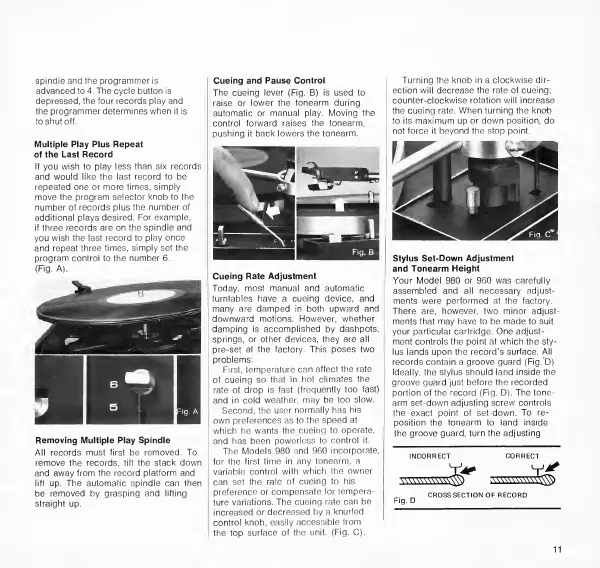
Multiple
Play
Plus
Repeat
of
the
Last
Record
If
you
wish
to
play
less
than
six
records
and
would
like
the
last
record
to
be
repeated
one
or
more
times,
simply
move
the
program
selector
knob
to
the
number
of
records
plus
the
number
of
additional
plays
desired.
For
example,
if
three
records
are
on
the
spindle
and
you
wish
the
last
record
to
play
once
and
repeat
three
times,
simply
set
the
program
control
to
the
number
6.
(Fig.
A).
Removing
Multiple
Play
Spindle
All
records
must
first
be
removed.
To
remove
the
records,
tilt
the
stack
down
and
away
from
the
record
platform
and
lift
up.
The
automatic
spindle
can
then
be
removed
by
grasping
and
lifting
straight
up.
Cueing
and
Pause
Control
The
cueing
lever
(Fig.
B)
is
used
to
raise
or
lower
the
tonearm
during
automatic
or
manual
play.
Moving
the
control
forward
raises
the
tonearm,
pushing
it
back
lowers
the
tonearm.
Cueing
Rate
Adjustment
Today,
most
manual
and
automatic
turntables
have
a
cueing
device,
and
many
are
damped
in
both
upward
and
downward
motions.
Flowever,
whether
damping
is
accomplished
by
dashpots,
springs,
or
other
devices,
they
are
all
pre-set
at
the
factory.
This
poses
two
problems:
First,
temperature
can
affect
the
rate
of
cueing
so
that
in
hot
climates
the
rate
of
drop
is
fast
(frequently
too
fast)
and
in
cold
weather,
may
be
too
slow.
Second,
the
user
normally
has
his
own
preferences
as
to
the
speed
at
which
he
wants
the
cueing
to
operate,
and
has
been
powerless
to
control
it.
The
Models
980
and
960
incorporate,
for
the
first
time
in
any
tonearm,
a
variable
control
with
which
the
owner
can
set
the
rate
of
cueing
to
his
preference
or
compensate
for
tempera¬
ture
variations.
The
cueing
rate
can
be
increased
or
decreased
by
a
knurled
control
knob,
easily
accessible
from
the
top
surface
of
the
unit.
(Fig.
C).
Turning
the
knob
in
a
clockwise
dir¬
ection
will
decrease
the
rate
of
cueing;
counter-clockwise
rotation
will
increase
the
cueing
rate.
When
turning
the
knob
to'its
maximum
up
or
down
position,
do
not
force
it
beyond
the
stop
point.
Stylus
Set-Down
Adjustment
and
Tonearm
Height
Your
Model
980
or
960
was
carefully
assembled
and
all
necessary
adjust¬
ments
were
performed
at
the
factory.
There
are,
however,
two
minor
adjust¬
ments
that
may
have
to
be
made
to
suit
your
particular
cartridge.
One
adjust¬
ment
controls
the
point
at
which
the
sty¬
lus
lands
upon
the
record’s
surface.
All
records
contain
a
groove
guard
(Fig.'D)
Ideally,
the
stylus
should
land
inside
the
groove
guard
just
before
the
recorded
portion
of
the
record
(Fig.
D).
The
tone¬
arm
set-down
adjusting
screw
controls
the
exact
point
of
set-down.
To
re¬
position
the
tonearm
to
land
inside
the
groove
guard,
turn
the
adjusting
INCORRECT
CORRECT
A\\W\WW\\$S)
Fig.
D
CROSS
SECTION
RECORD
11

Related product manuals