This document is an owner's manual for the EVORA electric bicycle, providing comprehensive information on its function, specifications, usage, and maintenance.
Function Description
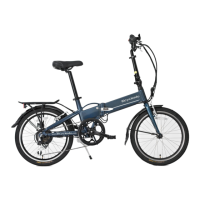
The EVORA is an electric bicycle designed for personal transportation. It features a folding mechanism for portability and storage, an electric motor to assist with pedaling, and a battery for power. The bicycle is equipped with standard components such as handlebars, a stem, saddle, saddle post, frame, crank, pedals, chain, derailleur, motor, mudguard, carrier, rim, fork, and spokes. The electric assist function allows riders to choose between different power modes, including a PAS (Pedal Assist System) mode, and provides power cut during braking for safety. The manual emphasizes that the e-bike is not suitable for competition, stunts, or off-road riding, nor for children under thirteen or the disabled.
Important Technical Specifications
- Maximum Rider Weight: 115 Kg
- Maximum Carrier Weight: 15 Kg
- Braking Length (Dry Surface): 4 meters at 25km/h
- Braking Length (Wet Surface): 15 meters at 25km/h
- Charger Input Voltage: 100V-240V
- Battery Indicator: Three lights for full capacity, two lights for half full, one light for nearly flat.
- Brake Shoe Gap: Average 1.5-2 mm between brake shoes and rim flank.
Usage Features
The EVORA e-bike offers several features to enhance the riding experience:
- Power On/Off: The e-bike is turned on and off by pressing a power button.
- Battery Management: The battery can be locked or unlocked from the frame using a key. It can be charged either on the e-bike or removed for separate charging. Battery capacity is indicated by LED lights.
- Acceleration: The bike accelerates by slowly turning the grip throttle. To stop, the throttle must be returned to the starting position or released.
- Folding Mechanism: The bike features a step-by-step folding and unfolding process for easy transport and storage. This involves removing safety catches, loosening quick releases, folding the stem, pulling pedal triggers, and folding the frame inwards.
- Safety Features: The motor stops working when braking and restarts when the brake lever is released. The manual advises riders to wear helmets, check brakes and tires, and maintain a safe distance from other vehicles, especially in wet conditions. It also warns against riding in water deeper than the controller or exposing electrical components to direct water.
- Riding Modes: The manual suggests riding in PAS mode on uneven roads, uphill, or against headwinds to optimize mileage. It also recommends riding for 3-5m in power mode when starting and reducing frequent braking or restarts.
- Traffic Regulations: Users are reminded to follow all traffic regulations.
Maintenance Features
Regular maintenance is crucial for the EVORA e-bike's safety, performance, and longevity. The manual outlines several maintenance aspects:
- Pre-Ride Checks: Before each ride, users should check:
- Handlebar stem and saddle post insertion (ensuring they are within maximum height markings).
- Brake shoe wear.
- Security of nuts on front and rear axles.
- Pedals and other fixtures for damage, and free movement of rotary parts.
- Tire pressure and tread wear.
- Functionality of brakes and power cut-off.
- Grip throttle function (ensuring it returns to place immediately after release).
- Security of electrical connections and mechanical parts, and dryness/undamaged state of cables, plugs, and sockets.
- Lubrication Schedule: A detailed lubrication schedule is provided for various components:
- Weekly: Chain (Chain Lube or Light Oil).
- Monthly: Derailleur Pulleys, Derailleurs, Brake Calipers, Brake Levers, Shift Levers (Oil or Lithium Based Grease).
- Every Six Months: Freewheel, Bottom Bracket, Pedals (Lithium Based Grease).
- Yearly: Derailleur Cables, Wheel Bearings, Headset, Seat Post (Lithium Based Grease).
- Chain Maintenance: The chain should be regularly (especially after riding in the rain) lubricated with a standard chain-caring product. Physical stretching of the chain requires checking procedures to be carried out to ensure tension is adequate. Adjusting chain tension involves loosening axle nuts, adjusting the chain tension screw nuts, checking wheel stands, and tightening axle nuts and tension screws. Over-tightening the chain can cause pops during riding.
- Derailleur Adjustment: Fine-tuning the nut or screw on the derailleur is necessary if abnormal sounds occur.
- Brake Adjustment: The brake system can be adjusted by turning the adjusting screw on the brake lever and tightening or loosening crosshead screws on the brake arms to center the brakes to the rim.
- Troubleshooting Guide: A table lists common problems, possible causes, and solutions, such as battery gauge not displaying (power switch open, battery case with no power), motor not performing (being in power mode, connection error), speed-adjust failure (connection error, throttle failure), poor traveling range (insufficient charge, battery aging), and abnormal charging time (battery failure, connection error).
- Professional Servicing: It is recommended to have the e-bike serviced by a professional cycle engineer at least once a year.
- Genuine Parts: Users are advised to use genuine parts for long-term service and to ensure waterproof connections are properly made.
- Battery Care: Instructions for safe charging include ensuring dry charger plugs, not covering the battery or charger, avoiding flammable products or unventilated places, keeping the battery away from water, using only the provided charger, not disassembling or modifying the battery, avoiding extreme temperatures or impact, and unplugging the power plug first after charging. Regular and occasional use guidelines for recharging are also provided.
- Warranty Information: The manual includes a warranty table detailing coverage for various parts (frame, fork, handlebars, spindle, seat post, rim, shaft skin, chains, speed control switch, motor, battery) against specific faults (fracture, sealing off, performance failure) for a period of one year. It also specifies conditions under which the warranty does not apply, such as negligent use, normal wear and tear, poor maintenance, external causes, rental use, and consumables like bulbs, brake blocks, and tires.


 To Next Page
 General