40
a. Keep any flammable or heat sensitive materials (furniture, curtains, and clothing) at a minimum distance of about 150cm.
b. If the equipment is installed on a floor which is not completely refractory or inflammable it is necessary to replace this part or introduce
a fire-resistant base.
c. Do not place the boiler near combustible walls or likely to be affected by a thermal shock.
d. The boiler should only be used when the ash pan is inserted and the doors are closed (both of the combustion chamber and the ash
pan) as well as with the ash compactor (Hydroconfort model only).
e. It is recommended to install carbon monoxide detector (CO) in the room where the equipment is installed.
f. If you need a longer wire than the one provided use it always with an earthed plug.
g. Do not install the in a bedroom.
h. The boiler should never be turned on in the presence of emission of gases or vapours (e.g., linoleum glue, gasoline, etc). Do not place
nearby flammable materials.
i. Solid combustion residues (ashes) should be collected in an airtight container and resistant to fire.
j. Do not allow anybody to make operations in the boiler without training relevant to the installation.
k. Do not leave children unattended in the room without an adult supervision.
l. Keep away the animals.
m. If you notice visible damage (e.g. water leaks, thermal deformations, smoke or fire traces, mechanical imperfections, etc.) you
should neither go ahead with the service nor restart the boiler. The faults have to be repaired. In case of any doubt, please contact a
specialised technician or the technical service.
n. If the installation remains stopped during a long period of time you should guarantee an absolute antifreeze protection in every part
where the water is stored in.
o. The boilers should not be submitted to any external mechanical load (e.g. tray, rise means, support, or similar). This remark also
applies to its individual components (door, cover, etc.).
p. The temperature could reach very high values in some other parts (smoke pipe, ash pan door, etc.) For this reason, it is recommended
not to touch any component as a precaution.
q. Regarding the legionnaire’s disease, the current general technical rules must be respected.
r. Leave some space around the boiler to be able to do the maintenance and repairs.
s. Prepare the boiler room or the space to place the boiler well-ventilated.
t. A certified fire extinguisher must be placed in the boiler room.
u. Make sure all the cleaning and maintenance intervals are rigorously maintained. Any damage produced through lack of respect for the
maintenance tasks is likely to invalidate the warranty.
v. In order to ensure an economic and reliable functioning of the heating system, the user is obliged to check and clean the equipment
once a year by qualified staff. We recommend that you sign a maintenance service contract
w. The components of the boiler must not be removed, bypassed or cancelled in any way.
x. Never spill flammable liquid on the boiler combustion chamber nor use different fuels from those prescribed. Otherwise, the warranty
will no longer be valid.
y. The equipment must be disconnected before the chimney-sweep cleans the smoke duct.
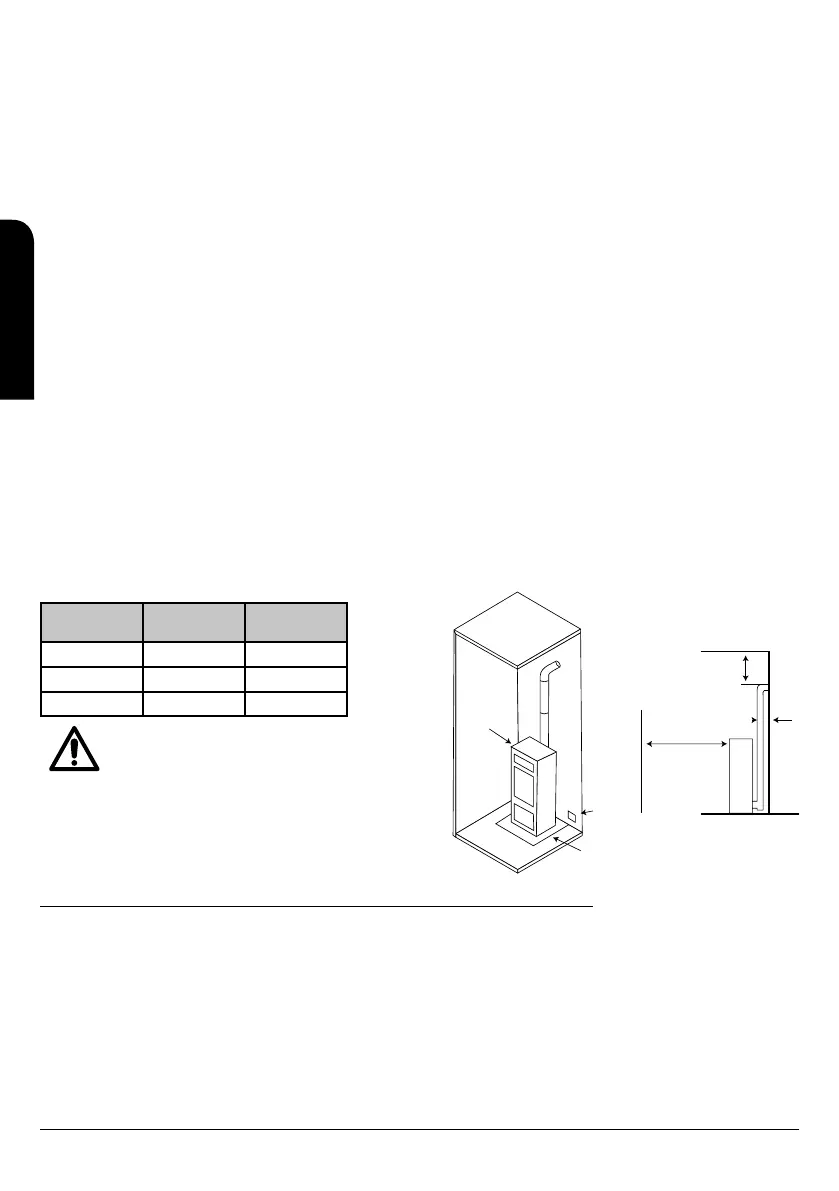
It is necessary to keep a safe distance when they are installed in spaces where materials are susceptible of being flammables, either the
construction materials or different materials that surround the boiler.
20 cm
A
B
C
80-120 cm
2
Floor covering
References Flammable
items
Non-flammable
items
A 1500 800
B 1500 150
C 1500 400
WARNING!! It is noted that the boiler gets very hot and
should not be touched.
In case of fire in the boiler or smoke duct:
a. Close the loading door.
b. Put out the fire by using carbon dioxide extinguishers (CO2
powder).
c. Request for the immediate intervention of the fire-fighters.
DO NOT PUT OUT THE FIRE WITH WATER.
UK HETAS regulations as stated in document J combustion appliances and fuel storage systems.
Whilst the document J gives the guidance for compliance, the installer must interpret the guidance from manufactures for the correct
installation of their equipment in order to be compliant with UK building regulations and the guidance in this document.
The points which we discussed at the training were:
1) The document J requires the installer to provide adequate ventilation for combustion if room air is being used for combustion and for
heat dissipation. So the room should always be adequately ventilated unless you wish to specify additional requirements. It would be possible
to specify “in accordance with document J sections 1.” In the Bronpi manual if you wanted to make sure that an installer maintains sufficient
ventilation for the boilers.
So particular to the Bronpi boilers we think the manufacturer’s recommendations should include the following:
2) If the flue is to pass straight through the wall then it must run horizontally and connect with a double skin 90* Tee on the outside. This
horizontal section must not exceed 500mm in length. Do not run the first length of flue at 45* through the wall. Alternatively, the first run may
run from a 90* Tee vertically to a maximum height of 2m before connecting to a double skin insulated flue (but within 450mm of the ceiling)
or exiting the building on a 45* through the wall after rising above the boiler to a height which will allow draught stabilisers and inspection
hatches to be mounted. Any bends should have an analyser port so that an installer can put a gas analyser probe to check flue gases.
EN
INSTALLATION, OPERATING AND SERVICING INSTRUCTIONS HYDROBOX, HYDROTEX AND HYDROCONFORT



 To Next Page