Device Description
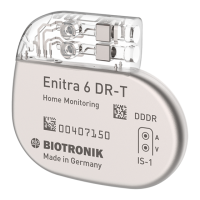
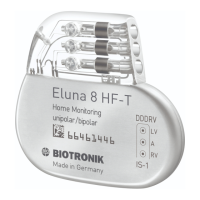
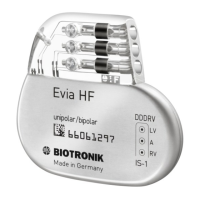
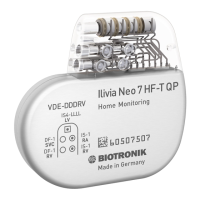
The Edora, Evity, Enitra HF-T / HF-T QP pacemakers are state-of-the-art implantable cardiac resynchronization therapy pacemakers (CRT-Ps) manufactured by BIOTRONIK. These devices are designed to provide pacing support with a variety of rate-adaptive and non-rate adaptive pacing modes, incorporating advanced diagnostic and monitoring capabilities. They feature wandless telemetry communication to simplify implantation and follow-up procedures.
Function Description
The pacemakers offer two primary methods of rate-adaptation:
- Closed-Loop Stimulation (CLS): This unique principle translates myocardial contractility into patient-specific pacing rates. The device monitors intracardiac impedance signals, and changes in these signals, reflecting the heart's inotropic response to exercise and acute mental stress, are used to adjust the pacing rate.
- Motion-Based Rate-Adaptation: Equipped with an internal accelerometer, the pacemakers detect physical activity and adjust the pacing rate accordingly in rate-adaptive (R) modes.
The devices are triple-chamber pacemakers, with the QP models specifically supporting quadpolar LV pacing. They are indicated for patients with chronotropic incompetence who benefit from increased pacing rates during physical activity, as well as for generally accepted long-term cardiac pacing indications such as sick sinus syndrome, SA block, second- and third-degree AV block, and carotid sinus syndrome. The CRT-P models (Edora HF-T QP/HF-T, Evity HF-T QP/HF-T, and Enitra HF-T QP/HF-T) are indicated for patients with moderate to severe heart failure (NYHA Class III/IV), left ventricular dysfunction (EF ≤ 35%), and QRS ≥ 120 ms who remain symptomatic despite optimal heart failure drug therapy.
A key feature is Home Monitoring™, an automatic, wireless, remote monitoring system that allows physicians to review patient cardiac status and pacemaker functionality between regular follow-up visits, optimizing therapy. Home Monitoring has been shown to extend routine in-office follow-up intervals and provides early detection of arrhythmias and device system anomalies.
Important Technical Specifications
Wireless Technology:
- Inductive Coil Telemetry: Short-range (0–5 cm), near-field communication at 32.768 kHz, used for follow-up and programming with a programmer wand.
- Radio Frequency (RF) Link: Long-range (0–3 meters), far-field communication at 403 MHz (MedRadio/MICS band), used for wandless device interrogation, programming during follow-up, and Home Monitoring.
- Modulation: Pulse distance coding, OOK (Inductive Coil); Binary FSK (RF).
- Uplink Data Rate: 2978 bps (Inductive Coil); 16 kbps (RF).
- Downlink Data Rate: 2978 bps (Inductive Coil); 4 kbps (RF).
- Effective RF Radiated Output Power: -64.09 dBm EIRP (Inductive Coil); Less than 25µW EIRP (RF).
Pacing Modes (HF-T):
- DDD-CLS, VVI-CLS
- DDDR-ADIR, DDD-ADI, DDD(R), DDI(R), DVI(R), DOO(R), DDT
- VDD(R), VDI(R), VVI(R), VOO(R), VVT
- AAI(R), AOO(R), AAT, OFF (Temporary only)
Pulse- and Control Parameters:
- Basic Rate: 30–200 bpm (programmable in 5 or 10 bpm steps).
- Night Rate: OFF, 30–200 bpm (programmable in 5 or 10 bpm steps).
- Rate Hysteresis: OFF; -5 to -65 bpm (programmable in 5 bpm steps).
- Repetitive/Scan Hysteresis: OFF; ON (5 cycles).
- Pulse Amplitude:
- Atrium: 0.2–7.5 V (programmable in 0.2 V or 0.5 V steps). Default: 3.0 V.
- Right/Left Ventricle: 0.2–7.5 V (programmable in 0.2 V or 0.5 V steps). Default: 3.0 V.
- Pulse Width:
- Atrium: 0.1, 0.2, 0.3, 0.4, 0.5, 0.75, 1.0, 1.25, 1.5 ms. Default: 0.4 ms.
- Right/Left Ventricle: 0.1, 0.2, 0.3, 0.4, 0.5, 0.75, 1.0, 1.25, 1.5 ms. Default: 0.4 ms.
- Sensitivity:
- Atrium: AUTO, 0.1–7.5 mV (programmable in 0.1 V or 0.5 V steps). Default: AUTO.
- RV/LV: AUTO, 0.5–7.5 mV (programmable in 0.5 V steps). Default: AUTO.
- Refractory Periods:
- Atrial: AUTO (225 ms nominal).
- RV: 200–500 ms (programmable in 25 bpm steps).
- LV: 200 ms (fixed).
- PVARP: AUTO, 175–600 ms (programmable in 25 bpm steps). Default: 225 ms.
- AV Delay: 20–350 ms (programmable in 5 bpm steps) in 6 rate bins.
- Maximum Sensor Rate: 80–180 bpm (programmable in 10 bpm steps). Default: 120 bpm.
- Rate Increase/Decrease: 1, 2, 4, 8 bpm/cycle (Increase); 0.1, 0.2, 0.5, 1.0 bpm/cycle (Decrease).
Physical Specifications:
- Housing: Titanium.
- Connector Receptacle: Epoxy resin.
- Sealing Plugs: Silicone Rubber.
- Electrical Data:
- Pace: Unipolar/bipolar.
- Pulse form: Biphasic, asymmetric.
- Polarity: Cathodic.
- Input impedance: >10 kΩ (A); >10 kΩ (V).
- Power source: LiMnO2 or LiSVO2.
- Battery voltage at BOS: 3.1 V.
- Conducting surface: 33 cm².
- Conducting shape: Ellipsoidal.
- Mechanical Data (Edora/Evity/Enitra 8 HF-T):
- Leads: IS-1.
- Size: 6.5 x 53 x 52 mm.
- Mass: 27 g.
- Volume: 14 cc.
- Mechanical Data (Edora/Evity/Enitra 8 HF-T QP):
- Leads: IS-1/IS4.
- Size: 6.5 x 53 x 53 mm.
- Mass: 31 g.
- Volume: 15 cc.
Usage Features
- Lead Compatibility: Designed for use with atrial and ventricular unipolar or bipolar leads with IS-1 compatible connectors. QP models also use an IS4 lead for the left ventricle.
- MRI Conditional: These devices are MR Conditional, allowing MRI scans under specific conditions (refer to ProMRI® Technical Manual).
- Mode Switching: Automatically changes pacing modes in response to atrial tachycardias (e.g., PATs) to prevent tracking non-physiologic atrial rates. Available in atrial tracking modes DDD(R), VDD(R), DDD-CLS, and DDD(R)-ADI(R).
- Ventricular Capture Control (VCC): Periodically measures capture threshold, automatically adjusts pacing output with a programmable safety margin, and continuously assesses ventricular pacing capture on a beat-to-beat basis, responding to loss of capture with a safety back-up pulse.
- Atrial Capture Control (ACC): Automatically measures atrial pacing threshold and adjusts amplitude, with routine threshold tests based on programmed schedules.
- Vp-Suppression: Promotes intrinsic AV conduction by pacing the ventricle only when intrinsic conduction becomes unstable or disappears. Available only with RV pacing in DDD(R)-ADI(R) mode.
- Dynamic AV Delay: Provides independent selection of AV Delays across five rate ranges, mimicking physiologic shortening of AV Delay with increasing rate.
- AV Hysteresis (Positive/Negative/I-Opt): Promotes intrinsic activity by periodically extending or decreasing the AV interval. I-Opt is a one-button feature for intrinsic activity promotion.
- Rate Fading: Prevents sudden drops in heart rate when transitioning from intrinsic rhythm to pacing, reducing symptoms like dizziness.
- Atrial Overdrive Pacing: Increases atrial pacing rate after non-AES atrial sensed events to suppress atrial tachyarrhythmias.
- PMT Management: Includes PMT Protection (prevents pacemaker-mediated tachycardia) and a PMT Detection and Termination algorithm.
- NIPS (Atrial Non-Invasive Programmed Stimulation): Allows externally controlled pacing pulses for burst or programmed stimulation, up to four extra stimuli at rates up to 800 bpm.
- ProgramConsult®: Provides programming suggestions based on ACC/AHA/HRS guidelines, enhancing programming efficiency and allowing storage of individual parameter sets.
- MRI Programming: Offers an AUTO program that automatically activates a stored MRI program when the patient is near an MRI scanner and reverts to the permanent program after the scan.
Maintenance Features
- Diagnostics: Stores comprehensive diagnostic information including rate histograms, event counters, sensor trends, PVC statistics, and activity reports.
- Timing Statistics: Event episodes, AV histogram, rate histograms, pacing trends.
- Arrhythmia Statistics: Atrial burden, total AT episodes, duration, tachy episodes/24h, AT/AF burden, ventricular response.
- Heart Failure Monitoring: Mean heart rate, heart rate variability, patient activity, thoracic impedance.
- 24 Hours: A/V heart rates, A/V pacing percentages.
- More Statistics: Event counters, pulse amplitude and threshold, Ax-Vs interval distribution, sensor rate, arrhythmia, P/R wave trend, lead impedance trend, far-field histogram, Vp suppression.
- Lead Impedance Trends with Lead Check: Measures and stores lead impedance data for atrial and ventricular leads, detecting bipolar lead failures and automatically switching to unipolar configuration if necessary.
- P/R Wave Trend: Periodically performs P- and RV-wave amplitude measurements, displayed as trend data for up to 240 days.
- Elective Replacement Indication (ERI): Activates when battery capacity drops to a predetermined level, indicating the optimal time for pacemaker replacement.
- Follow-up History: Stores up to 10 follow-up records, with the first serving as a baseline.
- Real-time IEGM Transmission: Provides real-time intracardiac electrogram (IEGM) transmission to the programmer for display with surface ECG and markers.
- Impedance Test: Measures atrial and right ventricular impedance in unipolar and bipolar configurations.
- Threshold Test: High-precision test to determine atrial and ventricular pacing thresholds, can be performed manually or automatically.
- Sensing Test (P/R Measurement): Measures minimum, mean, and maximum P- and R-wave amplitudes in each chamber.
- Sensor Optimization: Utilizes sensor rate forecast to optimize rate adaptation parameters (sensor gain, threshold, maximum sensor rate) without repeated exercise tests.

 Need help?
 General

 To Next Page