
 Need help?
Do you have a question about the BIOTRONIK EVIA and is the answer not in the manual?
Describes the primary purpose and therapeutic objective of the pacemaker for bradycardia indications.
Details the components of the implant system, including the implant, leads, and programmer.
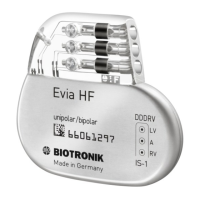
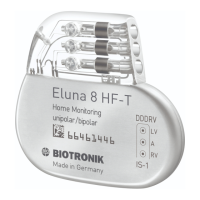
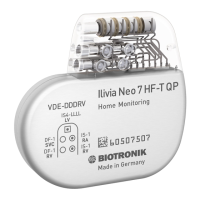
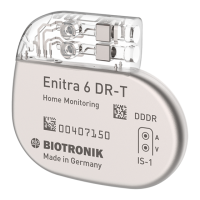
Lists available implant models and their corresponding NBG codes for different configurations.
Explains the various diagnostic capabilities and therapeutic functions offered by the pacemaker.
Lists the standard package contents and available order numbers for the implants.
Outlines potential complications for patients and implant systems during use.
Details potential malfunctions of the implant system and their causes.
Addresses risks associated with electromagnetic interference (EMI) and static magnetic fields.
Covers risks related to diagnostic/therapeutic procedures, defibrillation, and contraindicated actions.
Provides guidance on approved uses and situations where implantation is not recommended.
Specifies permissible temperature ranges and storage requirements for the implant.
Details the sterilization process and handling instructions for maintaining sterility.
Guides on having necessary parts ready and the procedure for unpacking the implant.
Describes the typical locations for implanting the pacemaker.
Provides a step-by-step sequence for the physical implantation procedure.
Details the connection options and procedures for attaching pacing leads to the implant.
Explains the automatic initialization process after lead connection.
Lists crucial safety steps to follow during implant programming.
Describes how the pacemaker reacts to magnet application.
Outlines the schedule and procedure for post-implantation patient follow-ups.
Provides essential information and warnings for medical professionals.
Details the criteria and statuses indicating when the pacemaker needs replacement.
Describes the procedures for removing an old implant and replacing it.
Lists and explains the available pacing modes for the Evia family.
Details timing parameters specific to DR(-T) implant types.
Details timing parameters specific to SR(-T) implant types.
Covers pacing amplitude, pulse width, and sensing parameters for DR(-T).
Covers pacing amplitude, pulse width, and sensing parameters for SR(-T).
Explains the rate adaptation features using CLS and accelerometer.
Describes the default and safe program settings for DR(-T) implants.
Specifies the allowed tolerances for various parameter settings.
Provides physical dimensions, volume, and mass for different implant models.
Details electrical properties, housing shape, and conductive surface area.
Presents information on battery type, power consumption, and estimated service times.
Includes international certification details and material compliance for China.
Explains the meaning of various icons used on product labels.
 General
| Device Type | Pacemaker |
|---|---|
| Manufacturer | BIOTRONIK |
| Model | EVIA |
| Rate Responsive | Yes |
| MRI Conditional | Yes |
| Wireless Telemetry | Yes |
| Pacing Modes | DDD, VVI, AAI |


 To Next Page