EasyManua.ls Logo

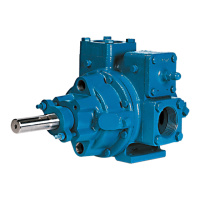
BLACKMER NPH2F - User Manual

BLACKMER NPH2F
12 pages
Print Icon
To Next Page IconTo Next Page
Loading...
BLACKMER POWER PUMPS
960052
INSTRUCTIONS 103-A00
INSTALLATION OPERATION AND MAINTENANCE INSTRUCTIONS
Section
Effective
Replaces
103
Oct 2015
Oct 2012
MODELS: NP1.5B, NP2F, NP2.5F, NP3F, NP4F,
NPH2F, NPH2.5F, NPH3F, NPH4F
TABLE OF CONTENTS Page
PUMP DAT
A
Safety Data 1 - 2
Technical Data 2
Initial Pump Start Up Information 2
INSTALLATION
Pre-Installation Cleaning 3
Location and Piping 3
Mounting 3
Coupling Alignment 4
Pump Rotation 4
Heating Heads / Jackets 4
Heating Heads / Electric 4
Check Valves 4
OPERATION
Pre-Start Up Check List 5
Start Up Procedures 5
Running the Pump in Reverse Rotation 5
Flushing the Pump 6
Pump Relief Valve 6
Relief Valve Setting and Adjustment 6
MAINTENANCE
Strainers 7
Lubrication 7
Vane Replacement 7
Pump Disassembly 8
Pump Assembly 8
TROUBLE SHOOTING 10
AFFF PUMPS 11
NOTE: Numbers in parentheses following individual parts
indicate reference numbers on Blackmer Parts Lists.
Blackmer pump manuals and parts lists may be obtained
from Blackmer's website (www.blackmer.com) or by
contacting Blackmer Customer Service.
NP1.5 NP2 NP2.5 NP3 NP4
103-A01 103-A02 103-A03 103-A04 103-A05
NPH2 NPH2.5 NPH3 NPH4
103-A12 103-A13 103-A14 103-A06
SAFETY DATA
This is a SAFETY ALERT SYMBOL.
When you see this symbol on the product, or in the
manual, look for one of the following signal words and be
alert to the potential for personal injury, death or major
property damage
Warns of hazards that WILL cause serious personal injury,
death or major property damage.
Warns of hazards that CAN cause serious personal injury,
death or major property damage.
Warns of hazards that CAN cause personal injury
or property damage.
NOTICE:
Indicates special instructions which are very
important and must be followed.
NOTICE:
Blackmer Pumps MUST only be installed in systems,
which have been designed by qualified engineering
personnel. The system MUST conform to all applicable
local and national regulations and safety standards.
This manual is intended to assist in the installation and
operation of the Blackmer NP Series pumps, and MUST
be kept with the pump.
Pump service shall be performed by qualified technicians
ONLY. Service shall conform to all applicable local and
national regulations and safety standards.
Thoroughly review this manual, all instructions and hazard
warnings, BEFORE performing any work on the pump.
Maintain ALL system and pump operation and hazard
warning decals.

Questions and Answers

Overview

This document is the Installation, Operation, and Maintenance Instructions for Blackmer Power Pumps, specifically models NP1.5B, NP2F, NP2.5F, NP3F, NP4F, NPH2F, NPH2.5F, NPH3F, and NPH4F. The manual, identified as 960052, Instructions 103-A00, is effective October 2015 and replaces the October 2012 version.

Function Description

Blackmer Power Pumps are positive displacement pumps designed for various industrial applications. They are engineered to handle a range of fluids, including highly viscous liquids, and are capable of self-priming. The pumps utilize a sliding vane mechanism, which is efficient for transferring liquids and maintaining consistent flow rates. The manual emphasizes that these pumps must be installed in systems designed by qualified engineering personnel and must conform to all applicable regulations and safety standards.

Important Technical Specifications

The manual provides a "TABLE 1 - TECHNICAL DATA" outlining key specifications for different pump sizes: 1.5", 2", 2.5", 3", and 4".

  • Maximum Pump Speed:
    • 640 RPM for 1.5", 2", 2.5", 3" models.
    • 500 RPM for 4" models.
  • Maximum Operating Temperature: 240°F (115°C).
  • Maximum Viscosity: 20,000 SSU (4,250 cP).
  • Maximum Differential Pressure: 150 psi (10.3 Bar).
  • Maximum Working Pressure: 175 psi (12 Bar).

For AFFF (Aqueous Film-Forming Foam) Service Pumps, which are a special application of NP pumps, the technical data differs:

  • Maximum Differential Pressure:
    • 200 psi (13.79 Bar) for 1.5", 2", 2.5", 3" models.
    • 175 psi (12.07 Bar) for 4" models.
  • Maximum Working Pressure:
    • 220 psi (15.17 Bar) for 1.5", 2", 2.5", 3" models.
    • 195 psi (13.44 Bar) for 4" models.

AFFF pumps also feature specific construction options like Duravanes (1.5"-3"), Laminate Vanes (4"), Lip Seal, Corrosion Resistant RV, Stainless Steel 200 psi spring, Buna-N O-Rings, and Casing Drain.

The manual also details bolt torque specifications for head and bearing cover capscrews, varying by model size.

Usage Features

  • Installation:
    • Requires pre-installation cleaning to remove residual test fluid and rust inhibitor.
    • Pump location should be as near as possible to the supply source to minimize inlet pipe friction.
    • Inlet piping must be at least as large as the intake port, slope downward, and avoid upward loops, sharp bends, and undersized strainers.
    • A strainer is recommended in the inlet line, located at least 24" (0.6m) from the pump, with specific open area requirements based on fluid viscosity.
    • Expansion joints are recommended at least 36" (0.9m) from the pump.
    • All piping and fittings must be properly supported to prevent pump loads.
    • Pump mounting requires a solid foundation, secured by anchor bolts, to reduce noise and vibration and improve performance.
    • Coupling alignment (parallel and angular) between the pump and driver is critical, with maximum offsets specified (.005" or .127 mm).
  • Heating Heads/Jackets:
    • Recommended for highly viscous liquids or to thaw congealed liquids.
    • Hot oil or steam can be circulated through 3/4" NPT connections (3/8" NPT on 1.5" models). Maximum recommended steam pressure is 150 PSI (10.3 bar).
    • Electric heating heads are available for 2.5", 3", and 4" pumps, with specific ports for heating cartridges and temperature sensors.
  • Pump Rotation:
    • Right-hand pumps rotate clockwise with the intake on the right side (viewed from the driven end).
    • Left-hand pumps rotate counterclockwise with the intake on the left side (viewed from the driven end).
    • Rotation can be reversed by disassembling and reassembling the pump with the shaft on the opposite side.
    • Running the pump in reverse rotation is possible for limited periods (no more than 10 minutes) for system maintenance, but at a reduced performance level, and only if a separate pressure relief valve is installed.
  • Check Valves:
    • Not recommended in the supply tank for self-priming, positive displacement pumps.
    • A check valve in the discharge piping is recommended if liquid backflow is possible when the pump is off, to prevent reverse rotation and undue stress.
  • Start-Up Procedures:
    • Priming should occur within one minute.
    • Vacuum and pressure gauges should be checked against expected conditions.
    • Piping, fittings, and equipment should be inspected for leaks, noise, vibration, and overheating.
    • Flow rate should be checked.
    • Relief valve pressure setting must be checked by briefly closing a discharge line valve (DO NOT operate against a closed discharge valve for more than 15 seconds). The setting should be 10-20 psi (0.7-1.4 bar) higher than maximum operating pressure.
  • Flushing:
    • To flush, run the pump with the discharge valve open and intake valve closed, bleeding air into the pump for 30-second intervals.
    • Follow with a system-compatible flushing fluid for one minute.
    • If flushing fluid remains in the pump, it must be lubricating and non-corrosive. Corrosive or non-lubricating fluids must be flushed immediately. Water is not suitable.
  • Pump Relief Valve:
    • Designed to protect the pump from excessive pressure for LIMITED time operation against a partially closed discharge valve.
    • Not to be used as a system pressure control valve; an external bypass system is required for operation against closed/partially closed discharge valves for periods greater than one minute.
    • Setting must be higher than the system pressure control valve but not exceed maximum differential pressure.
    • Adjustment involves removing the cap, loosening the locknut, and turning the adjusting screw (inward to increase, outward to decrease).

Maintenance Features

  • Scheduled Maintenance:
    • Strainers: Must be cleaned regularly to avoid pump starvation; schedule depends on application.
    • Lubrication: Sleeve bearings are lubricated by the pumped liquid; no additional lubrication is required. Gear reducers (if equipped) require oil, with an initial change after 48 hours and subsequent changes every 500 hours.
    • Vane Replacement: Involves draining/flushing the pump, removing the head assembly and outboard parts, rotating the shaft to position vanes at 12 o'clock, removing and replacing vanes with the rounded edge outward and relief grooves facing the direction of rotation.
    • Pump Disassembly/Assembly: Detailed steps are provided for disassembling and reassembling the pump, including removal of shaft key, packing, heads, rotor, and vanes. Instructions for replacing sleeve bearings (bushings) are included, emphasizing heating the head to aid installation.
    • Packing and Packing Follower: Instructions for re-packing with new rings, staggering split joints, and hand-tightening stud nuts. Adjustment of packing follower is done after 10-15 minutes of pump operation, by tightening stud nuts 1/4 turn at a time to reduce leakage, checking for overheating, and readjusting after 20-30 minutes. Some leakage is desirable for lubrication.
    • Optional Lip Seal Assembly: Instructions for installing wave spring, lip seal assembly, and seal follower. Lip seals should require no adjustment.
    • Commercial Mechanical Seal: Refer to separate literature for installation instructions.
    • Relief Valve Assembly: Instructions for inserting valve, spring, spring guide, attaching gasket and cover, screwing in adjusting screw, and installing cap. The relief valve setting MUST be tested and adjusted precisely before pump service.
  • Troubleshooting: A comprehensive table lists common symptoms (Pump Not Priming, Reduced Capacity, Noise, Damaged Vanes, Broken Shaft, Overload on Motor, Mechanical Seal Leakage) and their probable causes.
  • AFFF Service Pumps Maintenance:
    • MUST be tested for a ten-minute period every 30 days, with discharge recirculated through a bypass system (not against a closed discharge).
    • Pump MUST be disassembled and checked after each ten hours of system trial operation, or five years, whichever occurs sooner. Heads, cylinder, bushing, and vanes MUST be inspected for wear and replaced if necessary. Rotor and shaft must be inspected for wear, corrosion, scaling, flaking rust particles, or cracking, and replaced if necessary.
    • If the foam concentrate tank is depleted or the pump has run dry, the pump MUST be completely disassembled and inspected for damage or wear, with replacement of worn parts.

The manual strongly emphasizes safety, using DANGER, WARNING, and CAUTION alerts for potential hazards such as personal injury, death, or major property damage, and NOTICE for important instructions. It stresses that all service must be performed by qualified technicians only.

BLACKMER NPH2F Specifications

General IconGeneral
BrandBLACKMER
ModelNPH2F
CategoryPower Pump
LanguageEnglish

Related product manuals