Functional limitations
The wrong way warning system may be re-
stricted in the following situations, for example,
and will either output an incorrect wrong way
warning or no warning at all:
▷ When the signage is not clear.
▷ If the traffic signs are fully or partially con-
cealed or soiled.
▷ If the traffic signs are poorly legible or ro-
tated.
▷ If the traffic signs are too small or too large.
▷ If the traffic signs do not correspond to the
standard.
▷ When traffic signs are detected that apply
to a junction or parallel street.
▷ In the presence of country-specific road
signs or road layouts.
▷ Up to 10 seconds after drive-ready state is
switched on via the Start/Stop button.
▷ In the case of navigation data that is inva-
lid, outdated or not available.
▷ It may not be possible to use the system in
all regions.
No Turn on Red function
Principle
The No Turn on Red function assists the driver
by indicating at which traffic lights turning on
red is prohibited.
To do so, this function analyzes traffic lights
and traffic signs using the camera behind the
windshield. In addition, the navigation system
data is used.
Safety information
Follow the safety information in the "Forward
Collision Mitigation" chapter.
Functional requirements
The following functional requirements apply to
the No Turn on Red function:
▷ The system detects the right-of-way situa-
tion ahead by analyzing traffic lights and
traffic signs.
▷ Vehicle is less than approx. 164 ft/50 m
from the traffic lights.
Sensors
The No Turn on Red function is controlled by
the camera behind the windshield.
Display in the instrument cluster
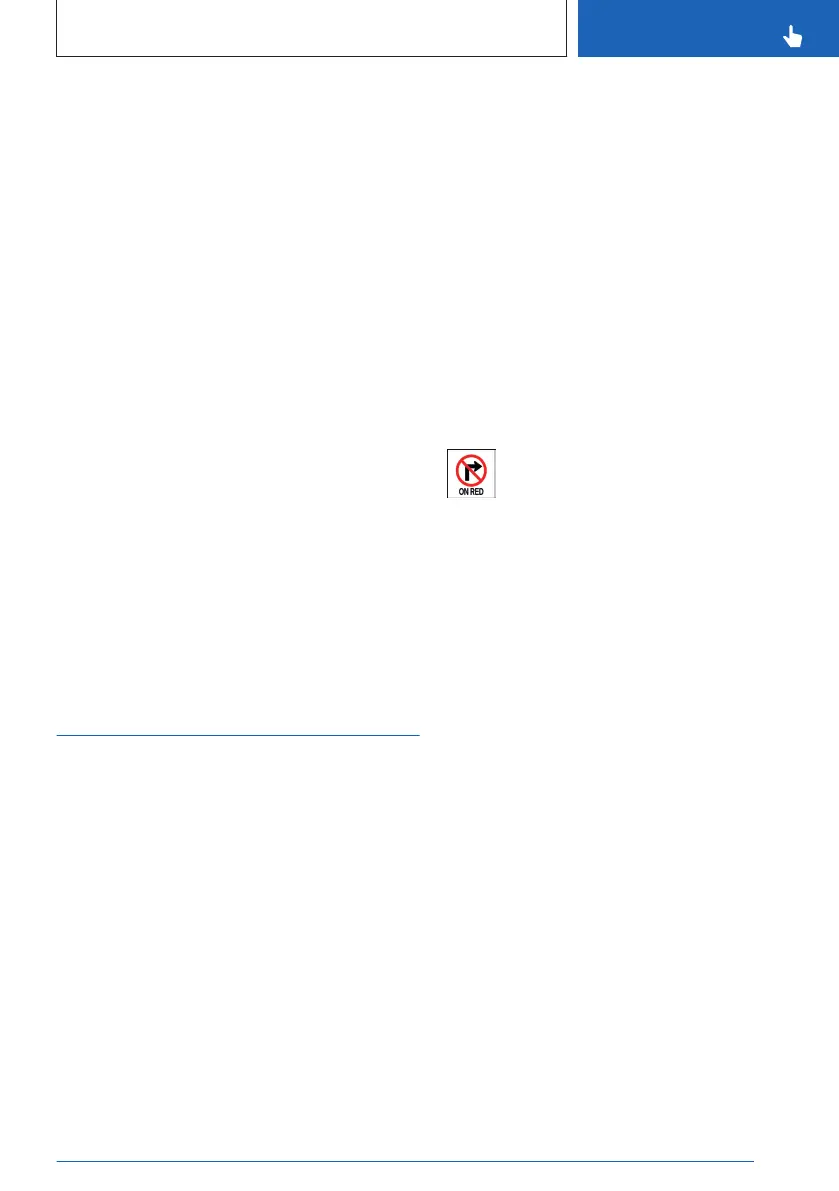
If the driver approaches a red traffic
light with a traffic sign that prohibits
a turn on red, an indicator light is dis-
played on the instrument cluster.
The indicator light goes out automatically after
you drive off at a speed greater than approx. 9
mph/15 km/h.
System limits
General information
Follow the system limits in the "Collision warn-
ing systems" chapter.
Functional limitations
The No Turn on Red function may be limited in
the following situations, for example:
▷
If road signs or light signal systems are un-
clear.
▷ If traffic signs or light signal systems are
fully or partially concealed or soiled.
▷ If traffic signs or light signal systems are
difficult to read or rotated.
▷ If traffic signs or light signal systems are
too small or too large.
▷ If the traffic signs do not correspond to the
standard.
Seite 191
Safety
CONTROLS
191
Online Edition for Part no. 01405A8A536 - VI/23


 To Next Page