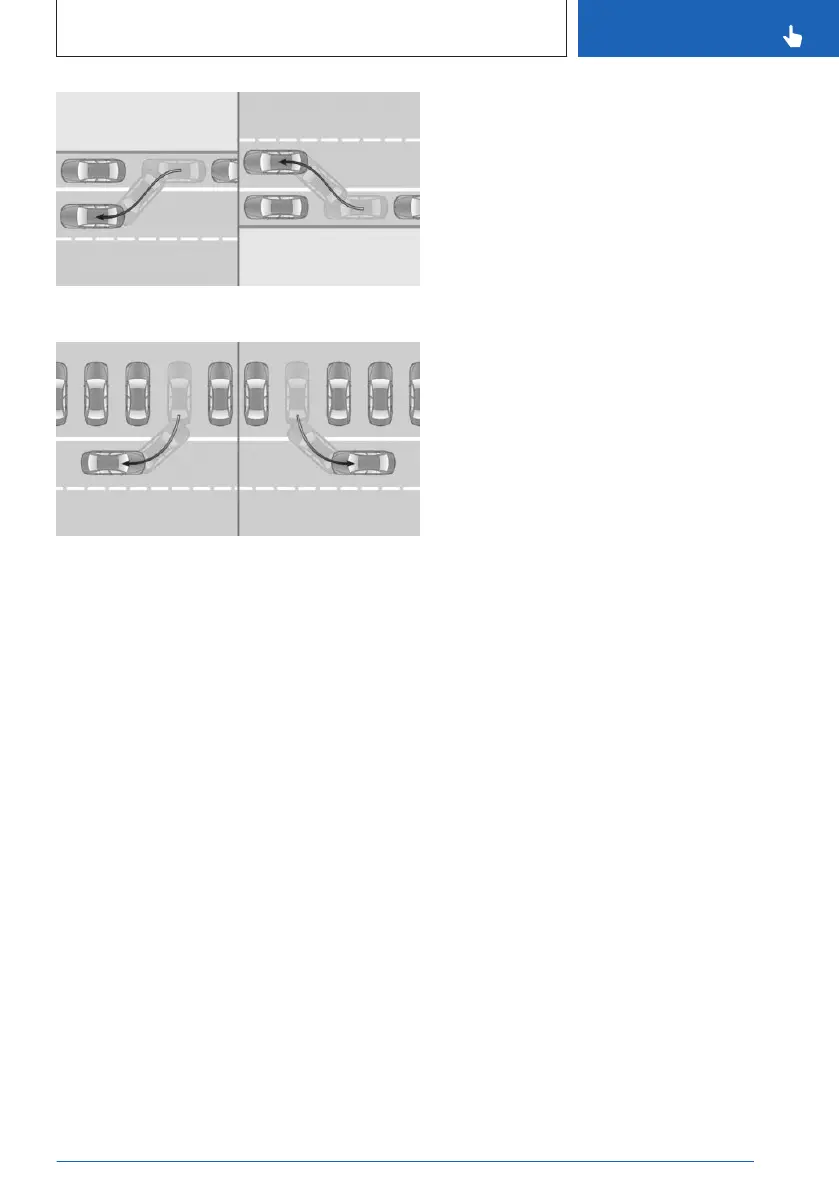
When driving out of parallel parking spaces.
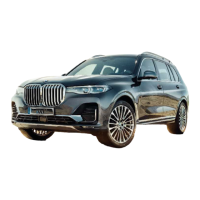
When driving out of perpendicular parking
spaces.
Sensors
The Automatic Parking Assistant is controlled
by the following sensors:
▷
Ultrasonic sensors in the front/rear bump-
ers.
▷ Ultrasonic sensors at the sides.
Functional requirements
Measurement of parking spaces
The following functional requirements apply
when measuring parking spaces:
▷
Driving forward: up to approx.
22 mph/35 km/h.
▷ Maximum distance to row of parked vehi-
cles: approx. 5 ft/1.5 m.
Suitable parking space
The following functional requirements apply for
suitable parking spaces:
Longitudinal parking:
▷ Minimum length of detected object, e.g.,
parking vehicle: approx. 3 ft/1 m.
▷ Minimum length of gap between two
objects: vehicle length plus approx.
2.6 ft/0.8 m.
▷ Minimum depth: approx. 5 ft/1.5 m.
Perpendicular parking:
▷ Minimum length of detected object, e.g.,
parking vehicle: approx. 3 ft/1 m.
▷ Minimum width of gap: vehicle width plus
approx. 2.3 ft/0.7 m.
▷ The minimum depth corresponds to your
vehicle's length.
The depth of perpendicular parking spaces
must be estimated by the driver. Due to
technical limitations, the system is only able
to approximate the depth of perpendicular
parking spaces.
Parking operation
The following functional requirements apply
when pulling into a parking space:
▷
The doors and cargo area are closed.
▷ The driver’s seat belt is fastened.
Leaving parking spaces
The following functional requirements apply
when pulling out of a parking space:
▷
The vehicle was parked using the Auto-
matic Parking Assistant, and an object has
been detected in the area around the vehi-
cle.
▷ The vehicle was manually parked in re-
verse, and objects have been detected in
the immediate vicinity of the vehicle. The
distance to a detected curb is at least 6 in-
ches/15 cm.
▷ The parking space is at least 2.6 ft/0.8 m
longer than the vehicle.
Seite 253
Parking
CONTROLS
253
Online Edition for Part no. 01405A8A536 - VI/23


 To Next Page