Warning
Different levels of braking may occur when
towing with adaptive recuperation. There is a
risk of accident, injury, and property damage.
Deactivate adaptive recuperation before tow-
ing.
NOTICE
If the tow bar or tow rope is attached incor-
rectly, damage to other vehicle parts can oc-
cur. There is a risk of property damage. Cor-
rectly attach the tow bar or tow rope to the
towing eye.
Tow bar
The towing eyes used should be on the same
side on both vehicles.
If it is not possible to avoid mounting the tow
bar at an incline, note the following:
▷ Free movement will be restricted when cor-
nering.
▷ The inclination of the tow bar will generate
lateral forces.
Tow rope
Observe the following notes when using the
tow rope:
▷ Use nylon ropes or straps, which will enable
the vehicle to be towed without jerking.
▷ Make sure the tow rope is not twisted when
fastening.
▷ Check the attachment of the towing eye
and tow rope in regular intervals.
▷ Do not exceed a towing speed of
30 mph/50 km/h.
▷ Do not exceed a towing distance of
3 miles/5 km.
▷ When driving off to tow the vehicle, make
sure that the tow rope is taut.
Towing eye
Principle
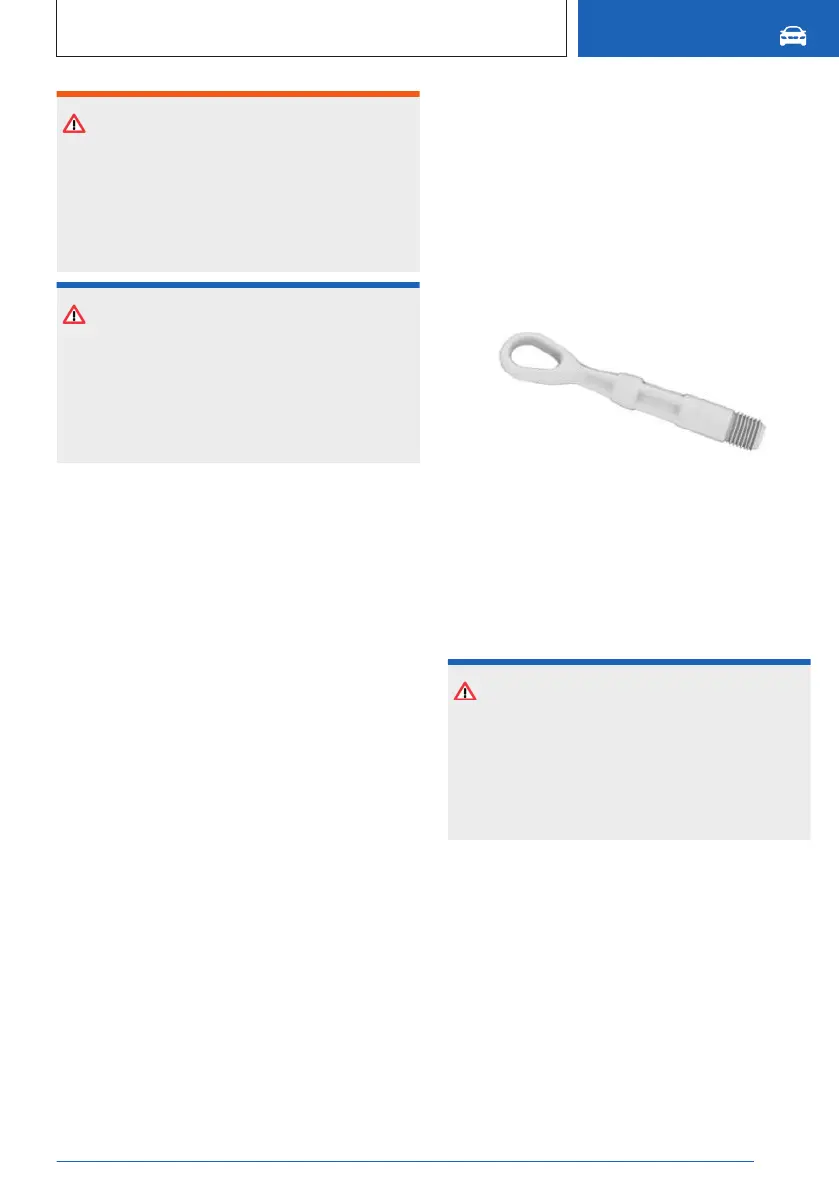
The towing eye is a device that can be
screwed onto the vehicle in order to, e.g., se-
cure tow cables or tow rods.
General information
The screw-in towing eye should always be car-
ried in the vehicle.
The towing eye can be screwed in at the front
or rear of the vehicle.
Safety information
NOTICE
If the towing eye is not used as intended,
there may be damage to the vehicle or to the
towing eye. There is a risk of property dam-
age. Follow the notes on using the towing
eye.
Storage
Depending on vehicle equipment, the towing
eye may be stored in a bag as follows:
▷ In the cargo area under the cargo area
floor.
▷ In the cargo area on the left or right side.
▷ In the cargo area behind a side trim panel.
Using the towing eye
When using the towing eye, note the following:
Seite 367
Breakdown Assistance
MOBILITY
367
Online Edition for Part no. 01405B46537 - VI/24



 To Next Page