
 Need help?
Do you have a question about the Bosch Condens 4700iW and is the answer not in the manual?
Details signal words and symbols used for warnings and information.
Outlines critical safety advice for appliance operation and usage.
How to find model and serial number on the data label.
Importance of annual servicing by a qualified engineer.
Requirements for sealed heating systems, including pressure checks.
How to check system pressure using the pressure gauge or menu.
How appliance indicates low system pressure and potential faults.
Investigating frequent pressure increases and potential leaks.
Operation for semi-sealed systems, noting automatic topping-up.
Guide to topping up system pressure for sealed systems.
Instructions for using keyless filling link to repressurise the system.
Instructions for using keyed filling link to repressurise the system.
Details on repressurising the system using an external filling loop.
Identifies and explains functions of control panel buttons and displays.
Lists and describes functions of each control panel key.
Explains meaning of various symbols appearing on the appliance's display.
Guides on setting the maximum flow temperature for heating.
Instructions for setting the domestic hot water (DHW) temperature.
Advises on setting room temp and energy saving via heating controller.
Explains how to navigate and change settings within the appliance's menu.
Details various menu settings like time programs and system info.
Describes different states of the LED on the Key accessory.
Guides on setting time programs for heating and hot water.
Explains how to set frost protection to prevent system freezing.
Specifies minimum clearances around appliance for installation and maintenance.
Details specific requirements for reduced front clearance installations.
Specifies minimum clearances for appliances installed in roof spaces.
Guidance on ensuring adequate air supply and avoiding obstructions.
User responsibilities for system safety and recommended annual servicing.
Instructions on how to clean the appliance casing safely.
Essential checks before contacting a service engineer for faults.
Section to record installer/engineer contact information.
How to perform a fault reset and interpret fault codes.
Specific advice for fault code 2980, requiring immediate engineer contact.
Guidance on preventing and thawing frozen condensate pipes.
Flowchart to diagnose and troubleshoot system gassing issues.
Information on packaging disposal and recycling.
Guidance on recycling and disposing of old electrical and electronic appliances.
Explains Quick Tap for saving water during hot water use.
Advice on optimizing heating for comfort and energy efficiency.
Information on registering the product guarantee and terms.
Presents detailed energy consumption data for natural gas appliances.
Details energy consumption data specific to LPG models.
Explains how personal data is processed, stored, and protected by Bosch.
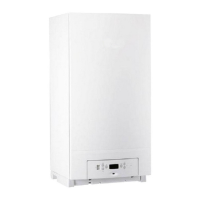
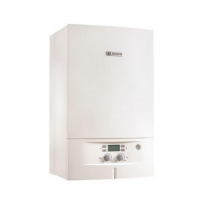
This document provides user instructions for the Bosch Condens 4700iW gas-fired condensing appliance, available in models GC4700iW 24/25 C and GC4700iW 24/30 C. It covers operation, maintenance, and safety information for the heating system operator.
The Bosch Condens 4700iW is a gas-fired condensing boiler designed for heating boiler water and domestic hot water (DHW). It can be connected to either a sealed or semi-sealed heating system. In a sealed system, the appliance is pre-pressurized and requires regular pressure checks and refilling if the pressure drops below 0.8 bar. A semi-sealed system, conversely, is automatically topped up from a header tank and operates at very low system pressures, potentially displaying "0 pressure" without indicating a low-pressure fault. The appliance features a control panel with a display, navigation buttons, and dedicated keys for heating mode, DHW mode, menu access, selection/saving settings, and a back arrow. It includes a burner display that illuminates when the burner is active.
The appliance's maximum flow temperature can be adjusted between 30 °C and 82 °C, with typical settings around 50 °C for underfloor heating and 65 °C for radiator heating systems. For DHW, the temperature can also be set, with a warning about potential scalding if the central heating temperature is set too high. The appliance is supplied with the CH control set at approximately 65 °C.
Regarding energy consumption, the natural gas models (GC4700iW 24/25 C NG and GC4700iW 24/30 C NG) have a rated heat output of 24 kW and a seasonal space heating energy efficiency of 94%, earning an Energy Efficiency Class A. Useful heat output at rated capacity (high temperature regime) is 24 kW, and at 30% rated capacity (low temperature regime) is 8.1 kW. Useful efficiency is 87.9% at high temperature and 98.9% at low temperature. Auxiliary electricity consumption is 0.039 kW at full load, 0.013 kW at part load, and 0.002 kW in standby mode. Standby heat loss is 0.061 kW. Emissions of nitrogen oxides (NOx) are 40 mg/kWh. Annual energy consumption is 20556 kWh (74 GJ). The sound power level indoors is 45 dB. For combination heaters, the declared load profile is XL, water heating energy efficiency is 85%, and water heating energy efficiency class is A. Daily electricity consumption is 0.173-0.180 kWh, and annual electricity consumption is 38-40 kWh. Daily fuel consumption is 22.908 kWh, and annual fuel consumption is 18 GJ.
LPG models (GC4700iW 24/30 C LPG and GC4700iW 24/25 C LPG) share similar specifications: rated heat output of 24 kW, seasonal space heating energy efficiency of 94%, and Energy Efficiency Class A. Useful heat output and efficiency values are identical to the natural gas models. Auxiliary electricity consumption, standby heat loss, NOx emissions, annual energy consumption, sound power level, and combination heater data are also consistent with the natural gas variants.
The appliance offers various operational modes, including heating mode (On, Auto, Advance, Off) and DHW mode (On, Auto, Once, Off (eco)). The "Auto" setting allows heating or DHW to operate according to programmed times, while "Advance" moves to the next on/off time. "Off (eco)" for DHW preheat puts the boiler in eco mode. The control panel allows users to navigate menus, adjust settings, and view appliance status codes and diagnostic information during faults. A "Cleaning mode" locks the screen for 15 seconds for cleaning.
For sealed heating systems, the appliance can be refilled using a "keyless filling link" or a "keyed filling link," both located underneath the appliance on the right-hand side. An external filling loop can also be used. Users are instructed to monitor the pressure menu indicator, ensuring it remains in the green zone (normal pressure) after refilling. The "Quick Tap" function is designed to save water by preheating DHW; users fully open and close the hot water tap for a few seconds, wait up to 30 seconds for the boiler to prepare hot water, and then open the tap again for hot water. This can save an average of 3.5 litres of water.
Regular maintenance is crucial for the appliance's safe, reliable, and environmentally optimum operation. An annual service by a competent, qualified engineer is recommended, and a service contract is advised. The "Benchmark Checklist" and "Service Record" at the rear of the Installation and Maintenance Instructions manual should be completed by the installer and service engineer after each service. Original spare parts should always be used to maintain efficiency, safety, and reliability.
Users are advised to regularly check the system pressure in sealed heating systems and to contact an installer or maintenance engineer if a permanent significant decrease or increase in pressure is observed, or if frequent refilling is needed. If the system pressure repeatedly increases and air needs to be vented from radiators, it may indicate system gassing, which requires investigation.
In extreme cold weather, the condensate pipework can freeze, causing the boiler to shut down. Users can thaw a frozen pipe at ground level by applying a hot water bottle, a microwaveable heating pack, or a cloth soaked in hot water to the exterior of the pipe. Hot water (not boiling) can also be poured onto the pipe. After thawing, the appliance should be reset. If a fault persists, users should contact the Bosch appointments team or their installer, providing the displayed fault code. Fault 2980, in particular, requires immediate attention from a qualified heating engineer due to safety concerns.
The appliance casing should be wiped with a soft, clean cloth, avoiding chemical cleaning products. Minimum clearances around the appliance must be maintained for service and maintenance access, especially in roof spaces, where specific access and working area requirements apply, including a permanently fixed, retractable loft ladder, safety guards, and fixed lighting. Ventilation must not be restricted or contaminated.







 To Next Page
 General