
 Need help?
Do you have a question about the Bosch Condens 7000 F and is the answer not in the manual?
Defines signal words, warnings, and symbols used in the manual.
Provides essential safety guidelines for the heating system operator.
Specifies the intended application and use of the gas condensing boiler.
States the product's compliance with European and national regulations.
Identifies the designated importer for Great Britain.
Details technical specifications and energy consumption data for various models.
Advises on the appropriate water quality requirements for the heating system.
Provides a general description of the boiler's main components and features.
Briefly describes the available optional control units for the boiler.
Guides on the initial steps to switch on the boiler using a control unit.
Introduces the MX25 control unit, showing its components and user interface.
Details the various control elements and buttons on the MX25 unit.
Explains the procedure for turning the boiler on via the MX25 control unit.
Guides on how to activate or deactivate the heating function using the MX25.
Presents the CC8313 control unit, its housing, and physical control elements.
Explains the purpose and function of the keys on the CC8313 user interface.
Describes key function buttons and how to interpret system status indicators.
Details the function and usage of the reset button for fault clearing.
Explains the operation of the chimney sweep button for flue gas testing.
Covers the buttons used for manual and emergency operation modes.
Guides on how to turn on and activate the CC8313 control unit.
Explains the lock screen feature for unauthorized access protection.
Details the various elements and icons on the CC8313 touch screen.
Shows how to access and interpret the overall system status on the CC8313.
Explains how to select and manage connected control units in the system.
Details how to access functions and messages of networked control units.
Illustrates how to view heat production status and sensor values on the display.
Provides general guidance on navigating and operating the CC8313 touch screen.
Explains how to navigate through menu levels and select specific functions.
Guides on how to access and utilize submenus for advanced settings.
Describes how to access the information menu to view system details.
Covers essential steps for initial system setup and maintenance.
Details the procedure for checking the heating system's operating pressure.
Explains how to add heating water and remove air from the system.
Guides on the correct procedure to switch on the heating system.
Explains how to properly shut down the heating system using the control unit.
Provides instructions for immediate emergency shutdown procedures.
Information on the responsible disposal of old electrical and electronic equipment.
Guidance on the correct disposal of batteries.
Explains the benefits and necessity of regular servicing for the heating system.
Provides instructions for cleaning and maintaining the boiler's exterior.
Guides on identifying operational issues and clearing common faults.
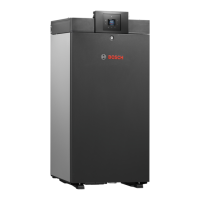
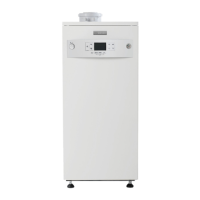
The Bosch Condens 7000 F is a floor-standing gas condensing boiler designed for both domestic hot water (DHW) and central heating. It features an aluminium heat exchanger and is available in various nominal heat output capacities ranging from 69 kW to 280 kW. The boiler is designed to operate with approved gases and complies with European and national requirements, as indicated by its CE marking.
The Condens 7000 F boiler's primary function is to generate heat for central heating and domestic hot water. It achieves this through a gas burner with a burner rod, transferring heat to the heating water via its aluminium heat exchanger. Thermal insulation helps reduce radiation and standby losses, contributing to efficiency. The boiler's operation is managed by a control unit, which monitors and controls all electrical components. Depending on the specific model, the boiler can be operated via either the CC 8313 or MX25 control unit. These control units enable standard operations such as switching the heating system on/off, setting DHW temperature, and adjusting the maximum boiler temperature in heating mode. Advanced monitoring, diagnosis, and control can be achieved through a mobile terminal device, PC, or tablet when combined with the relevant control unit and App or Web Portal.
The Condens 7000 F series offers a range of models with varying nominal heat outputs (Prated) from 69 kW (GC7000F 75) to 280 kW (GC7000F 300). Useful efficiency at rated output and high-temperature operation (η4) is consistently around 88.1% to 88.3%. At 30% of rated output and low-temperature operation (η1), the efficiency is higher, ranging from 97.7% to 98.1%. Auxiliary power consumption at full load (elmax) varies from 0.083 kW to 0.336 kW, while at part load (elmin) it ranges from 0.028 kW to 0.057 kW. In standby mode (PSB), power consumption is minimal at 0.009 kW across all models. Standby heat loss (Pstby) ranges from 0.161 kW to 0.298 kW. NOx emissions are also specified, ranging from 32 mg/kWh to 49 mg/kWh. The boiler requires specific water quality for filling and topping up, with instructions provided in the operator's log, and softened water should not be used.
The boiler's control units offer a user-friendly interface for operation. MX25 Control Unit: This unit features a main power switch, appliance fuse, and various buttons for common functions: "fav" for favourites, "man" for manual operation, "auto" for automatic mode, "menu" for calling up menus, "info" for information and help, and a "Back" key. A selector knob allows for selection and confirmation. Special keys include a flue gas inspector, reset, and emergency operation key. An LED status indicator provides visual feedback. The MX25 enables activation of chimney sweep mode, displays status for boiler and burner operation, allows resetting of locking faults, and activates emergency operation. CC8313 Control Unit: This unit features a touch screen display, an ON/OFF switch, miniature circuit breakers, and function keys for Reset, Chimney sweep (flue gas test), and Manual operation. An LED status display provides system status. The touch screen allows navigation through various menu levels to view system overview, heat sources, heat consumers, networked control units, and monitor data. A lock screen with a 4-digit password protects against unauthorised access. The display shows boiler temperature and can switch to sleep mode to reduce power consumption. The system overview provides information on heat production, control unit status, and internet connection status.
Regular inspection and maintenance are crucial for safe, economical, and environmentally responsible operation. Heating systems should be serviced regularly to maintain high efficiency, operational reliability, and clean combustion. It is recommended to arrange an annual inspection and demand-dependent maintenance contract with an authorised contractor. Maintenance and repairs must only be carried out by authorised personnel, and any faults should be rectified immediately to prevent system damage. Only genuine spare parts supplied by Bosch should be used. For cleaning, the boiler casing should be cleaned with a damp cloth and soapy solution; abrasive or aggressive cleaning agents should be avoided. The flue system must be checked annually, and any damaged parts due to corrosion or other causes should be replaced. The boiler should only be operated with its casing fitted and closed. The operating pressure needs to be checked regularly, ensuring the pressure gauge needle is within the green band. If it drops, heating water must be topped up, but only when the system is cold and the maximum flow temperature is 40°C, to prevent thermal stress. Frequent topping up may indicate system damage, and a certified heating contractor should be consulted regarding water quality and treatment. The chimney sweep button on the control units activates a flue gas test, which is performed according to specified minimum/maximum boiler temperature and performance settings. During this test, the heat source emits heat until the maximum boiler temperature is reached. In case of a fault, a fault code flashes on the control unit display, and the corresponding technical documentation should be consulted for rectification. If a fault cannot be cleared, the fault message should be noted, and a heating contractor notified. For environmental protection, used appliances contain valuable recyclable materials and should be disposed of at waste collection points for treatment, recycling, and disposal, in accordance with local regulations. Batteries must also be disposed of in local collection systems.







 To Next Page

 General