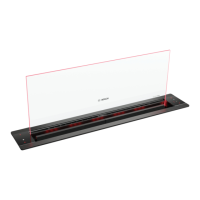
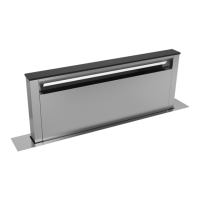
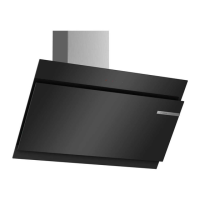
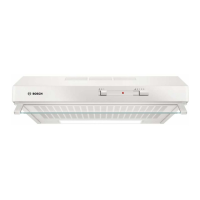
This document is a user manual and installation guide for a Bosch extractor hood, specifically models DDW88MM65 and DDW88MM66. It provides comprehensive instructions for safe operation, maintenance, and installation, along with information on environmental protection, energy saving, and smart home connectivity.
The primary function of the extractor hood is to remove cooking vapor from the kitchen. It can operate in two modes: air extraction mode and air recirculation mode. In air extraction mode, the air is cleaned by grease filters and then discharged to the exterior through a pipe system. In air recirculation mode, the air is cleaned by both grease filters and an odour filter before being returned to the room. For optimal performance in recirculation mode, an odour filter must be installed. The manual emphasizes that the appliance is designed to be built into kitchen units and should only be used for extracting cooking vapor in private households and enclosed domestic spaces, up to an altitude of 4000 meters above sea level. It explicitly warns against using the appliance with a gas hob or an external timer.
The control panel features various buttons and indicators for managing the appliance's functions. Users can switch the appliance on or off, adjust the fan setting (from 1 to 3, with two intensive modes), and activate or deactivate the automatic mode. The automatic mode utilizes a sensor to detect cooking odors and adjust the fan speed accordingly. The sensor sensitivity can be customized to react more or less strongly to odors. The appliance also includes a "Guided Air" function, which is designed to improve the collection and removal of cooking vapor, especially from front cooking zones. This function is off by default and can be switched on or off as needed.
The extractor hood is equipped with saturation indicators for both grease and odour filters. These indicators flash after the appliance is switched off when the filters are saturated, prompting the user to clean or replace them. The saturation indicator can be adjusted based on the type of filter used (e.g., for clean air standard circulating-air sets, clean air plus circulating-air sets, or regenerable filters). After cleaning or replacing filters, the saturation indicator can be reset.
For enhanced connectivity, the appliance is Home Connect enabled. This feature allows users to control the extractor hood's functions, adjust basic settings, and monitor its operating status via the Home Connect app on a mobile device. The app also facilitates software updates for optimization, troubleshooting, and security. The manual provides detailed instructions for setting up Home Connect, including downloading the app and scanning a QR code for registration. It also explains how to reset the connection and highlights the availability of remote diagnostics through customer service.
Maintenance is crucial for the appliance's longevity and efficiency. The manual provides detailed instructions for cleaning various parts of the extractor hood. It specifies cleaning products to use and avoid, emphasizing the importance of not using harsh or abrasive detergents, high-alcohol content cleaners, or hard scouring pads. The glass panel, controls, and lights require careful cleaning with damp sponge cloths and hot soapy water, followed by drying with a soft cloth. The drip tray, which collects liquid during cooking or cleaning, should be removed, emptied, cleaned, and re-inserted regularly.
The grease filters can be cleaned either manually or in a dishwasher. For manual cleaning, they should be soaked in hot soapy water, brushed, rinsed thoroughly, and allowed to drain. For dishwasher cleaning, they should be placed loosely in the dishwasher, ensuring they are not squeezed, and washed at a temperature of no more than 70°C. The manual also describes how to remove and clean the grease filter cartridges. It warns against bending the grease filters to avoid damage and stresses the importance of regular cleaning to prevent fatty deposits from catching fire.
Safety is a paramount concern throughout the manual. It includes warnings about the risk of fire from unsuitable appliance combinations (e.g., gas hobs), suffocation from packaging materials, poisoning from flue gases being drawn back into the living space (especially when operating in exhaust air mode simultaneously with room-air-dependent heat-producing appliances), burns from hot surfaces, and electric shock from damaged power cords or moisture ingress. Users are advised to wear protective gloves when cleaning the interior due to sharp edges and to seek professional assistance for any repairs.
Installation instructions cover general information, appliance dimensions, and specific steps for secure installation. It emphasizes observing building regulations, local electricity and gas supplier regulations, and legal requirements for exhaust air discharge. The manual provides guidelines for installing the appliance in a worktop, including clearances and the use of flat or round ducts for the exhaust air pipe. It also details how to prepare the appliance for installation, including removing transit bolts and attaching seals, and how to physically install it into the cut-out, connect cables, and insert the glass pane and grease filters. The importance of ensuring the worktop has sufficient load-bearing capacity and stability is highlighted.



 To Next Page

 General