
 To Next Page

M
Mary BrownJul 27, 2025
How to fix H and ! symbols displayed on Bosch Boiler?
- CCassandra MillerJul 27, 2025
If the H and ! symbols are displayed, press and hold the key until the symbols disappear.

How to fix H and ! symbols displayed on Bosch Boiler?
If the H and ! symbols are displayed, press and hold the key until the symbols disappear.
What to do if only H appears on Bosch Gaz 6000 W Boiler display?
If only the H symbol appears, switch the device off and on again using the K key.
Defines signal words like DANGER, WARNING, CAUTION, and NOTICE for risk communication.
Provides essential safety guidelines for the heating system operator.
User responsibility for safe operation; recommends annual inspection.
Warns against improper modifications and emphasizes work by approved contractors.
States compliance with European Directives and mentions CE marking.
Describes WBN 6000 CR (combi boiler) and WBN 6000 HR (central heating/DHW).
Instructions on how to open the service valves for the heating system.
Explains how to check operating pressure and recommends 1-2 bar.
Guide on adding heating water, warning against topping up with cold water.
Details the function of buttons and displays on the appliance's control panel.
Instructions for turning the appliance on using the power key.
How to adjust the maximum flow temperature between 40°C and 82°C.
Guide to setting the domestic hot water temperature between 35°C and 60°C.
Instructions to activate summer mode, where heating is switched off but DHW is retained.
Procedure for turning the device off or setting it to standby mode.
Explains device frost protection and system frost protection measures.
Explains modulating control for efficient heating and reduced fuel consumption.
Recommends room temperature-dependent or weather-compensated controllers.
Guidance on using thermostatic valves for optimal room temperature.
Advises on setting flow temperature for underfloor heating systems.
Proper ventilation techniques for rooms with the heating system.
Tips for energy saving and preventing calcification with DHW settings.
Instructions for setting the DHW circulation pump's time program.
Information on country-specific recycling processes for packaging materials.
Guidance on dismantling and recycling used appliance components.
Definition of operating pressure in the heating system.
Explanation of how the appliance heats water as it flows through.
Definition of a heating controller's function in automatic temperature control.
Definition of the pipework returning heating water to the appliance.
Definition of the pipework supplying heated water from the appliance.
Definition of the water used to fill the heating system.
Definition of mechanical temperature controllers for heating water flow rate.
Definition of a siphon as a stench trap for draining water.
Definition of the temperature of heated water flowing to radiators.
Definition of a pump circulating hot water between storage and draw-off points.
This document provides operating instructions for the Bosch Gaz 6000 W wall-mounted gas boiler, specifically models WBN 6000-24/28/35 CR/HR N/L. It covers essential information for safe and efficient operation, including an explanation of symbols, safety instructions, product information, preparation for operation, operating the appliance, shutdown procedures, energy-saving tips, troubleshooting, and maintenance.
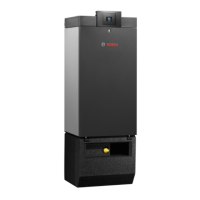
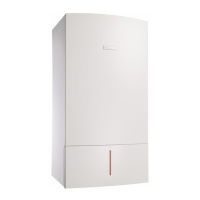
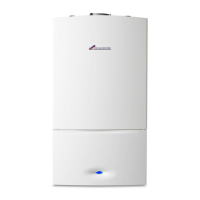
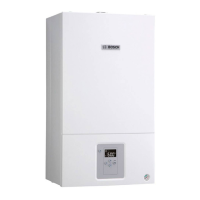
The Bosch Gaz 6000 W is a wall-mounted gas boiler designed for heating boiler water and domestic hot water (DHW). The WBN 6000-.. CR appliances function as combi boilers, providing central heating and instantaneous DHW heating. The WBN 6000-.. HR appliances are designed for central heating and DHW heating, featuring a heating circuit pump and a 3-way valve for connection to an indirectly heated cylinder.
The boiler's electronics continuously monitor all safety and control components. In the event of a fault, an error symbol and code will be displayed, indicating a problem that may require attention from an approved contractor. The device also incorporates an anti-seizing function that prevents the heating pump and 3-way valve from seizing up during long periods of inactivity, remaining active even in standby mode.
For thermal disinfection, particularly relevant for WBN 6000-.. HR models, the boiler can be used to prevent bacterial contamination, such as legionella, in hot water after long periods of inactivity.
To prepare the boiler for operation, users need to open the service valves by pushing the handle down and turning it to the left until it locks in the flow direction. The operating pressure of the heating system, typically between 1 and 2 bar, can be checked on the pressure gauge. If the pressure is too low, heating water must be topped up using the filling valve located at the bottom of the appliance. It's crucial to top up heating water only when the appliance is cold to prevent stress cracks in the heat exchanger. The maximum pressure should not exceed 3 bar.
The appliance is switched on using the power key, after which the display shows the heating water flow temperature. Users can adjust the maximum flow temperature for central heating between 40 °C and approximately 82 °C. The DHW temperature can be set between 35 °C and 60 °C. For hard water areas (≥ 15°dH/27°fH/2.7 mmol/l), it is recommended to set the DHW temperature to less than 55 °C to prevent limescale buildup.
The boiler offers a summer mode, which switches off the heating pump and central heating while retaining DHW and power supply for the heating control device and timer. This mode provides frost protection for the device itself, but users should observe additional frost protection measures for the entire heating system if there is a risk of frost.
For energy saving, the boiler features modulating control, which adjusts the fuel supply based on heat demand, leading to lower fuel consumption over longer operating periods. Using room temperature-dependent controllers or weather-compensated control units with thermostatic valves can further optimize heating system performance. For underfloor heating, the flow temperature should not exceed the manufacturer's recommended maximum. When ventilating, it's advised to close thermostatic valves and open windows fully for a short time, rather than leaving them slightly open. Setting the DHW temperature as low as possible also contributes to energy savings and reduces calcification. If a DHW circulation pump is installed, it should be set with a time program to suit individual requirements.
Regular inspection and maintenance are crucial for the safe and environmentally compliant operation of the heating system. It is recommended to enter into an annual inspection and demand-dependent maintenance contract with an authorized contractor. All work should be carried out by an approved contractor, and any discovered faults should be remedied immediately.
For cleaning the casing, users should avoid aggressive or corrosive cleaning agents and instead wipe the casing with a damp cloth.
In case of a fault indicated by the A symbol and flashing fault code, pressing and holding the reset key will attempt to clear the fault and return the device to operation. If only the A symbol appears, switching the device off and on again with the power key may resolve the issue. If a fault persists, an approved contractor or customer service should be contacted, providing the fault code and device details, which can be found on the data plate under the control panel cover.
 General
| Fuel Type | Natural Gas |
|---|---|
| Efficiency (%) | 93% |
| NOx Class | 5 |
| Mounting | Wall-mounted |
| Central Heating Output (kW) | 24 kW |
| Efficiency | 93% |
| Type | Combination Boiler |