
 Need help?
Do you have a question about the Bosch Worcester Greenstar 24i junior and is the answer not in the manual?
Critical steps to take immediately if gas smell is detected, including no ignition sources and calling the gas company.
Mandates installation by Gas Safe registered persons and prohibits unauthorized modifications to maintain warranty.
Stresses the necessity of regular servicing by qualified personnel to maintain performance and warranty.
Details the function of each control element on the boiler panel, including temperature, indicators, and buttons.
Instructions for switching the boiler on and off at the mains supply, and the effect on frost protection.
Details how to activate frost protection by leaving the boiler powered and setting the temperature low.
Explains the ECO button function for domestic hot water pre-heating to reduce wait times.
Describes how fault indicators and lights behave when the boiler encounters a problem.
Step-by-step guide on how to reset the boiler after a fault occurs.
Advises contacting Worcester, Bosch Group for persistent faults, providing necessary information.
Stresses the need for regular maintenance to ensure peak efficiency and longevity.
Provides solutions for problems like room temperature not reached, radiators too hot, or heating staying on too long.
Outlines conditions for receiving free parts and labour under warranty, including installation and servicing evidence.
Guides users on contacting the Service Department for breakdowns and the expected response times.
Outlines the 2-year guarantee period, coverage for faulty materials/workmanship, and usage limitations.
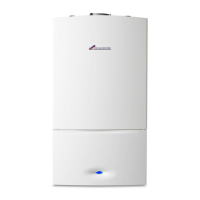
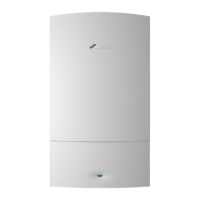
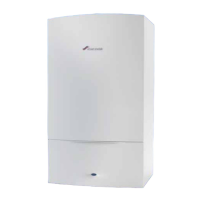
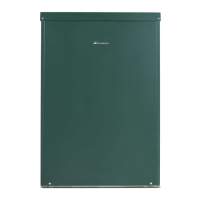
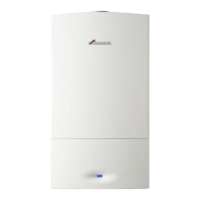
This document is the User Instructions & Customer Care Guide for the Worcester Bosch Greenstar 24i junior and 28i junior wall-hung, gas-fired condensing combination boilers. It provides comprehensive information for users on operating, maintaining, and understanding their boiler, as well as safety precautions and energy-saving tips.
The Greenstar 24i junior and 28i junior boilers are designed to provide both central heating (CH) for sealed systems and domestic hot water (DHW). As condensing boilers, they are highly energy-efficient, operating in SEDBUK Band A, which means they are among the top energy-rated boilers available. The boiler's gas supply to the burner is controlled by modulating control, which adjusts the flame level based on heat demand. This allows the boiler to operate with a low flame for extended periods, reducing temperature fluctuations and providing even heat distribution throughout the home, ultimately using less gas than boilers that constantly switch on and off. The hot water temperature is fixed at 55°C. The boiler also features a pre-heat function for domestic hot water, which reduces the time taken to produce hot water at the tap. This pre-heat function can be toggled on or off using the ECO button.
The boiler is fitted to a sealed heating system, which is pre-pressurised. Users are advised to regularly check the pressure gauge and contact an installer or maintenance engineer if a significant drop in pressure is observed. The boiler also incorporates a condensate drain, which regularly discharges condensate via a syphon to a drain, a normal function for a condensing boiler.
For safety, the boiler is a room-sealed appliance, meaning it does not require air for combustion from inside the property. If installed in a cupboard or compartment, the space around the boiler must be separated by a perforated non-combustible partition as described in BS 6798. The flue terminal, located on the outside wall or roof, must not be obstructed or damaged for safe operation.
The boiler includes a pump anti-seizure feature. If there has been no heating demand for 24 hours, the system pump will run for a few seconds to prevent seizure during long periods of inactivity, particularly during summer months.
Operating the boiler involves a few straightforward steps. To access the controls, users push at the top of the flap to release it. The main controls include a central heating temperature control knob, a mains on/off indicator (which also serves as a fault diagnostic light), a green burner on indicator light, an ECO button for domestic hot water pre-heat, a fault reset button, and a system pressure gauge. There is also a position for an optional programmer.
Switching the boiler on/off: The boiler is switched on at the mains supply, indicated by a blue light. It is generally not necessary to switch the boiler off unless a fault occurs. To switch off, the mains supply should be turned off, which will extinguish the blue indicator light. It's important to note that frost protection is disabled when the boiler is switched off.
Setting the central heating temperature: The temperature control knob allows users to set the desired central heating temperature. A table in the manual provides approximate temperatures for each setting, ranging from 40°C to 82°C. When the burner is active, the green burner on indicator light illuminates.
Controlling central heating: Effective central heating control involves setting the timer correctly, adjusting the room thermostat to the desired temperature, and setting thermostatic radiator valves (TRVs) to desired levels. It is recommended to fit TRVs to all but one radiator, with the uncontrolled radiator located where the room thermostat is.
Frost protection: For periods when the boiler is not in use, users should leave the power on and turn the temperature control to the frost protection setting (indicated by a snowflake symbol). If the boiler's internal temperature drops below 5°C, it will periodically fire to prevent freezing. For remote pipework exposed to low temperatures, an additional frost thermostat installed by the engineer is recommended.
Domestic hot water pre-heat: The ECO button controls the domestic hot water pre-heat function. When the ECO button is not illuminated, the boiler is in pre-heat mode, reducing the wait time for hot water. When the ECO button is illuminated, the boiler operates in ECO mode without pre-heat. Users press and hold the ECO button to toggle between these two states.
Fault condition: In the event of a fault, the reset button will flash once per second, and the mains indicator (blue light) will flash at different speeds, depending on the specific fault. To clear a fault, users press the reset button. The reset button will then cease to be illuminated, and the mains indicator will stop flashing, allowing the boiler to resume normal operation if the fault is resolved. If the fault persists after resetting, or if electrical power has been interrupted (which also triggers a "reset fault"), users are advised to contact Worcester, Bosch Group for assistance, providing a description of the fault and, if possible, the flashing sequence of the mains indicator.
The manual emphasizes that regular servicing and maintenance by a competent, qualified person (such as a Worcester service engineer or a Gas Safe registered person) are essential to ensure the boiler's maximum working life, peak efficiency, and performance beyond the initial 2-year guarantee period. Original spare parts should always be used to maintain the boiler's economy, safety, and reliability.
Benchmark Checklist: A critical aspect of maintenance and warranty is the Benchmark Checklist and Service Interval Record. Installers are required to complete all details, including their Gas Safe registration number, and sign to confirm correct installation and commissioning. Service engineers must complete the Service Record in the Benchmark Checklist after each service. This checklist is vital for any warranty work and may be required by the local Building Control Inspector.
Fault finding: The manual includes a fault-finding table to help users diagnose basic operating system problems before contacting service. This table lists common problems, their causes, and suggested remedies. For example, if the desired room temperature is not reached, causes could include thermostatic radiator valves set too low or the CH flow temperature control on the boiler being set too low. Remedies include increasing TRV settings or increasing the CH flow temperature control. If radiators are too hot, the cause might be radiators being set too high, with the remedy being to turn down TRVs or the room thermostat. Air trapped in the heating system is remedied by bleeding radiators and recharging the system.
Breakdown support: Worcester, Bosch Group provides support in the UK and Eire with specially trained service engineers. No charge is made for parts and labour if a boiler fault is found within 24 months of installation, provided reasonable evidence (e.g., the Benchmark Checklist) is supplied. A call-out charge applies if the boiler is over 24 months old, if evidence of the first-year service inspection is not provided, if no fault is found by the engineer, or if the breakdown is due to misuse, other plumbing/heating system parts, or equipment not supplied by Worcester, Bosch Group. The manual explicitly states that over 30% of service call-outs find no boiler fault, urging users to thoroughly read the guide and fault-finding section before contacting support.
Guarantee: The boiler comes with a 2-year guarantee against faulty material or workmanship from the date of installation. To validate the second year of the guarantee, the Guarantee Registration Card must be returned within 30 days of purchase. The guarantee covers the exchange or repair of faulty or defective components free of charge by Bosch Thermotechnology Ltd. However, the householder may need to prove the installation date, correct commissioning, and first-year service inspection. The guarantee is invalidated by faulty installation, neglect, misuse, accidental damage, or non-observance of instructions. It applies only to equipment purchased and used in the United Kingdom and Eire and does not affect statutory rights.
Energy-saving tips: The manual provides advice on heating economically, including setting the boiler's temperature control to maximum for central heating systems with room thermostats and TRVs, and individually setting room temperatures using TRVs. It also recommends upgrading heating control systems with a programmer, interlocking room thermostat, and TRVs. Other tips include improving roof insulation (preferably 200mm thick or more), considering double-glazed windows, and using lined or heavy full-length curtains (ensuring they don't drape over radiators). Users are also advised to reduce draughts around doors and windows, but not to block air vents necessary for safe boiler operation. Reducing the room thermostat setting by 1°C can reduce fuel consumption by up to 10%. Regular manual adjustment of TRVs every 2-3 months is recommended to prevent sticking, and care should be taken to avoid damaging valves and pipework during cleaning.
 General
| Type | Combi Boiler |
|---|---|
| Output | 24 kW |
| Fuel Type | Natural Gas |
| Mounting | Wall Mounted |
| Max. Central Heating Output | 24 kW |
| Central Heating Flow Temperature Range | 35-82°C |
| Maximum Working Pressure | 3 bar |
| Warranty | 2 years |
| Dimensions | 700mm x 400mm x 330mm |
| Flow Rate | 9.8 l/min |



 To Next Page