
 Need help?
Do you have a question about the Boss PS-3 and is the answer not in the manual?
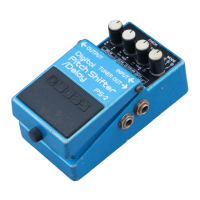
Details the power requirements and recommended usage for the unit.
Provides guidance on optimal operating and storage conditions for the unit.
Outlines safety measures to prevent damage or malfunction.
Explains the procedure for replacing the unit's battery.
Describes the power-up sequence and protection circuit behavior.
Details the connection for an optional AC adaptor.
Explains the function of the indicator light and battery check.
Describes connection points for audio output to amplifiers or devices.
Details the function of the pedal switch for turning effects on/off.
Explains the thumbscrew used for accessing the battery compartment.
Covers input signal connection and its role in battery power switching.
Describes connection for optional expression pedals or foot switches.
Details the first delay mode with its specific time range.
Describes the second delay mode with its time range.
Explains the third delay mode and its extended time range.
Details the single pitch shift mode for creating a detune effect.
Describes a fast single pitch shift mode up to +/- 2 octaves.
Details a slow single pitch shift mode for precise pitch alterations.
Explains the inverse single pitch shift mode for reversed pitch effects.
Describes a dual pitch shift mode for expansive detune effects.
Details a dual pitch shift mode with detune and +/- 2 oct effects.
Explains a dual pitch shift mode with two +/- 2 octave shifts.
Describes how to use an expression pedal to control pitch shift.
Explains how to connect and use foot switches with the EXP jack.
Details the Adaptive Focus Method for quantization noise reduction.
 General
| Input Impedance | 1 MOhm |
|---|---|
| Output Impedance | 1 kOhm |
| Modes | Pitch Shifter, Delay, Pitch Shifter/Delay |
| Controls | Fine Tune |
| Inputs | 1 x 1/4" |
| Outputs | 1 x 1/4" Mono Output |
| Power Supply | 9V DC |
| Dimensions | 73mm x 129mm x 59mm / 2.9" x 5.1" x 2.3" |
| Bypass | Buffered |


 To Next Page
