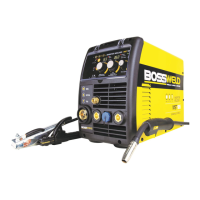
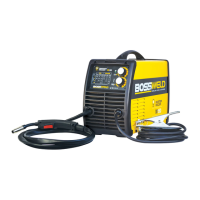
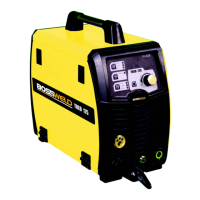
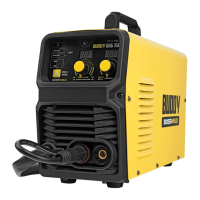
The BUDDY MIG 150 is an inverter welder designed for both MIG (Metal Inert Gas) and MMA (Manual Metal Arc, or Stick) welding processes. This versatile machine is suitable for a range of welding tasks, offering both gasless and gas-shielded MIG welding capabilities, as well as stick welding.
Function Description:
The BUDDY MIG 150 serves as a portable and efficient welding solution. For MIG welding, it can operate in both Manual and Synergic modes. In Manual MIG mode, the user has independent control over voltage and wire feed speed. In Synergic MIG mode, adjusting the current/wire feed speed knob automatically adjusts the voltage, with an option for fine-tuning the voltage by +/-2V. This simplifies setup for various materials and thicknesses. For MMA (Stick) welding, the machine allows for current adjustment to suit different electrode sizes. The inclusion of a Voltage Reduction Device (VRD) enhances safety by reducing the Open Circuit Voltage before welding.
Important Technical Specifications:
- Power Supply: 240V
- Primary Input Plug Fitted: 10 Amp
- Duty Cycle:
- MIG: 15% @ 160A, 60% @ 80A, 100% @ 62A
- STICK: 15% @ 140A, 60% @ 70A, 100% @ 54A
- Open Circuit Voltage:
- MIG: 73.3V
- STICK: 71.5V (18V VRD)
- Output Current Range:
- MIG: 30 - 160A
- STICK: 10 - 140A
- I ieff:
- Input Current Max:
- Protection Class: IP21S
- MIG Wire Range:
- Fe (Mild Steel): 0.6/0.8/0.9
- SS (Stainless Steel): 0.8/0.9
- Flux-Cored: 0.6/0.8/0.9
- Electrode Diameter Range (MMA): 2.5mm - 3.2mm
- Thermal Overload Protection: Yes
- Machine Dimensions: 430 x 150 x 290mm
- Machine Weight: 9kg
Usage Features:
The BUDDY MIG 150 is designed for user-friendliness with clear controls and indicators.
- Control Panel: Features digital displays for voltage and amperage, indicator lights for Manual MIG, Synergic MIG, Stick modes, and VRD. A process selection button allows easy switching between welding modes. Two adjustment knobs control voltage (left) and current/wire speed (right).
- MIG Wire Feeder: Includes a spool holder for 1kg or 5kg wire spools, wire inlet, wire feed tension adjustment knob and arm, and a wire drive roller. The manual provides detailed steps for fitting the wire spool, threading and tensioning the wire, and setting up the MIG torch. It emphasizes matching the drive roller and contact tip size to the wire being used.
- Polarity Settings: The machine supports polarity changes for different welding processes. For MIG Gasless welding, the work clamp connects to the positive terminal and the polarity change power connection to the negative terminal. For MIG Gas welding, the work clamp connects to the negative terminal and the polarity change power connection to the positive terminal. For Stick welding, the work clamp typically connects to the negative terminal and the electrode holder to the positive terminal for most common applications.
- Gas Connection (for MIG Gas): Instructions include connecting the gas line to a regulator on a gas bottle and then to the machine's inlet gas connector, with a recommended gas flow rate of 12-15 L/min. A welding gas selection guide is provided for different metal types (Mild Steel, Stainless Steel, Low Alloy Steel, Galvanised Steel, Aluminium) and their recommended gas types (Ar-CO2, Ar-CO2-O2, Ar).
- Welding Techniques: The manual describes both Forhand Pushing and Backhand/Pulling techniques for MIG welding, advising on torch angles and movement for optimal weld bead shapes. For Stick welding, it outlines the process of striking an arc and maintaining it for even weld distribution.
- Electrode Selection Guide (MMA): A table guides users on selecting appropriate electrode sizes (2.0mm, 2.6mm, 3.2mm, 4.0mm) based on average metal thickness (1.0-2.0mm, 2.0-5.0mm, 5.0-8.0mm, 8.0mm+).
- Welding Current Guide (MMA): Another table provides recommended welding current levels (40-50 Amps for 1.6mm, 50-75 Amps for 2.0mm, 75-105 Amps for 2.5mm, 105-140 Amps for 3.2mm, 140-160 Amps for 4.0mm) based on electrode size/gauge.
- Safety Features: Includes an overheat indicator light and VRD for added safety during stick welding. The manual stresses the importance of Personal Protective Equipment (PPE) such as gloves, protective clothing, and a welding helmet, and highlights work area safety considerations like ventilation and avoiding flammable materials.
Maintenance Features:
The BUDDY MIG 150 requires minimal user maintenance.
- General Cleaning: After use, the welder should be wiped down with a clean, soft, dry cloth.
- Internal Maintenance: There are no user-serviceable parts inside the welder; any internal maintenance should be referred to qualified service personnel.
- Cable Inspection: Regular inspection of the supply cord is required, and if damaged, it must be replaced by the manufacturer, its service agent, or similarly qualified persons.
- Wire Feeder Components: The troubleshooting section suggests checking and replacing components like the contact tip, liner, inlet guide, and drive roller if wire feed issues occur. It also advises on cleaning the gas nozzle and replacing the gas diffuser.
- Storage: The welder and accessories should be stored out of children's reach in a dry place, preferably in original packaging, and secured during transport.
The BUDDY MIG 150 comes with several accessories, including a MIG torch, work clamp with cable, welding cable with electrode holder, gas hose, dual stage argon regulator, and drive rollers. Optional accessories like welding helmets, various MIG wires (mild steel, gasless), welding gloves, and general purpose electrodes are also available. The manufacturer's warranty is void if the machine is modified in any way.


 To Next Page
 General