5
IMPORTANT: Always use ALKALINE batteries only.
Do not use heavy duty batteries.
DO NOT MIX OLD AND NEW BATTERIES
Always remove the batteries for prolonged storage.
CHECK THE BATTERIES if your detector exhibits any of the following
symptoms:
●
1 The unit does not turn on.
●
2 Low speaker volume.
●
3
Unit beeps continuously or erratically.
The LOW BATTERY indicator will come on and stay on if the batteries
are discharge. You may notice erratic beeping if using with LOW
BATTERY illuminated.
IMPORTANT: Your Pilot metal detector requires two 9-Volt
ALKALINE batteries.
Follow these steps to install the batteries.
●
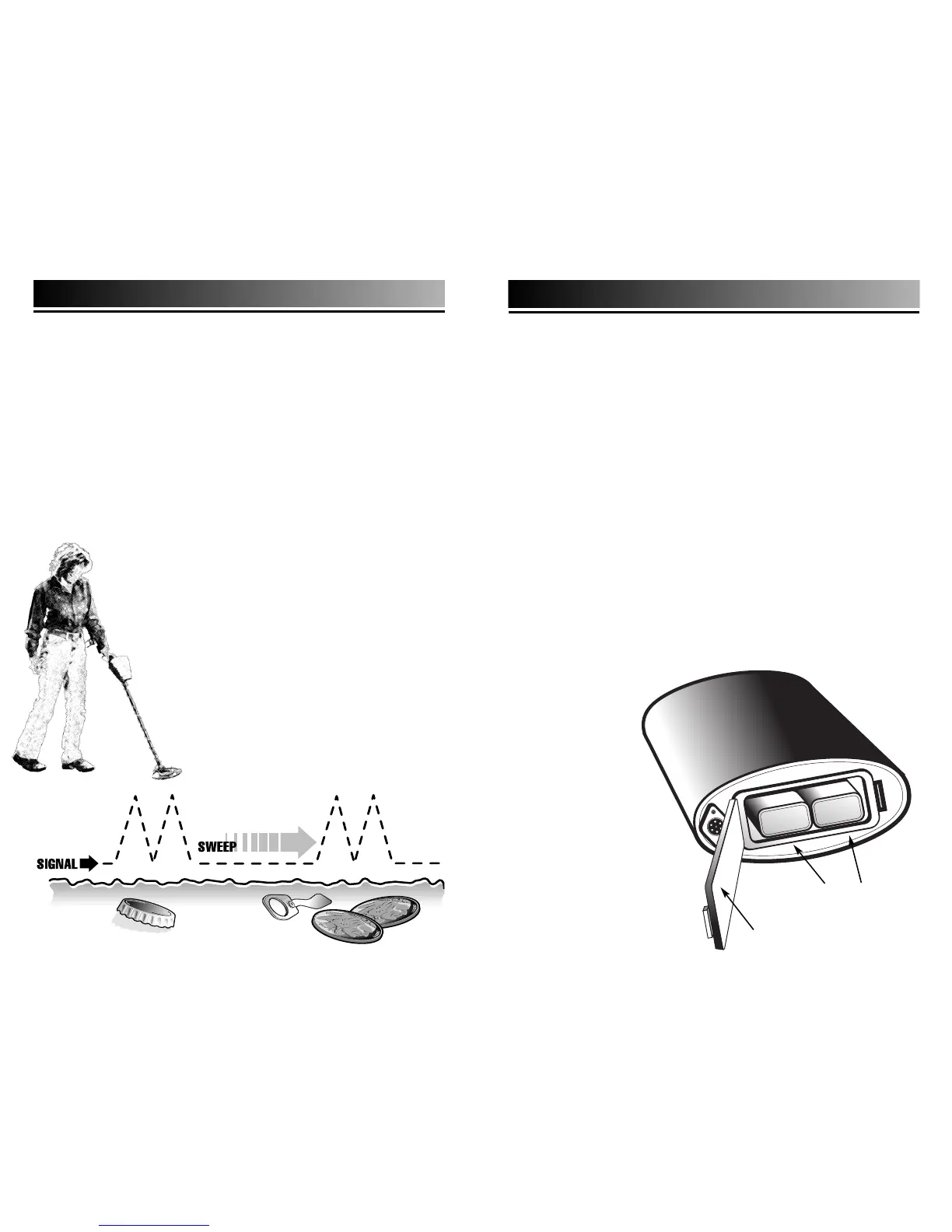
1 Carefully remove the battery compartment door by pressing the release
clip on the right side of the door.
●
2 Snap one battery onto each of the terminals and place the batteries in-
side the com-
partment.
Insert booth of
the batteries
with terminals
facing inward.
●
3
Replace the
compartment
door by carefully
inserting oppo-
site side of clip
first. Then press
down on clip
side until battery
door snaps into
place.
BATTERIES
Release
Clip
Both Batteries
teminals
facing in
16
Swing the search coil slowly,
overlapping each sweep as you
move forward. It is important to
sweep the coil at a consistent
speed over the ground as you
search. After identifying a target,
your sweep technique can help in
identifying both the location and
the nature of the target. If you
encounter a weak signal, try
moving the coil in short, rapid
sweeps over the target zone; such
a short rapid sweep may
provide a more
consistent target
identification.
Most worthwhile
objects will
respond with a
repeatable
tone. If the
signal does
not repeat
after
sweeping the coil directly over the
suspected target a few times, it is
more than likely trash metal.
Crossing the target zone with
multiple intersecting sweeps at
multiple angles is another way to
verify the repeatability of the signal,
and the potential of the buried
target. To use this method, walk
around the target area in a circle,
sweeping the coil across the target
repeatedly, every 30 to 40 degrees
of the circle, about ten different
angles as you walk completely
around the target. If a high-tone
target completely disappears from
detection at a given angle, chances
are that you are detecting oxidized
ferrous metals, rather than a silver
or copper object. If the tone
changes at different angles, you
many have encountered multiple
objects. If you are new to the
hobby, you may want to dig all
targets at first. With practice in the
field, you will learn to better discern
the nature of buried objects by the
nature of the detector’s response.
IN THE FIELD TECHNIQUES (continued)
WHAT
READS
LIKE THIS
…MAY
ACTUALLY
BE THIS






 To Next Page