2 3
2.2
Installing Your New Thermostat
NOTE: If you are installing this thermostat in a new installation be sure to locate
the thermostat 4 to 5 feet above the floor in accordance with applicable building
codes. Make sure to install the thermostat in a location that provides good airflow
characteristics and avoid areas behind doors, near corners, air vents, direct sunlight
or near any heat generating device. Installation in any of these areas could impact
thermostat performance.
NOTE: This thermostat is for use on low voltage 24 Volt AC multi-stage heat pump
systems with up to two stages of heating and two stages of cooling and requires a
transformer common wire for proper installation. This thermostat is not for use on
single stage heating or cooling systems.
TESTING YOUR
NEW THERMOSTAT
3
NOTE: Test your thermostat prior to programming any user settings. Pressing the
RESET button will erase any user entries previously programmed. This will erase all
user settings and return them to their default values.
WARNING!
Read BEFORE Testing
1. Place the system switch in the HEAT position.
2. Press the button on the keypad until the set point temperature setting is a minimum of 3
degrees higher than the current room temperature. The heating system should start within several
seconds. The fan may not turn on immediately due to the heating system built-in fan delay.
3. Place the system switch in the OFF position. The heating system should stop within
several seconds.
4. Wait 5 minutes for the automatic compressor short cycle protection period to expire, or press the
RESET button to bypass this feature for initial testing purposes. Pressing the RESET button will
erase any user entries previously programmed.
5. Place the system switch in the COOL position.
6. Press the button on the keypad until the set point temperature is a minimum of 3 degrees lower
than the current room temperature.
7. The cooling system should start within several seconds. Place the system switch in the OFF
position. The cooling system should stop within 90 seconds (dependent on the setting of the
Residual Cooling Fan Feature).
8. Place the fan switch in the ON position. The system blower should start.
9. Place the fan switch in the AUTO position. The system blower should stop.
PROGRAMMING
USER SETTINGS
4
4.1
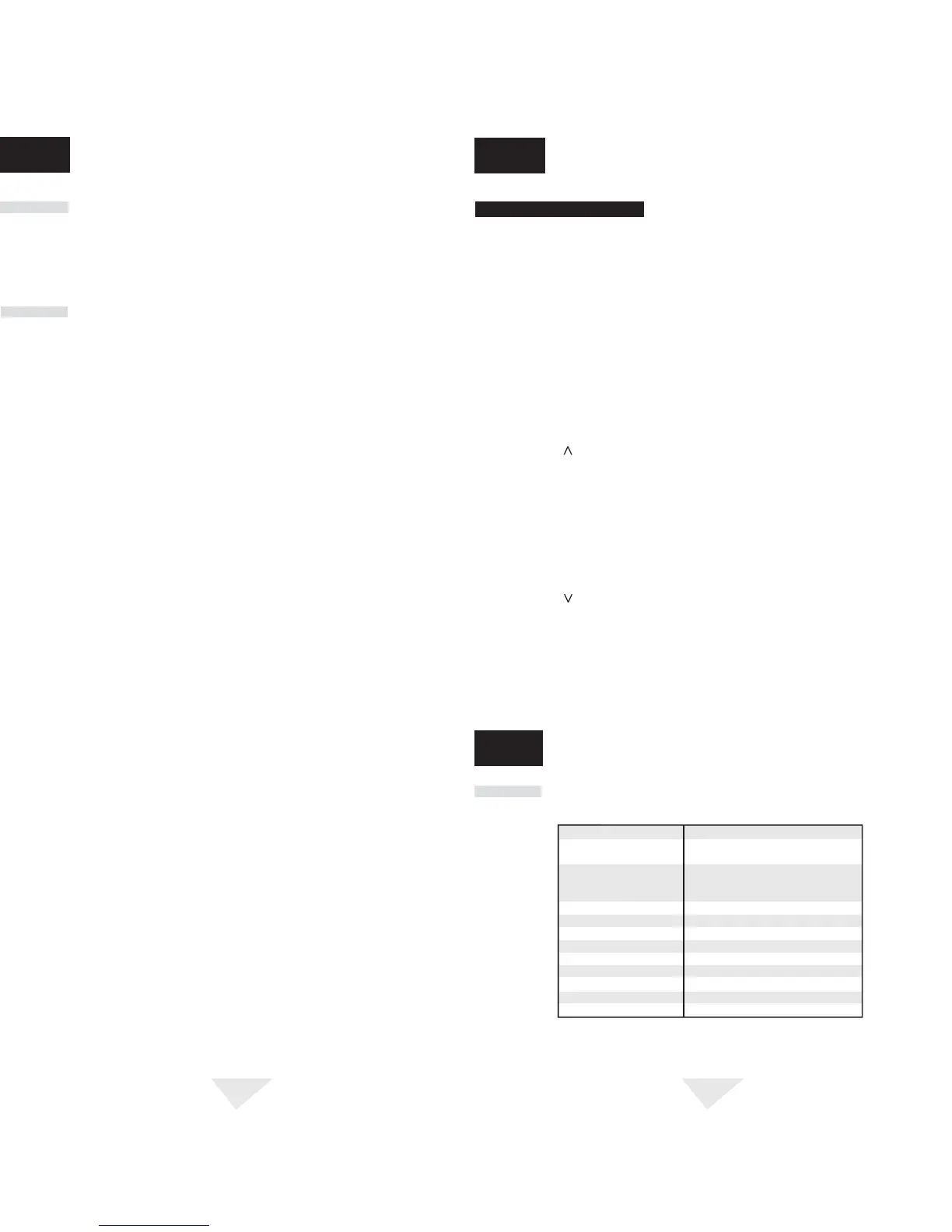
Default Thermostat Settings
Function Status After Reset
Operation Mode Normal Operating Mode
Room Temperature 70˚ F (21.0˚ C), to be renewed within
5 seconds
Set point Temperature According to system switch:
62˚ F (17.0˚ C) for Heat or Off
85˚ F (29.0˚ C) for Cool
Temperature Scale ˚F or ˚C dependent on switch setting
Low Battery Warning Off, to be renewed within 5 seconds
First Stage Differential .5˚ F (0.25˚ C)
Second Stage Differential 2.0˚ F (1.0˚ C)
Short Cycle Protection Timer Reset
Output Relays Off
Residual Cooling Fan Delay 60 Seconds
Recirculating Fan Timer Reset with 120 Min. Off Cycle
Keypad Lock Unlocked
INSTALLATION
2
cont.
2.1
Replacing Existing Thermostat cont.
1.
Always turn off power to the air conditioning or heating system prior to installing thermostat.
2.
Place system switch on front of thermostat to OFF position.
3.
Place fan control switch on front of thermostat to AUTO position.
4.
Remove front of thermostat from sub-base by pressing release latch on bottom
of thermostat.
5.
Place the thermostat sub-base against wall in the desired thermostat location.
6.
Guide thermostat wires through center hole in sub-base. Continue to hold against wall.
7.
Mark placement of mounting holes and drill using a 3/16" drill bit. Gently tap supplied plastic
anchors into the holes in the wall.
8.
Place the sub-base against the wall in the desired location, making sure the mounting
holes are aligned and the thermostat wires are properly inserting through opening
in sub-base.
9.
Fasten the sub-base to wall using supplied screws.
10.
Connect wires to quick wiring terminal block as appropriate using the new terminal
designations. Refer to Wiring Diagram section of this manual if required for assistance.
11.
Make sure all of the wire connections are secure and are not touching any other
terminal to prevent electrical shorts and potential damage to the thermostat.
12.
Turn the front thermostat body over, exposing the rear view of the circuit board.
13.
Locate the internal ˚F / ˚C switch on the circuit board.
14.
Using your finger, gently flip the switch toward the preferred temperature ˚F / ˚C scale.
15.
Locate the auxiliary heat option switch, AE-AG, on the circuit board. For electric
auxiliary heat units the switch should be set to the AE position. For units with gas
or oil auxiliary heat, move the switch to the AG position. This will lock out the
compressor stage 1 minute after a second stage heat call for maximum efficiency.
16.
Attach front body of thermostat to sub-base, being careful to align the
terminal pins on the front body with the terminal block on the sub-base.
17.
Restore system power so you can test installation.
• Do not short (or jumper) across terminals on the gas valve or at the heating or cooling
system control board to test the thermostat installation. This could damage the thermostat
and void the warranty.
• Do not select COOL mode of operation if the outside temperature is below 50˚ F (10˚ C).
This could possibly damage the controlled cooling system and may cause personal injury.
• This thermostat includes an automatic compressor protection feature to avoid potential
damage to the heat pump system from short cycling. This thermostat automatically
provides a 5-minute delay after turning off the heating or cooling heat pump output to
protect the compressor.


 To Next Page
 Loading...