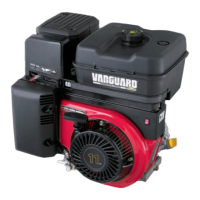
Vanguard
TM
Twin-Cylinder OHV Liquid-Cooled Engine
Section 2 - Troubleshooting
Page 14
Check Ignition (With Engine Starter)
With spark plugs installed, attach a
#19368 ignition tester
to each spark plug lead and ground the other end of the
tester as shown in Fig.12. Activate the electric starter. If
spark jumps the tester gaps, you may assume the
ignition system is functioning satisfactorily.
Fig. 12
NOTE: Engines equipped with Magnetron®
ignition system will still display spark at tester
with a partially or fully sheared flywheel key. A
partially sheared flywheel key will affect ignition
timing and engine performance.
If spark does not occur look for:
1. Improperly operating interlock system
2. Shorted equipment stop switch wire
3. Two closed diodes in ground wire harness (see:
Troubleshooting Ground Wire Harness)
4. Incorrect armature air gap
5. Armature failure
Check Ignition (Engine Running)
If engine runs but misses during operation, a quick check
to determine if ignition is or is not at fault can be made by
installing Tool
#19368 tester between the spark plug lead
and each spark plug, Fig.13. A spark miss will be readily
apparent when the engine is running. If spark is good but
engine misses, check for a fouled spark plug.
Fig. 13
Check Ignition (Fouled Plug or Other Causes)
To check for a fouled spark plug or a non-functioning
cylinder, attach Tool
#19368 tester between the spark
plug lead and each spark plug. With engine running at
top no load speed, ground one spark plug, Fig. 14. The
engine should continue to run on the other cylinder.
Repeat this test with the other cylinder. If the engine will
not continue to run when making this test, the cylinder
that is NOT grounded is not functioning and/or the spark
plug is fouled. Install a new spark plug before
proceeding. When replacing spark plugs always use
Briggs & Stratton
#491055 or #496018.



 To Next Page
 Loading...