EasyManua.ls Logo

Brinly PP-1200 - Upper Link; Depth Adjustment; Leveling Adjustment; Coulter Adjustment

Default Icon
6 pages
Print Icon
To Next Page IconTo Next Page
To Previous Page IconTo Previous Page
Loading...
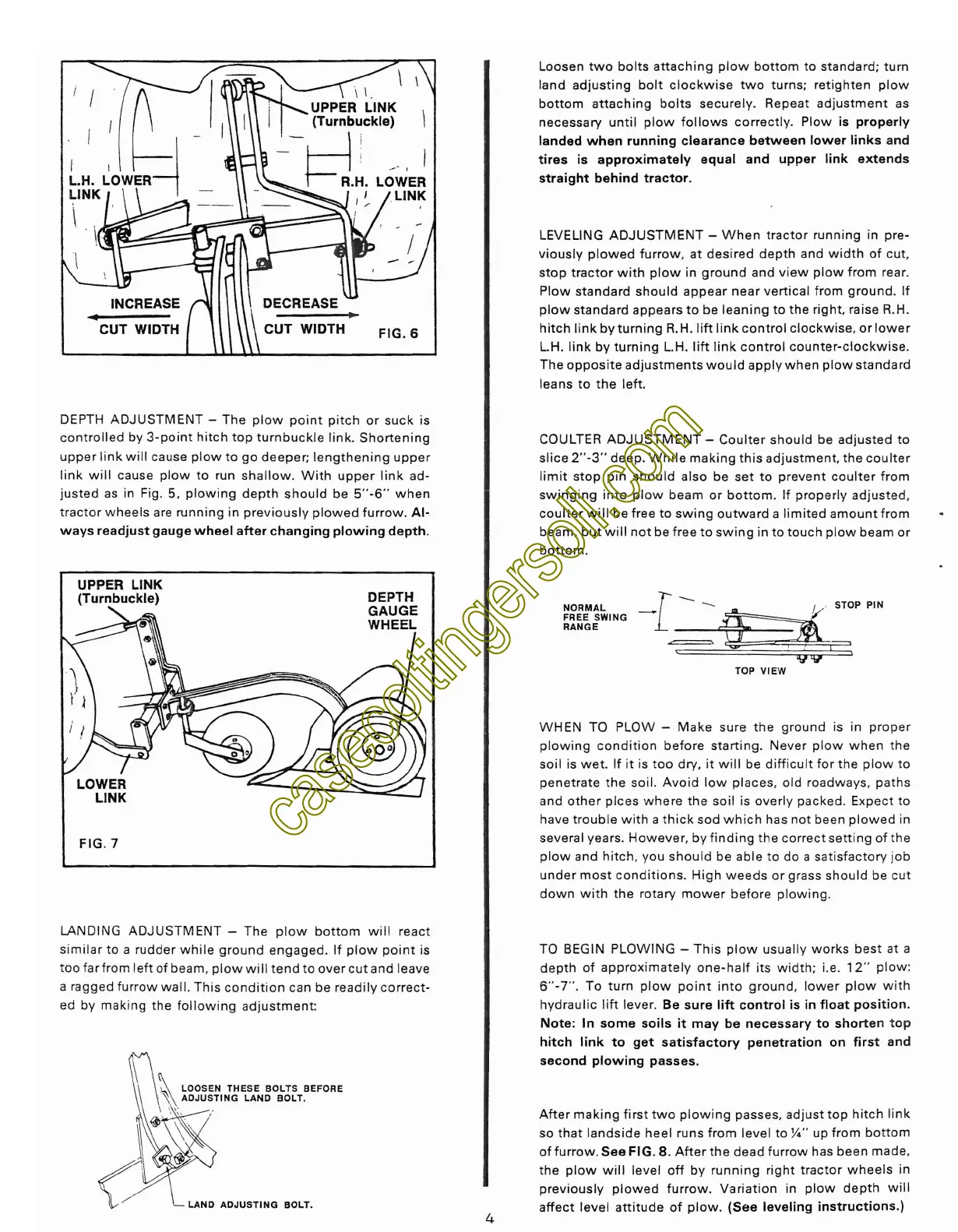
DEPTH
ADJUSTMENT
- The
plow
point
pitch
or
suck
is
controlled
by
3-point
hitch
top
turnbuckle
link.
Shortening
upper
l
ink
will
cause
plow
to go
deeper;
lengthening
upper
link
will
cause
plow
to run
shallow
.
With
upper
link
ad-
justed
as in Fig. 5,
plowing
depth
should
be
5"-6
"
when
tractor
wheels
are
running
in
prev
iously
plowed
furrow.
Al -
ways
readjust
gauge
wheel
after
changing
plowing
depth.
Loosen
two
bolts
attach
ing
plow
bottom
to standard;
turn
land
adjust
ing
bolt
clockw
ise
two
turns; ret
ighten
plow
bottom
attaching
bolts
securely.
Repeat
adjustment
as
necessary
until
plow
follows
correctly.
Plow
is
prope
rly
landed
when
running
clearance
between
lower
links
and
tires
is
approximately
equal
and
upper
link
extends
straight
behind
tractor.
LEVELING
ADJUSTMENT
-
When
tractor
running
in pre-
viously
plowed
furrow
, at
desired
depth
and
width
of cut,
stop
tractor
with
plow
in
ground
and
view
plow
from
rear.
Plow
standard
should
appear
near
vertical
from
g
round
. If
plow
standard
appears to be
leaning
to
the
right
, raise R.H.
hitch
link
by
turning
R.H.
lift
link
control
clockwise
, or
lower
L.H.
link
by
turning
L.H.
lift
link
control
counter-clockw
ise.
The
opposi
te ad
justments
would
apply
when
plow
standard
leans to
the
left
.
COULTER
ADJUSTMENT
-
Coulter
should
be
adjusted
to
slice
2
"-3"
deep.
While
making
this
adjustment,
the
coulter
limit
stop
pin
should
also be
set
to prevent
coulte
r
from
swinging
into
plow
beam
or
bottom.
If
properly
adjusted,
coulter
will
be free to
swing
outward
a
lim
ited
amount
from
beam,
but
will
not
be free to
swing
in to
touch
plow
beam or
bottom
.
UPPER LINK
(Turnbuckle)
FIG.7
DEPTH
GAUGE
WHEEL
TOP VIEW
WHEN
TO PLOW -
Make
sure
the
ground
is in
proper
plowing
condit
ion
before
start
ing.
Never
plow
when
the
soil
is
wet
. If it is
too
dry
, it
wil
l be
difficult
for
the
p
low
to
penetrate
the
soil.
Avoid
low
places
, old roadways,
paths
and
other
plces
where
the
soil
is
overly
packed. Expect to
have
trouble
with
a
thick
sod
which
has
not
been
plowed
in
several years.
However
, by
finding
the
correct
setting
of
the
plow
and
hitch,
you
should
be able to do a
satisfactory
job
under
most
cond
itions.
H
igh
weeds
or grass
should
be
cut
down
with
the
rotary
mower
before
plowing
.
LANDING
ADJUSTMENT
- The
plow
bottom
w ill
react
s
imilar
to a
rudder
wh ile
ground
engaged
. If
plow
po
int
is
too
fa
rf
rom left of beam,
plow
will
tend
to
over
cut
and leave
a ragged furrow
wal
l.
This
cond
ition
can be read
ily
correct-
ed by
making
the
following
adjustment:
- LAND
ADJUSTING
BOLT.
4
TO BEGIN PLOWING -
This
plow
usually
works
best
at a
depth
of
appro
x
imately
one
-half
its w
idth
; i.e.
12
"
plow
:
6
"-7"
. To
turn
plow
po
int
into
ground,
lower
plow
w
ith
hydraulic
lift
lever
. Be
sure
lift
control
is in
float
position.
Note
: In
some
soils
it
may
be
necessary
to
shorten
top
hitch
link
to
get
satisfactory
penetration
on
first
and
second
plowing
passes
.
After
making
first
two
plowing
passes,
adjust
top
hi
tch
l
ink
so
that
landside
heel
runs
from
level to
)14"
up
from
bottom
offurrow.
See FIG . 8 .
After
the
dead
furrow
has
been
mad
e,
the
plow
will
level
off
by runn
ing
right
tractor
wheels
in
previous
ly
plowed
furrow
.
Variation
in
plow
depth
will
affect
level
attitude
of
plow
.
(See
leveling
instructions.)

Related product manuals