3
SPECIAL REQUIREMENTS FOR INTERCONNECTED SMOKE ALARMS
• Failure to meet any of the above requirements could damage the
units and cause them to malfunction, removing your protection.
• Mains (AC) and AC/DC Smoke Alarms can be interconnected.
Under mains (AC) power, all units will alarm when one senses
smoke. When power is interrupted, only the AC/DC units in the
series will continue to send and receive signals. Mains (AC)
powered Smoke Alarms will not operate.
Interconnected units can provide earlier warning of fire than stand-alone units,
especially if a fire starts in a remote area of the dwelling. If any unit in the series
senses smoke, all units will alarm. To determine which Smoke Alarm initiated an
alarm, see table:
On Initiating Alarms Red LED flashes rapidly
On All Other Alarms Red LED is Off
Interconnect units within a single family residence only. Otherwise all house-
holds will experience unwanted alarms when you test any unit in the series.
Interconnected units will only work if they are wired to compatible units and
all requirements are met. This unit is designed to be compatible with:
BRK
®
Smoke Alarm Models 86RACEN, 86RACHE10N, 2002RACEN,
2002RACHE10N; BRK
®
Heat Alarm Models 6230BFP, 6230B10FP.
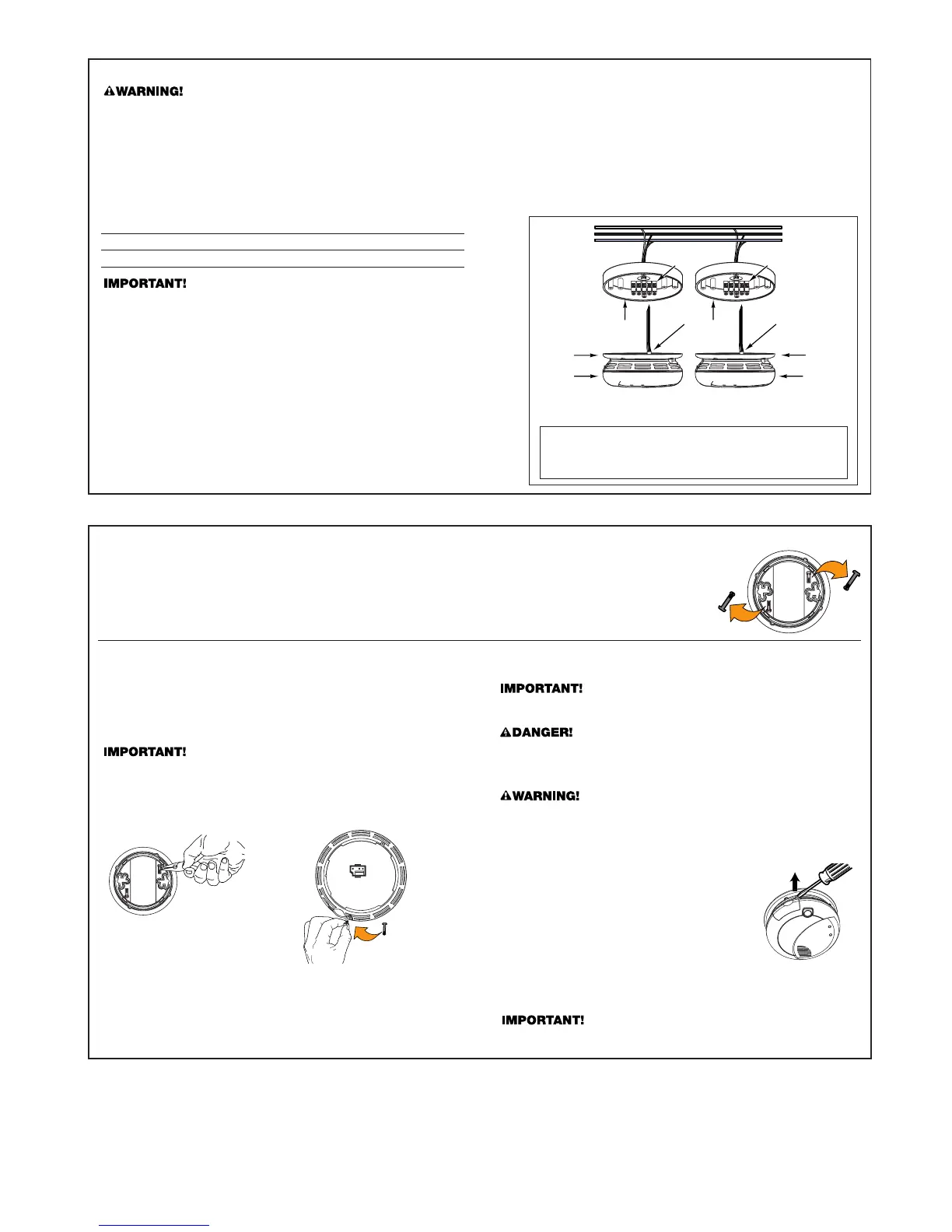
A. Unswitched 230V
mains (AC) 50 Hz source
B. To additional units; Maximum = 18 total
(Maximum 12 Smoke Alarms)
1. Smoke Alarm
2. Mounting Bracket
3. Power Connector
4. Terminal Block
5. Pattress
(Not Included)
6. Neutral Wire (Blue)
7. Interconnect Wire
(Orange)
8. Hot Wire (Brown)
Interconnected units must meet ALL of the following requirements:
• A maximum of 18 compatible units may be interconnected
(Maximum of 12 Smoke Alarms).
• The same fuse or circuit breaker must power all interconnected units.
• The total length of wire interconnecting the alarms should be less than
150 metres (500 feet). The interconnecting cables should be 1.5mm
2
and be rated at least 300V. If an interconnect wire is not already part of
your household wiring, you will need to install one. This type of wire is
commonly available at Hardware and Electrical Supply stores.
• The wiring must conform to current IEE regulations for electrical
installations.
MANDATORY LOCKING FEATURES
The mandatory locking features are designed to discourage unauthorized removal of the battery or Alarm.
These Smoke Alarms have two separate locking features: one to lock the battery compartment, and the other to lock the Smoke
Alarm to the mounting bracket.
Tools you will need: • Needle-nose pliers or utility knife • Standard Flathead screwdriver.
Both locking features use locking pins, which are molded into the mounting bracket. Using needle-nose pliers or a utility knife,
remove one or both pins from the mounting bracket, depending on how many locking features you want to use.
TO LOCK THE BATTERY COMPARTMENT
(Model 7010BE Only)
Do not lock the battery compartment until you have installed the
battery and tested the battery back-up.
1. Push and hold Test/Silence button until the alarm sounds:
beep, beep, beep...
If the unit does not alarm during testing, DO NOT lock the battery com-
partment! Install a new battery and test again. If the Smoke Alarm still
does not alarm, replace it immediately.
2. Using needle-nose pliers or a utility knife, detach one locking pin from
the mounting bracket.
3. Push the locking pin through the hole near the battery drawer on the
back of the Smoke Alarm.
TO UNLOCK THE BATTERY COMPARTMENT
(Model 7010BE Only)
Once the Smoke Alarm is installed, you must disconnect it from the mains
(AC) power before unlocking the battery compartment.
ELECTRICAL SHOCK HAZARD. Turn off the power to the area where the
Smoke Alarm is installed before removing it from the mounting bracket.
Failure to turn off the power first may result in serious electrical shock,
injury or death.
Always discharge the branch circuit before servicing a mains (AC) or AC/DC
Smoke Alarm. First, turn off the mains (AC) power at the circuit breaker or
fuse box. Next, remove the battery from Smoke Alarms with battery back-
up. Finally, press and hold the Test/Silence button for 5-10 seconds to
discharge the branch circuit.
1. Remove the Smoke Alarm from the mounting
bracket. If the unit is locked to the bracket, see
the section “To Unlock the Mounting Bracket.”
2. Disconnect the power connector by gently prying
it away from the back of the Smoke Alarm.
3. Insert a flathead screwdriver under the head of
the locking pin, and gently pry it out of the bat-
tery compartment lock. (If you plan to relock the
battery compartment, save the locking pin.)
4. To relock the battery compartment, close the battery door and reinsert
locking pin in lock.
5. Reconnect the power connector to the back of the Smoke Alarm, reattach
the Smoke Alarm to the mounting bracket, and restore the power.
When replacing the battery, always test the Smoke Alarm before relocking the
battery compartment.




 To Next Page