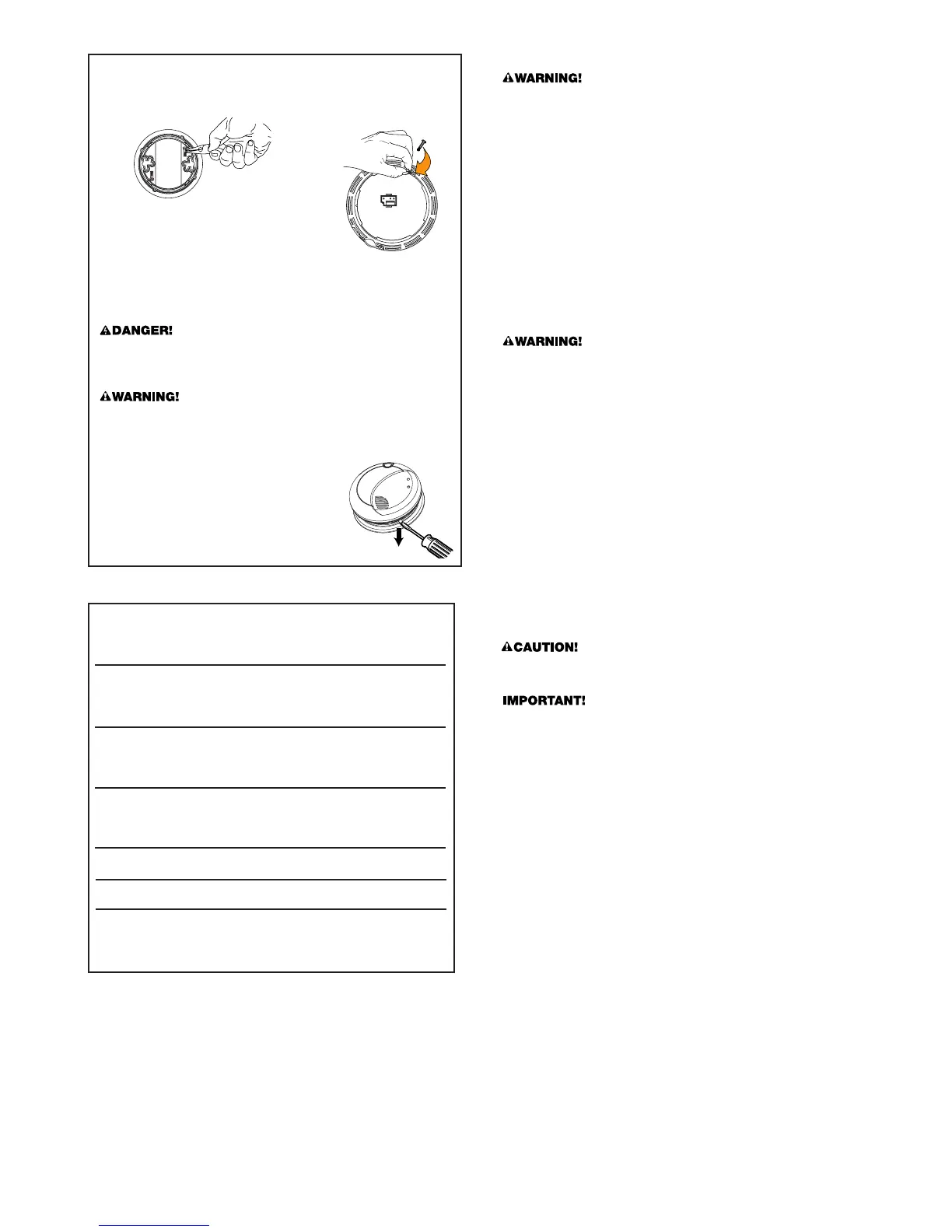
TO UNLOCK THE MOUNTING BRACKET
ELECTRICAL SHOCK HAZARD. Turn off the power to the area where
the Smoke Alarm is installed before removing it from the mounting
bracket. Failure to turn off the power first may result in serious electri-
cal shock, injury or death.
Always discharge the branch circuit before servicing a mains (AC) or
AC/DC Smoke Alarm. First, turn off the mains (AC) power at the circuit
breaker or fuse box. Next, remove the battery from Smoke Alarms with
battery back-up. Finally, press and hold the Test/Silence button for 5-10
seconds to discharge the branch circuit.
1. Insert a flathead screwdriver between the
mounting bracket pin and the mounting bracket.
2. Pry the Smoke Alarm away from the bracket by
turning both the screwdriver and the Smoke
Alarm counterclockwise (left) at the same time.
TO LOCK THE MOUNTING BRACKET
1. Using needle-nose pliers, detach one locking pin from mounting bracket.
2. Insert the locking pin into the lock located
opposite from the battery drawer as shown
in the diagram.
3. When you attach the Smoke Alarm to the mounting bracket, the locking
pin’s head will fit into a notch on the bracket.
Mandatory Locking Features (Continued)
WEEKLY TESTING
NEVER use an open flame of any kind to test this unit. You might
accidentally damage or set fire to the unit or to your home. The built-in
test switch accurately tests the unit’s operation as required by British
Standards (BSI). If you choose to use an aerosol smoke product to test
the Smoke Alarm, be certain to use one that has been certified to British
Safety Standards, and use it only as directed. Use of non-BSI certified
products or improper use of BSI certified products may affect the Smoke
Alarm’s sensitivity.
It is important to test this unit every week to make sure it is working
properly.
Using the test button is the recommended way to test this Smoke
Alarm. Press and hold the test button on the cover of the unit until the alarm
sounds (the unit may continue to alarm for a few seconds after you release
the button). If it does not alarm, make sure the unit is receiving power and test
it again. If it still does not alarm, replace it immediately. During testing you will
hear a loud, repeating horn pattern: beep, beep, beep...
When testing a series of interconnected units you must test each unit
individually. Make sure all units alarm when each one is tested.
REGULAR MAINTENANCE
This unit has been designed to be as maintenance-free as possible, but there
are a few simple things you must do to keep it working properly.
Use only the replacement batteries listed below. The unit may not
operate properly with other batteries. Never use rechargeable batteries
since they may not provide a constant charge.
• Test it at least once a week.
• Clean the Smoke Alarm at least once a month; gently vacuum the
outside of the Smoke Alarm using your household vacuum’s soft brush
attachment. Test the Smoke Alarm. Never use water, cleaners or solvents
since they may damage the unit.
• If the Smoke Alarm becomes contaminated by excessive dirt, dust and/or
grime, and cannot be cleaned to avoid unwanted alarms, replace the
unit immediately.
• Relocate the unit if it sounds frequent unwanted alarms. See “Locations
To Avoid For Smoke Alarms” for details.
•
Model 7010BE Only: When the battery back-up becomes weak, the
Smoke Alarm will “chirp” about once a minute (the low battery warning).
This warning should last 30 days, but you should replace the battery
immediately to continue your protection.
Model 7010BE Only
—
Choosing a replacement battery:
Your Smoke Alarm requires a standard 9V battery. The following batteries
are acceptable as replacements: Duracell #MN1604, Energizer #522, Eveready
#1222. You may also use the Ultralife U9VL-J lithium battery for longer service
life between battery changes. These batteries are available at many local
retail stores.
When using a lithium battery there is a danger of explosion if the battery
is incorrectly replaced. Replace a lithium battery only with the same or
equivalent type.
Most carbon zinc batteries have an average service life of 1 year; most
alkaline batteries have an average service life of 1-2 years; most Lithium
batteries have an average service life of 6-10 years.Actual battery service life
depends on the Smoke Alarm and the environment in which it is installed. All
the batteries specified above are acceptable replacement batteries for this
unit. Regardless of the manufacturer’s suggested battery life, you MUST
replace the battery immediately once the unit starts “chirping” (the “low
battery warning”).
UNDERSTANDING THE INDICATOR LIGHTS
AND ALARM HORN PATTERNS
NOTE: When power is applied, unit(s) may alarm momentarily.
*When any Smoke Alarm in an interconnected series triggers an alarm,
its red LED will flash rapidly. The red LEDs will remain OFF on any remaining
alarms in the series. This feature helps responders identify which unit(s)
triggered the alarm.
Mains (AC) Power
All Models
DC Power
Normal Operation Constant Green LED
Flashing Red LED
approx. once/minute
No Audible Alarm
Green LED Off
Flashing Red LED
approx. once/minute
No Audible Alarm
Test Condition Constant Green LED
Rapidly Flashing
Red LED
Audible Alarm
Green LED Off
Rapidly Flashing
Red LED
Audible Alarm
Silence Mode Red LED flashes once
every 10 seconds
Red LED flashes once
every 10 seconds
Alarm Condition*
(Initiating Unit)
Constant Green LED
Rapidly Flashing
Red LED
Audible Alarm
Green LED Off
Rapidly Flashing
Red LED
Audible Alarm
Low Battery Not Applicable Alarm “chirp’’ approx.
once/minute
4



 To Next Page