EasyManua.ls Logo

BRUEL & KJAER 2006 - RF Voltage Measurements

BRUEL & KJAER 2006
40 pages
Print Icon
To Next Page IconTo Next Page
To Previous Page IconTo Previous Page
Loading...
ment
is
now
adjusted
to
the
correct
reference,
and
RF
measurements
can
be
carried
out.
RF
Voltage
Measurements.
1.
Set
the
VOLTAGE RANGE
switch
to
its
"50
mV''
position.
Note:
If
the
RF
Voltage
to
be
measured
is
considered
higher
than
50 m V
the
attenuator
should
be
appliPd
to
the
Input
Probe.
2.
Select
BANDWIDTH,
Wide
or
Narrow.
In
the
FREQUENCY
RANGE I
(o.l-6
MHz)
use
only
"Narrow"
for
precise
measurements.
3. Set
the
FREQUENCY
RANGE
switch
to
the
desired
range,
and
with
the
TUNING
knob
tune
to
the
signal
frequency.
If
no
signal,
then;
4.
Turn
the
VOLTAGE RANGE
switch
anticlockwise
until
a
suitable
de-
flection
is
obtained
on
the
RF
-meter.
5.
Fine
adjust
the
frequency
TUNING
knob
for
maximum
deflection
on
the
meter.
The
LS AND MOD. ADJ.
knob
should
be
turned
up
when
tuning
is
carried
out
to
aid
the
identification
of
the
signal.
The
RF
voltage
can
now
be
read
off
the
meter
in
conjunction
with
the
VOLTAGE
RANGE
switch.
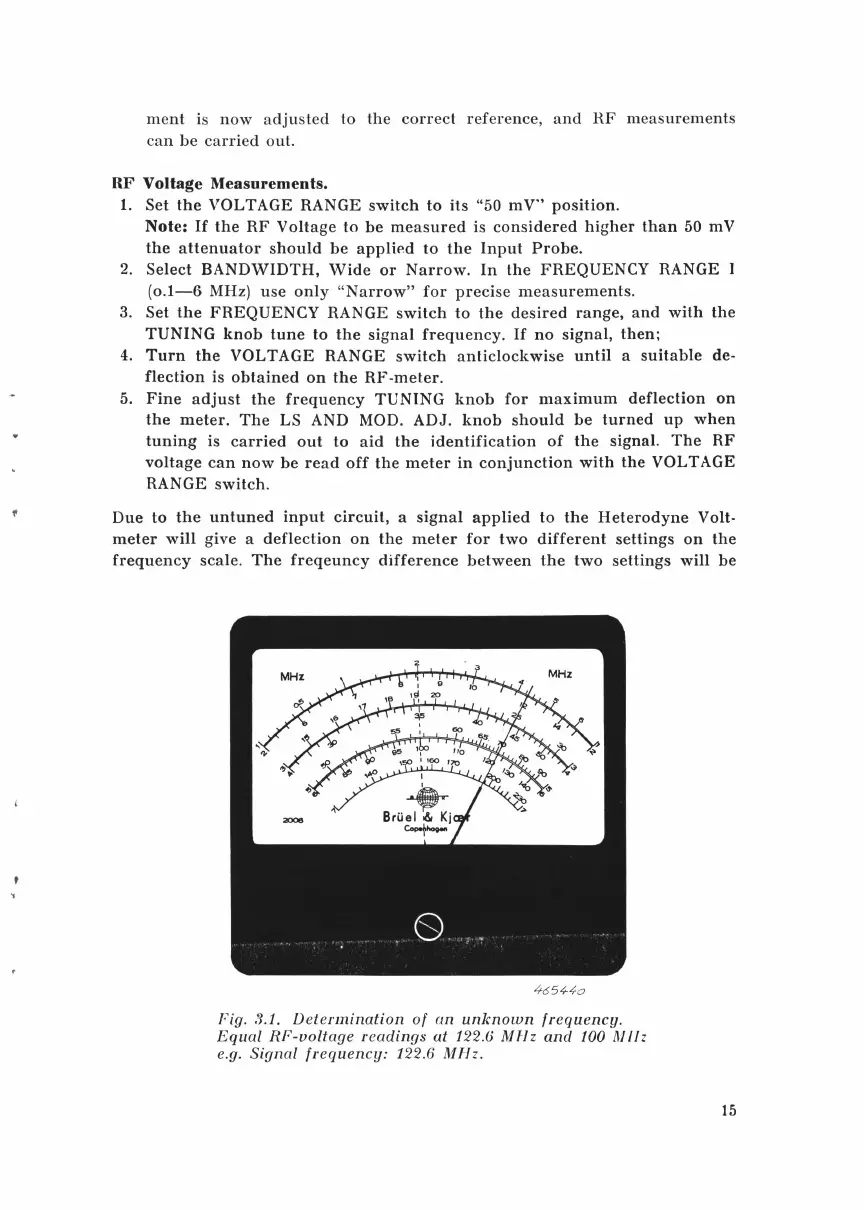
Due
to
the
untuned
input
circuit,
a
signal
applied
to
the
Heterodyne
Volt-
meter
will
give a
deflection
on
the
meter
for
two
different
settings
on
the
frequency
scale.
The
freqeuncy
difference
between
the
two
settings
will
be
4654-4-o
Fig
..
~.1.
Det
er
mination
of
an
unknown
frequency.
Equal
RF-voltage
readings
at
122.u M l-Iz
and
100 M
liz
e.g.
Signal
frequency:
122.6
MHz.
15

Related product manuals